

Last updated:
Custom Bathroom Vanity Auckland: A Designer’s Guide to Getting It Right
Quick answer: A custom bathroom vanity is a made-to-measure cabinet built to fit your exact bathroom, finishes and storage needs — and in Auckland it usually runs from around $2,000 to $3,000+ versus roughly $500–$1,500 for an off-the-shelf unit, with the extra spend earning its keep in awkward, compact, or character-home bathrooms.
Stand in front of an off-the-shelf vanity in any plumbing showroom and the maths looks simple. Eight hundred dollars, pick a colour, done. Then you get it home, into your actual bathroom — the one with the slightly-out-of-square wall, the waste pipe in the wrong spot, the 820mm gap that a standard 900mm unit refuses to sit in — and the simple maths falls apart.
That gap between the showroom and the real room is exactly where a custom bathroom vanity earns its place. We build them at our 700m² Auckland factory, and most of the vanities we’re called in for start with the same sentence: “the standard one doesn’t fit.” Sometimes it’s a villa ensuite carved out of an old hallway in Grey Lynn. Sometimes it’s a 1970s brick-and-tile in Pakuranga where the bathroom is a tight 4m² and every centimetre counts. Either way, the off-the-shelf unit was never going to work — and a vanity built to the millimetre was always going to.
This guide walks through the lot: when custom is genuinely worth it and when it isn’t, how to design a vanity that fits your space and the way you actually use it, the materials and hardware that survive an Auckland bathroom, and what the process, lead times and money look like when you commission one. No fluff, real NZ figures, and the things most showrooms won’t tell you.
Custom vs Off-the-Shelf: When a Made-to-Measure Vanity Is Worth It
Let’s deal with the money first, because it’s the thing everyone wants to know and nobody in a showroom will give you straight.
An off-the-shelf vanity from a major retailer typically lands somewhere between $500 and $1,500 for the cabinet, basin and top. A genuinely cheap flat-pack unit can be had for a few hundred dollars; a better-finished standard range from a bathroomware brand sits higher. A custom vanity (designed for your space, built in a factory, fitted with proper hardware) generally starts around $2,000 and commonly runs to $3,000 or more depending on size, the top you choose, and how much storage you pack in.
So you’re often looking at roughly double. The honest question isn’t “which is cheaper” — it obviously isn’t custom — it’s “what does the extra money actually buy me?”
Where custom pays for itself
Three situations, in our experience, where the spend is worth it almost every time.
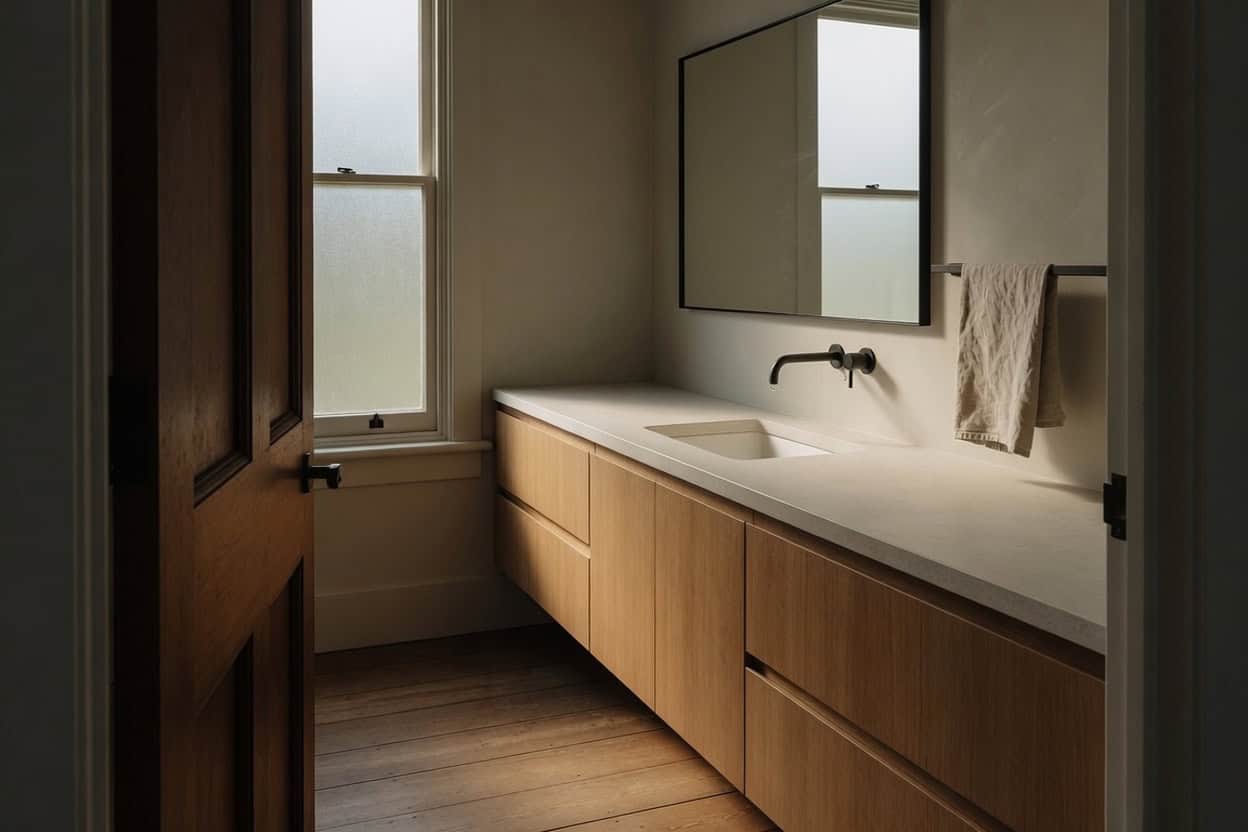
Awkward or non-standard spaces. Off-the-shelf vanities come in fixed widths — 600, 750, 900, 1200mm. Real Auckland bathrooms rarely come in those. Villas and bungalows in Ponsonby, Mt Eden and Grey Lynn were built long before standard cabinetry existed, and their bathrooms were often squeezed in later. A custom vanity fills the wall edge to edge, turns a dead 120mm gap into a usable drawer, and works around a window sill or a sloping ceiling that a boxed unit simply can’t. Compact bathrooms are where this matters most — when every centimetre counts, a unit built to your dimensions buys back storage you’d otherwise lose.
Matching the rest of your home. If we’ve done your kitchen, or you’re planning to, a custom vanity can carry the same door profile, the same Laminex or Melteca colour, the same handle. That continuity is hard to fake with a separate off-the-shelf range — and it’s one of the most common reasons clients come back to us for the bathroom after the kitchen’s done.
Storage that suits how you live. A his-and-hers double vanity with deep drawers instead of a single cupboard. A pull-out for the hairdryer with a power point inside. A tall, narrow tower beside the basin for towels. Standard units give you a box and a door. Custom gives you the inside of the cabinet sorted for the way your household actually uses the room.
💡 Design tip: In a small bathroom, drawers beat doors. A single deep drawer under the basin (notched around the plumbing) holds far more than a cupboard with a fixed shelf and a U-bend eating the middle of it.
When off-the-shelf is the smarter call
We’ll be upfront — custom isn’t always the right answer, and we’ll tell you if it isn’t. If you’ve got a standard-sized bathroom, a tight budget, and a like-for-like swap in mind, a good off-the-shelf vanity in the same footprint can be the sensible move. A rental refresh is the clearest case: if you’re keeping the plumbing where it is and just want it tidy and functional, you don’t need us to build you something. Spend the money where it shows.
The line we draw is roughly this: if the space is standard and the goal is “clean and done,” buy off-the-shelf; if the space is awkward, the design matters, or you want it to last and match, build custom. Most of the Auckland bathrooms we see fall into the second camp — but not all of them, and it’s worth being honest with yourself about which one you’re in.
One more cost note that catches people out: moving the plumbing. A like-for-like vanity swap that keeps the basin and waste in the same position generally doesn’t need building consent. The moment you start relocating plumbing points or building a wet-area shower, you can be into consent territory and added cost — Auckland Council consents for that kind of work run from several hundred to a couple of thousand dollars (building.govt.nz / Auckland Council). Keep the basin roughly where it is and you keep the budget honest. If your project is a full bathroom redo rather than just the vanity, our group’s renovation team at Superior Renovations handles the wider Auckland bathroom renovation side, and we build the joinery that goes into it.
Worth it or not, the decision really comes down to the space itself — so let’s get into how a vanity actually gets designed around one.
Designing a Bathroom Vanity That Fits Your Space and Your Routine
A vanity is the one piece of furniture in the bathroom that does three jobs at once: it holds the basin, hides the plumbing, and stores your stuff. Get the design right and the whole room works. Get it wrong and you’re living with the irritation every single morning.
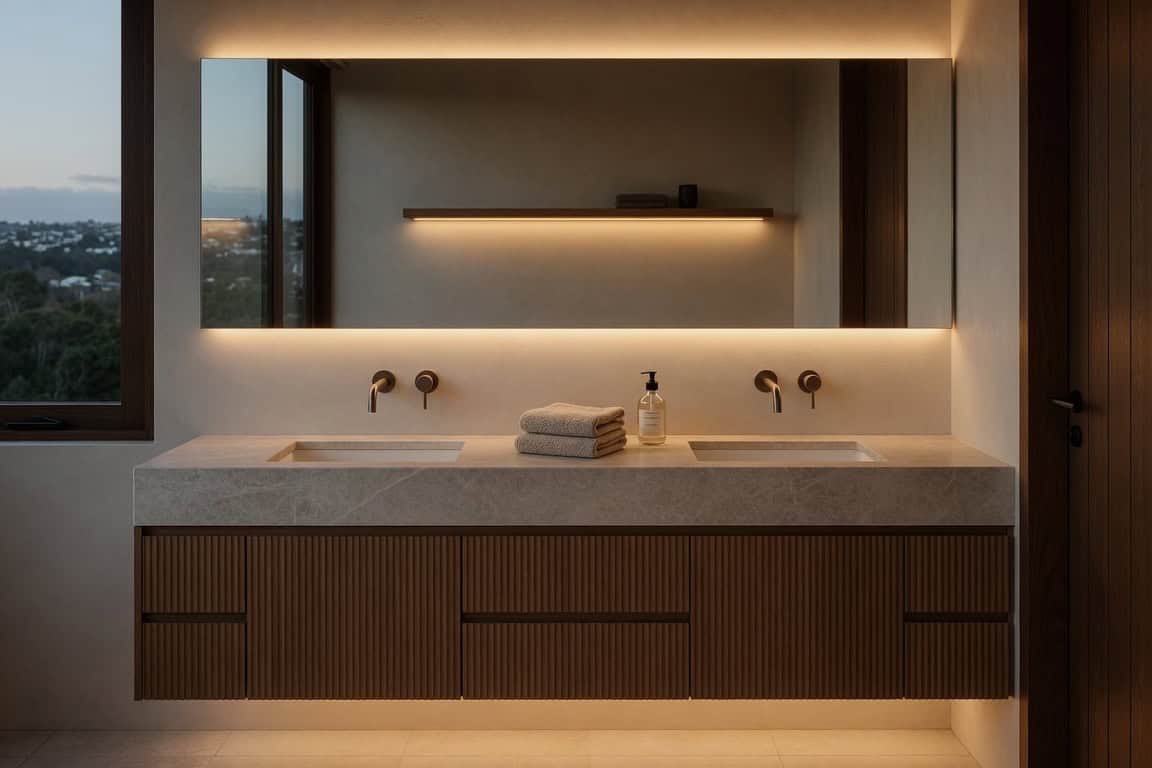
Wall-hung vs floor-standing vs corner
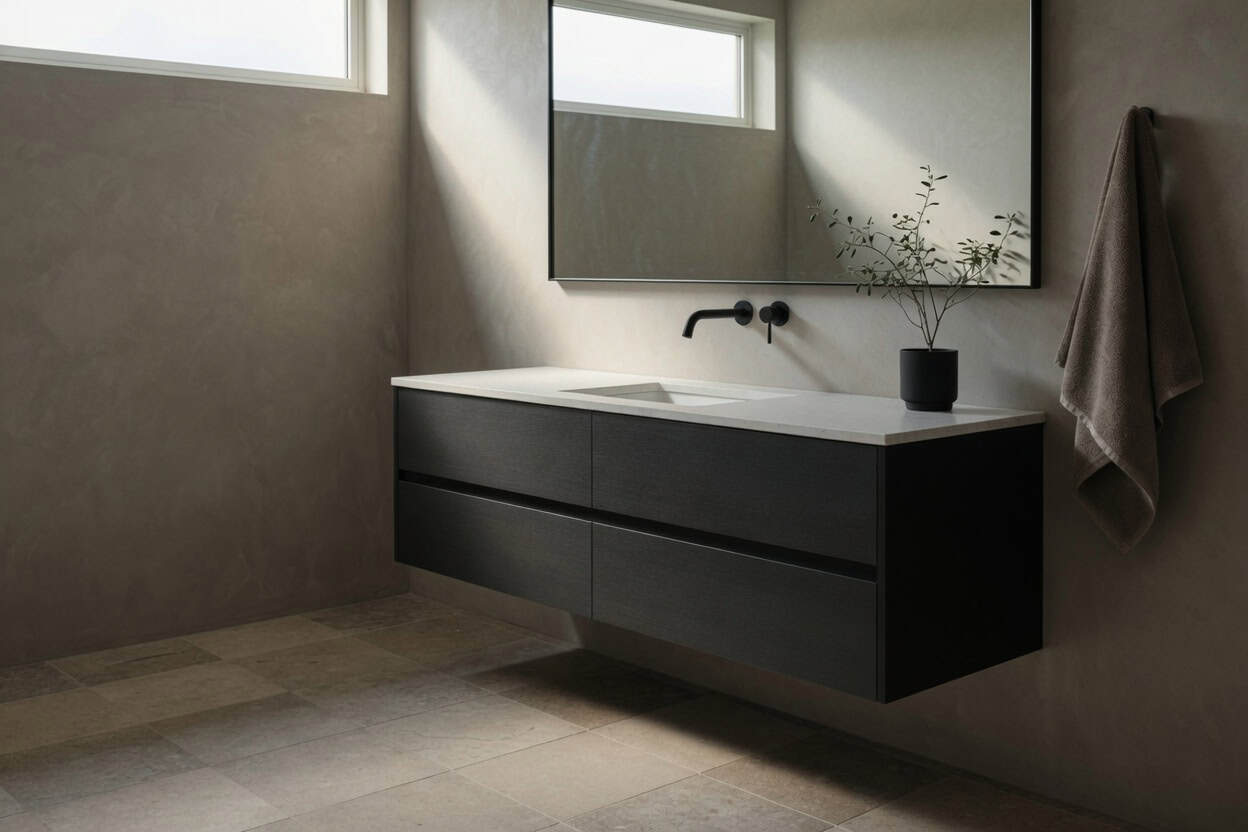
Wall-hung (floating) vanities mount to the wall with nothing touching the floor. They make a small bathroom read bigger because you can see the floor running underneath, they’re easier to clean around, and they keep the cabinet base up out of the way of any water that ends up on the floor. The catch: they need solid fixing into the framing, so the wall has to be up to it. In a renovated villa with original studs, we check that before we promise anything.
Floor-standing vanities sit on the floor (or a recessed kick) and carry their load straight down. They’re the traditional choice, they give you a little more storage volume, and they don’t lean on the wall framing. They suit larger family bathrooms and character homes where a grounded, solid look fits the bones of the house.
Corner vanities are the compromise for genuinely tiny spaces — a powder room under the stairs, an ensuite shoehorned into a Takapuna apartment. They claw back floor space by tucking into an angle most units can’t use. This is the kind of problem custom solves and off-the-shelf doesn’t — there’s no “standard” corner vanity that fits your exact corner.
💡 Design tip: Standard vanity height in NZ has crept up over the years. If you’re tall, ask for a benchtop at 900mm instead of the older 800–850mm — your back will thank you. We set the height to the people using the room, not a default.
Single, double, and the powder-room question
How many basins depends on who’s using the room and how wide the wall is. A single vanity is the everyday choice and the more affordable one. A double vanity — two basins side by side — is the morning-rush solver for couples and families, but it needs roughly 1500mm of wall as a practical minimum to avoid two people elbowing each other. Below that, you’re better off with one generous basin and more bench, not two cramped ones.
Powder rooms and guest loos are their own thing. Here it’s about looking sharp in a small footprint, not packing in storage — a slim wall-hung unit, a feature basin, maybe a single drawer. It’s the room visitors see, so it’s the one where a considered custom piece does the most work per dollar.
Storage, drawers and the inside of the cabinet
This is where custom quietly wins. The outside of two vanities can look identical; the inside is where the difference lives. We design drawers notched around the P-trap so you keep the storage most cabinets throw away. We put a power point inside a drawer so the electric toothbrush and the hairdryer live charged and out of sight. We size shelves to your actual bottles and baskets rather than a generic grid.
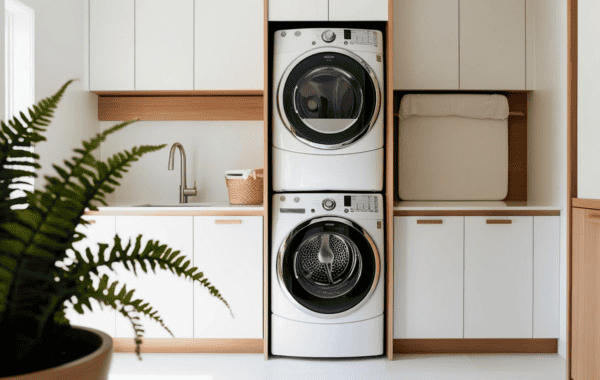
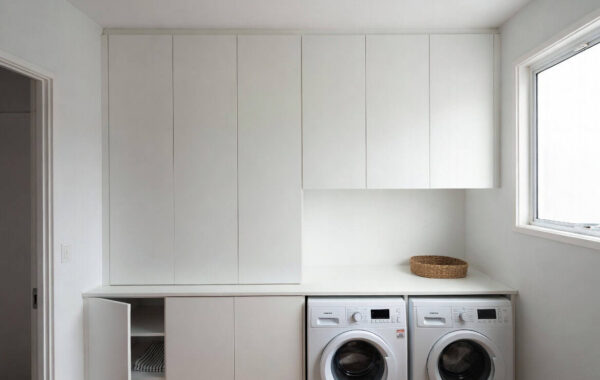
If you’ve seen what good drawer design does in a kitchen or laundry, it’s the same thinking — and it’s worth a read of our laundry cabinet NZ ideas guide, because the wet-area storage principles carry straight across to the bathroom. The hardware doing the heavy lifting is the same too: BLUM and Hettich runners and soft-close, which we’ll come to in the materials section.
Whatever the layout, none of it lasts if the materials underneath can’t handle a bathroom. That’s the part that separates a vanity still looking new at year ten from one that’s swollen and peeling by year two.
Materials and Moisture: Building a Vanity That Survives an Auckland Bathroom
Here’s the truth most vanity sellers skip: a bathroom is a hostile environment for cabinetry, and Auckland’s climate makes it worse. Our summers are warm and humid, our winters mild but damp, and the bathroom is the wettest room in the house. BRANZ research from its House Condition Survey found visible mould in roughly 49% of New Zealand homes, with bathrooms the most affected room of all (BRANZ House Condition Survey). That’s the room your vanity has to live in for a decade or more.
The board: where cheap vanities fail first
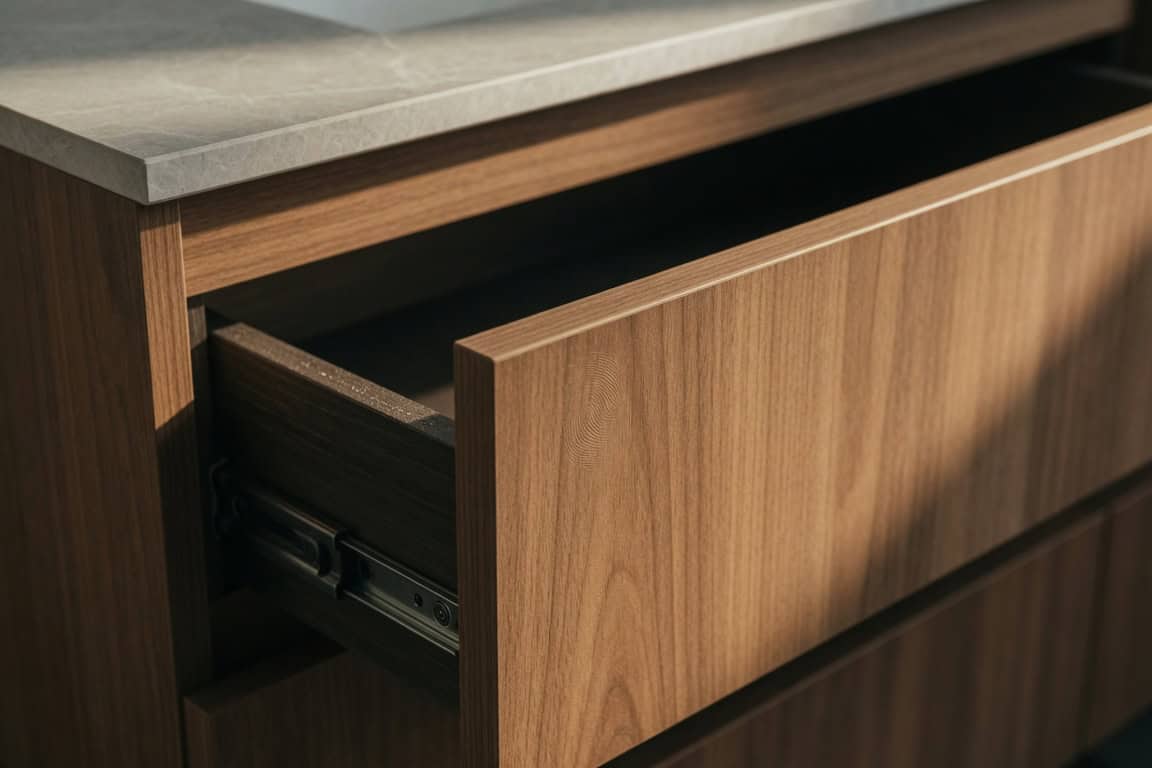
The single most common failure we get called in to replace is swollen, lifting board. Cheap flat-pack vanities use a chipboard core with iron-on edge tape. After a year or two of basin splash and shower steam, the tape lifts at a corner, water creeps in behind it, the chipboard swells, and the door front bows so it won’t close flush. Once that starts, there’s no fixing it — the cabinet’s done.
We build vanity carcasses and fronts from moisture-resistant board, and we finish the edges differently. Our suppliers are Laminex and Melteca — NZ-made, moisture-resistant surfaces with a long product warranty (Laminex carries a 10-year product warranty; Melteca also carries a 10-year product warranty on our warranty schedule). The decors run to the dozens, so matching your kitchen or hitting a specific colour is rarely a problem.
The bigger difference is the edge. Instead of iron-on tape that can lift, every cabinet we make is finished on a German laser edge-bander in our Auckland factory. The laser fuses the edge strip to the board with no glue line — there’s no seam for water to get behind. It’s automated, so there’s no manual buffing and no human error in the finish. For a wet room, that fused edge is the difference between a vanity that shrugs off years of splash and one that quietly drinks it up.
The hardware: soft-close that actually lasts
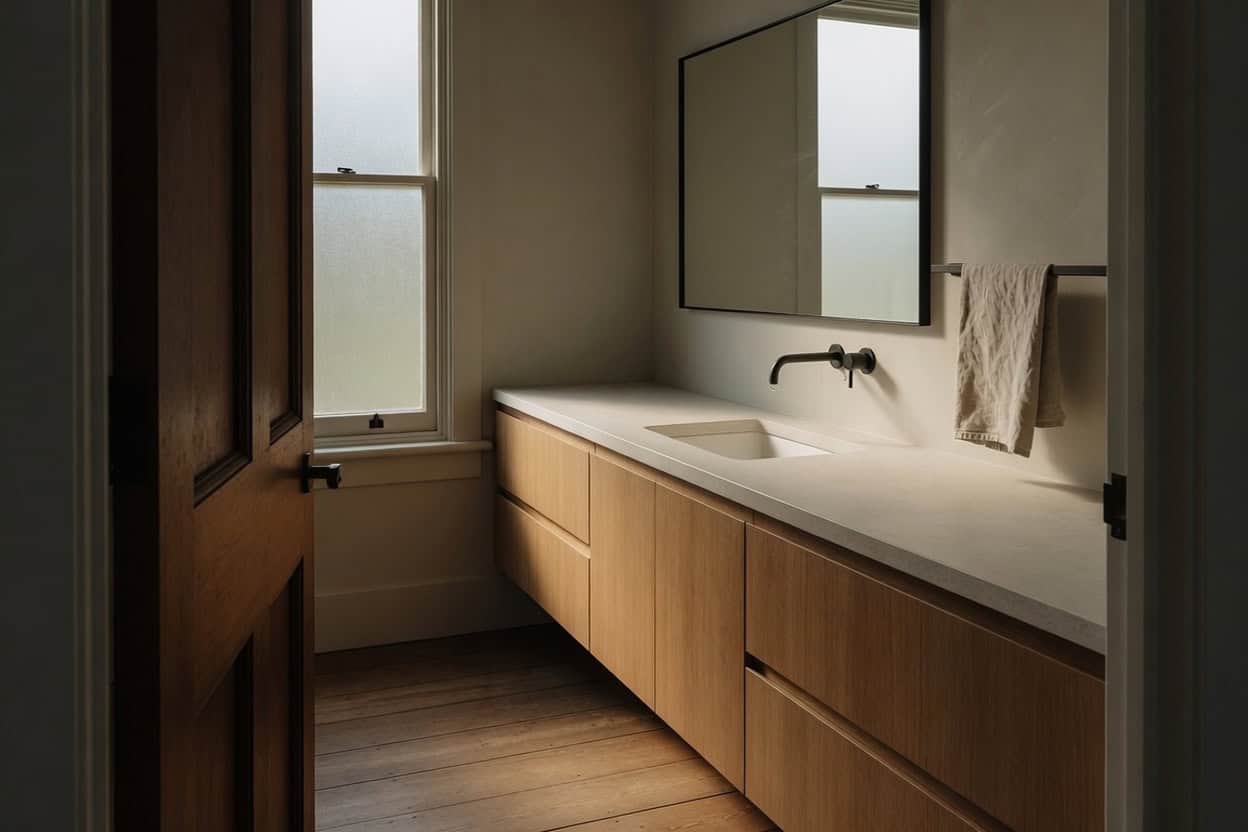
Drawer runners and hinges take a beating in a bathroom — doors slammed, drawers yanked, all of it in a humid room. We default to BLUM and Hettich for runners, hinges and soft-close, and both carry lifetime warranties on our schedule. Soft-close isn’t a luxury in a bathroom — it’s what stops the doors getting hammered against the carcass thirty times a week until they rattle. Häfele covers the wider hardware range where a project calls for it. You can see the full supplier list on our partners page.
💡 Design tip: Specify soft-close on everything in a bathroom, including the bin pull-out. It’s a small upcharge that’s the single biggest factor in whether the vanity still feels tight at year ten or sloppy at year two.
The top: stone, laminate or timber
The vanity top is the bit that gets wet most, so material choice matters. Your main options in NZ:
| Vanity top | Why it works in a bathroom | Worth knowing |
|---|---|---|
| Engineered stone (e.g. Caesarstone) | Non-porous, hard-wearing, easy to wipe down; broad colour range | The premium option; carries a long product warranty (10 years on our schedule) |
| Laminate | Affordable, huge colour range, fine for low-splash vanities | Seal the edges well; not ideal where water pools constantly |
| Timber | Warm, natural look; suits character and coastal homes | Needs sealing and a bit of care; best paired with a vessel basin |
For most Auckland bathrooms we steer clients toward engineered stone on the top, because it’s the surface that copes best with constant water and cleaning. If you want to weigh stone against the alternatives in detail, our guide to engineered stone alternatives in NZ covers porcelain, sintered stone, timber and laminate with real pros and cons.
Ventilation: the bit that protects everything else
No vanity material survives a bathroom that can’t dry out. Ventilation is the quiet factor behind whether your cabinetry — and the room around it — stays sound. NZ’s Healthy Homes Standards require bathroom extractor fans installed after 1 July 2019 in rentals to move a minimum of 25 litres per second, or run a duct of at least 120mm (Tenancy Services, Healthy Homes Standards). It’s a rental rule, but it’s a good baseline for any bathroom. Get the moisture out and a well-built vanity will outlast the trends in the room. Skip it and even the best joinery is fighting a losing battle.
Good materials and a proper build are only half the story, though. The other half is the process — how the thing gets designed, made and fitted, and what that costs you in time and money.
The Process, Lead Times and What It Costs to Commission One
Commissioning a custom vanity isn’t like buying one off a shelf, and the difference is mostly time. You’re trading a same-day pickup for something built to your room — and that build takes weeks, not days. Here’s how it runs.
How a custom vanity gets made
Our process is the same one we run for a kitchen, scaled to a vanity: a free in-home consultation, an estimate with a free preliminary 3D design, a finalised custom design, materials and manufacturing in our Auckland factory, installation, and handover. You can see the full walk-through on our design and build process page.
The bit clients value most is the free 3D render. Before a single panel is cut, you see your vanity in your bathroom — the colour, the handle, the drawer layout, the height. It answers the question everyone has and nobody asks out loud: “will it actually look like I’m imagining?” You sign off on the design, not on a leap of faith.
💡 Design tip: Bring photos of your existing kitchen, or a finish you’ve saved, to the consultation. It lets the designer match decors and door profiles on the spot and tightens the 3D render to what you’re actually picturing.
Once you’ve approved the design and materials, we measure the site precisely, feed the design into our automated machinery, and build. Installation itself is quick — most vanities go in inside a day, two at most — but if you’ve chosen a stone top, it gets templated after the cabinet is fitted and installed roughly ten days later, the same way a kitchen benchtop does. Worth knowing so the timeline doesn’t surprise you.
Lead times: weeks, not days
From signed design to installed vanity, you’re realistically looking at a few weeks — design finalising, manufacturing, then the install and (if stone) the top to follow. Having our own factory in Auckland and local suppliers keeps that lead time shorter than it would be with imported or outsourced joinery, but it’s still measured in weeks. If you’re working to a hard deadline — a new ensuite before guests arrive, a rental turnaround — tell us early and we’ll be straight with you about what’s achievable.
Important note: Book in your plumber and electrician around the install, not after it. We coordinate the cabinetry, but the basin connection, waste and any in-drawer power point need a licensed plumber and electrician. Lining those up in advance saves the most common post-install delay.
What you’ll actually pay — and the warranty behind it
We don’t quote a vanity off a price list, because a custom vanity isn’t a product off a list: the cost depends on size, the top, the hardware and the storage inside. As a market guide, custom vanities in Auckland generally start around $2,000 and commonly sit at $3,000 or more, against roughly $500–$1,500 for an off-the-shelf unit. Auckland also sits about 20–30% above the national average on trade rates, with labour around $90–$120 an hour, so local pricing reflects that. We price each vanity after the free design consultation, and the quote is fixed once the design and materials are locked — no moving target.
On the warranty side, the build is backed properly: a 5-year installation warranty on our workmanship, 10 years on Laminex product, lifetime warranties on BLUM and Hettich hardware, and 10 years on Caesarstone tops (per our current warranty schedule — see our guarantee page). That’s the difference you’re paying for — not just a nicer-looking cabinet, but one that’s built and stood behind to last in the wettest room in your house.
If the budget side is the sticking point, we offer interest-free finance options so you can get the vanity (or the whole bathroom’s joinery) sorted sooner rather than waiting. Which leaves the fun part — what your vanity could actually look like.
Custom Bathroom Vanity Ideas Trending in Auckland Homes
Design moves on, and what’s landing in Auckland bathrooms in 2026 is quieter and more considered than the high-gloss everything of a few years ago. A few directions worth a look if you’re at the ideas stage.
Fluted fronts and integrated handles
Fluted and slatted timber-look fronts are doing a lot of work in Auckland bathrooms right now — they add texture without colour, and they read as warm rather than clinical. Pair them with integrated handles (a J-pull routed into the door edge, or push-to-open) for a clean, handle-free face that suits the pared-back look most clients are after. It’s the same detailing we run on a custom kitchen — and a detail custom does easily and flat-pack can’t.
💡 Design tip: Test a fluted or matte door sample in your actual bathroom light before locking it in. North-facing Auckland bathrooms read warmer; south-facing ones cooler — and the same decor can look like two different colours between them.
Matte over gloss, and warmer colours
Matte finishes have largely taken over from high-gloss in residential work — they hide water spots and fingerprints far better, which in a bathroom is practical as much as aesthetic. Colour’s warming up too: soft greens, clay and muted earth tones over the stark white-and-grey of the last decade. A word of caution we give every client, though — chase timelessness over trend on the big-ticket items. The vanity carcass and top are the expensive parts; keep those calm and classic, and express the trend in the cheap-to-change things like tapware, the mirror and the wall colour.
Double vanities and integrated lighting
In the larger ensuites of newer homes — the Hobsonville and Flat Bush new builds, the renovated villas in Remuera with a bedroom-sized ensuite — the double vanity with integrated lighting is the standout. A long bench, two basins, drawers down the middle, and lighting built into the mirror or under a floating shelf so the face is lit evenly rather than from a single point overhead. It turns a functional wall into the feature of the room.
Whatever direction you lean, the point of going custom is that none of it is off a menu. It’s designed around your bathroom, your home and the way you use the room — which is exactly the kind of work we built our Auckland factory to do.
The Bottom Line on Custom Bathroom Vanities
An off-the-shelf vanity is the right call for a standard bathroom and a tidy budget. For everything else — the awkward villa ensuite, the tight apartment bathroom, the home where you want the joinery to match and to last — a custom vanity is the one that actually fits, the one built from materials that survive the room, and the one you stop thinking about because it just works. You’re paying roughly double to never have the “if only it fit” conversation with yourself every morning.
If you’re weighing it up, the cheapest way to find out whether custom makes sense for your bathroom is to ask. The consultation and the 3D design cost nothing, and you’ll come away knowing exactly what your space can take and what it’ll cost — before you commit to anything.
➡ Book your free in-home design consultation with Little Giant Interiors
➡ See how our design and build process works
➡ Learn more about our custom cabinetry in Auckland
How much does a custom bathroom vanity cost in NZ?
As a 2026 market guide, custom bathroom vanities in Auckland generally start around $2,000 and commonly sit at $3,000 or more, against roughly $500 to $1,500 for an off-the-shelf unit. The exact figure depends on size, the benchtop you choose, the hardware, and how much internal storage is built in. Auckland trade rates also run about 20 to 30% above the national average. At Little Giant Interiors we price each vanity after a free design consultation, and the quote is fixed once your design and materials are locked.
Is a custom bathroom vanity worth it over an off-the-shelf one?
It's worth it when the space is awkward, when you want the vanity to match other cabinetry in your home, or when storage needs to suit your routine — which covers most Auckland villas, apartments and compact bathrooms. A made-to-measure vanity fills the wall exactly, works around plumbing and windows, and uses moisture-resistant materials built to last. For a standard-sized bathroom on a tight budget where you're swapping like-for-like, a good off-the-shelf unit can be the smarter, cheaper call.
What is the best material for a bathroom vanity in NZ's climate?
A moisture-resistant board carcass with a laser-fused edge is the foundation, because Auckland's humid climate punishes cheap chipboard with iron-on edge tape — it swells and peels within a year or two. For the top, engineered stone such as Caesarstone copes best with constant water as it's non-porous and easy to clean. Laminex and Melteca surfaces (NZ-made, moisture-resistant) suit the cabinet fronts. BRANZ has found mould in around 49% of NZ homes, with bathrooms most affected, so material choice genuinely matters.
How long does a custom bathroom vanity take to make in Auckland?
From signed-off design to installed vanity, expect a few weeks — covering design finalising, manufacturing in the factory, and installation. The install itself is quick, usually inside a day or two. If you've chosen a stone top, it's templated after the cabinet is fitted and installed about ten days later, the same as a kitchen benchtop. Having our own Auckland factory and local suppliers keeps lead times shorter than imported or outsourced joinery, but a custom vanity is still measured in weeks, not days.
Do I need building consent to replace a bathroom vanity?
Generally no, if you're doing a like-for-like swap that keeps the basin and waste in the same position — that's straightforward replacement work. You can move into consent territory once you relocate plumbing points or build a wet-area shower, because of the higher waterproofing risk. Auckland Council consents for that kind of work typically run from several hundred to a couple of thousand dollars. Keeping the basin roughly where it is is the simplest way to keep both your budget and your timeline predictable. Check building.govt.nz for current thresholds.
What's the difference between a wall-hung and floor-standing vanity?
A wall-hung (floating) vanity mounts to the wall with nothing touching the floor, which makes a small bathroom feel larger, is easier to clean around, and keeps the cabinet base clear of floor water — but it needs solid fixing into the wall framing. A floor-standing vanity sits on the floor or a recessed kick, carries its load straight down, offers a little more storage, and suits larger family bathrooms and character homes. The right choice depends on your wall structure, bathroom size and the look you're after.
Can you match a custom vanity to my kitchen cabinetry?
Yes — that's one of the main reasons people go custom. Because we build from the same Laminex and Melteca ranges, with the same door profiles and handles, a custom vanity can carry the exact colour and finish of your kitchen. With dozens of decors available, matching an existing kitchen or hitting a specific colour is rarely a problem. It's continuity that's hard to achieve with a separate off-the-shelf bathroom range, and it's a common reason clients return to us for the bathroom after we've done their kitchen.
What benchtop works best on a bathroom vanity?
Engineered stone such as Caesarstone is the standout for most Auckland bathrooms — it's non-porous, hard-wearing, easy to wipe down, comes in a wide colour range, and carries a long product warranty. Laminate is the affordable option with a huge colour range and works fine on lower-splash vanities, provided the edges are sealed well. Timber gives a warm, natural look that suits character and coastal homes but needs sealing and a little care. For a vanity that sees constant water, stone is usually worth the upgrade.
Do custom bathroom vanities come with a warranty?
Yes. At Little Giant Interiors the build is backed by a 5-year installation warranty on our workmanship, alongside supplier product warranties — 10 years on Laminex, lifetime warranties on BLUM and Hettich hardware, and 10 years on Caesarstone tops, per our current warranty schedule. That combination of workmanship and product cover is a real part of what you're paying for with custom over a cheap off-the-shelf unit, especially in a bathroom where materials and hardware are under constant moisture stress. Full details are on our guarantee page.
Can a custom vanity fit an awkward or small bathroom?
That's exactly where custom earns its place. Off-the-shelf vanities only come in fixed widths like 600, 750 and 900mm, and real Auckland bathrooms — especially in villas, bungalows and apartments — rarely match those. A custom vanity is built to your exact dimensions, fills the wall edge to edge, works around windows and sloping ceilings, and can use a corner that no standard unit fits. In compact bathrooms where every centimetre counts, that tailored fit buys back storage you'd otherwise lose.
Have you been putting off your kitchen renovation?
We offer flexible finance options to help you get your dream kitchen sooner. Learn more about our interest-free finance options.
References
- BRANZ — 2015 House Condition Survey: Mould and damp (mould visible in ~49% of NZ homes, most common in bathrooms)
- Tenancy Services — Healthy Homes Ventilation Standard
- Building Performance (MBIE) — Building work that doesn’t need a building consent
- Laminex New Zealand — moisture-resistant surfaces and product warranties