

Last updated:
Modular vs Custom Kitchens: The Honest Auckland Comparison (2026)
Quick answer: Modular kitchens use standard-sized cabinets that are cheaper and quicker but force your space to fit the boxes; custom kitchens are built to your exact dimensions for a better fit, more storage and stronger resale value. In Auckland the price gap has narrowed to roughly 20–80% depending on scope — and with local manufacturing, custom is no longer the slow option it used to be.
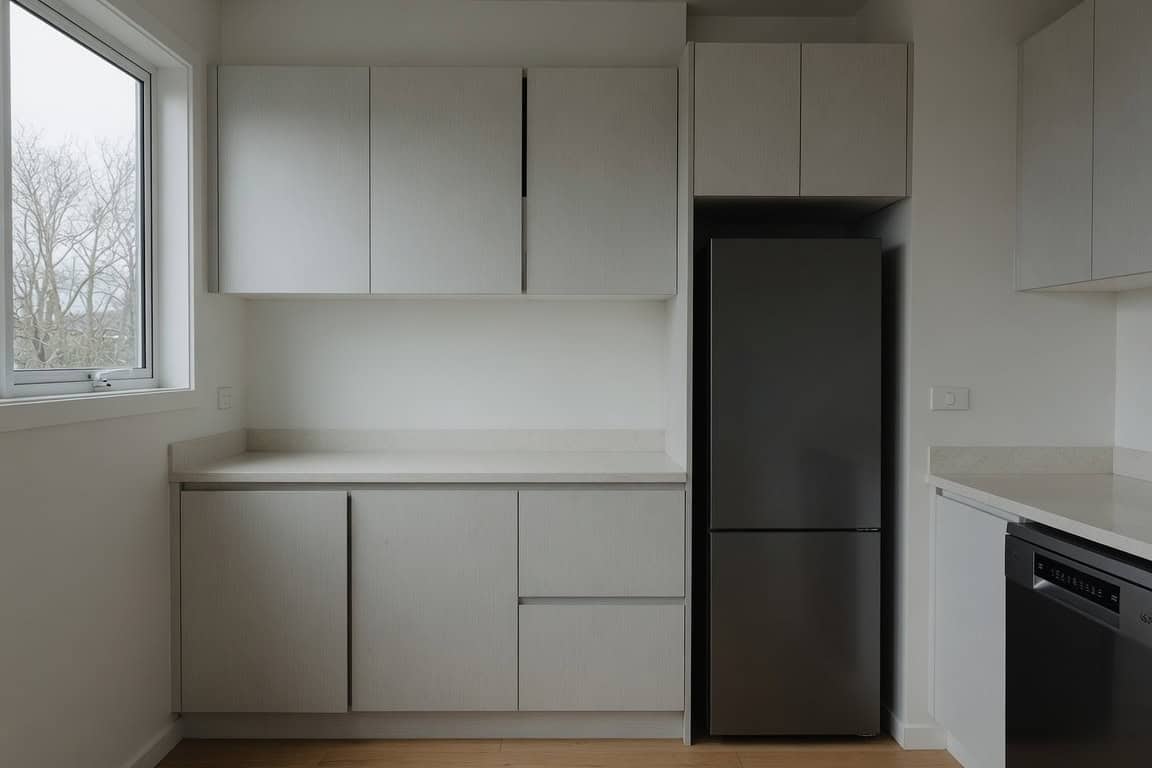
Every week someone sits at our design table with the same knot in their stomach. They’ve priced a flat-pack kitchen at the big-box store, they’ve had a custom quote that’s a fair bit higher, and they can’t work out whether the difference is worth it or whether they’re about to overpay for a word.
It’s a fair question. And most of the advice online doesn’t answer it honestly, because most of it is written by people selling one side of the argument.
We build custom kitchens — that’s our trade — but we’re not going to pretend modular is a mistake for everyone. For some homes it’s the right call. For others it’s a false economy that shows up as filler panels and awkward gaps two years down the track. The useful thing isn’t “which is better.” It’s “which is better for your kitchen, your house, and how long you’re staying.”
So here’s the full comparison, from a company that manufactures custom cabinetry in a 700m² factory in Auckland and sees both approaches land in real homes across the city. Real 2026 cost tiers. The truth about lead times, which has shifted more than people realise. And a straight decision framework based on the kind of house you actually live in — whether that’s a villa in Grey Lynn with walls that haven’t been square since 1910, or a new townhouse in Flat Bush where everything’s plumb.
What Modular and Custom Kitchens Actually Are
Before the comparison means anything, the two terms need pinning down — because the industry uses them loosely, and that vagueness is where people get caught out.
Modular (flat-pack) kitchens, defined
A modular kitchen is built from standard-sized cabinet units — the trade calls them modules. Base units usually come 60cm deep, in set widths: 30, 40, 45, 50, 60, 80, 90cm. Wall units run 35cm deep. You choose from that fixed menu of sizes and slot them together to roughly fit your room.
The key word is “roughly.” Because your walls almost never add up to a tidy sum of standard modules, the gaps get closed with filler panels — blank strips of matching board that bridge the leftover space. A 3.4m wall might take five modules and a 140mm filler. It works. It just doesn’t fit the way custom fits.
Flat-pack has genuinely improved over the last decade, and we’ll say so plainly. Some modular ranges now offer moisture-resistant board, soft-close hardware and a decent spread of finishes. This isn’t the chipboard-and-regret situation it was fifteen years ago.
Modular breaks down further into two camps worth knowing. There’s imported flat-pack — the cheapest, shipped in as a kitset, usually assembled on site or by you. And there’s locally made modular, where an Auckland manufacturer runs standard sizes through their own factory. Same standard-dimension logic, better board and hardware, warranty you can actually enforce here.
Custom kitchens, defined
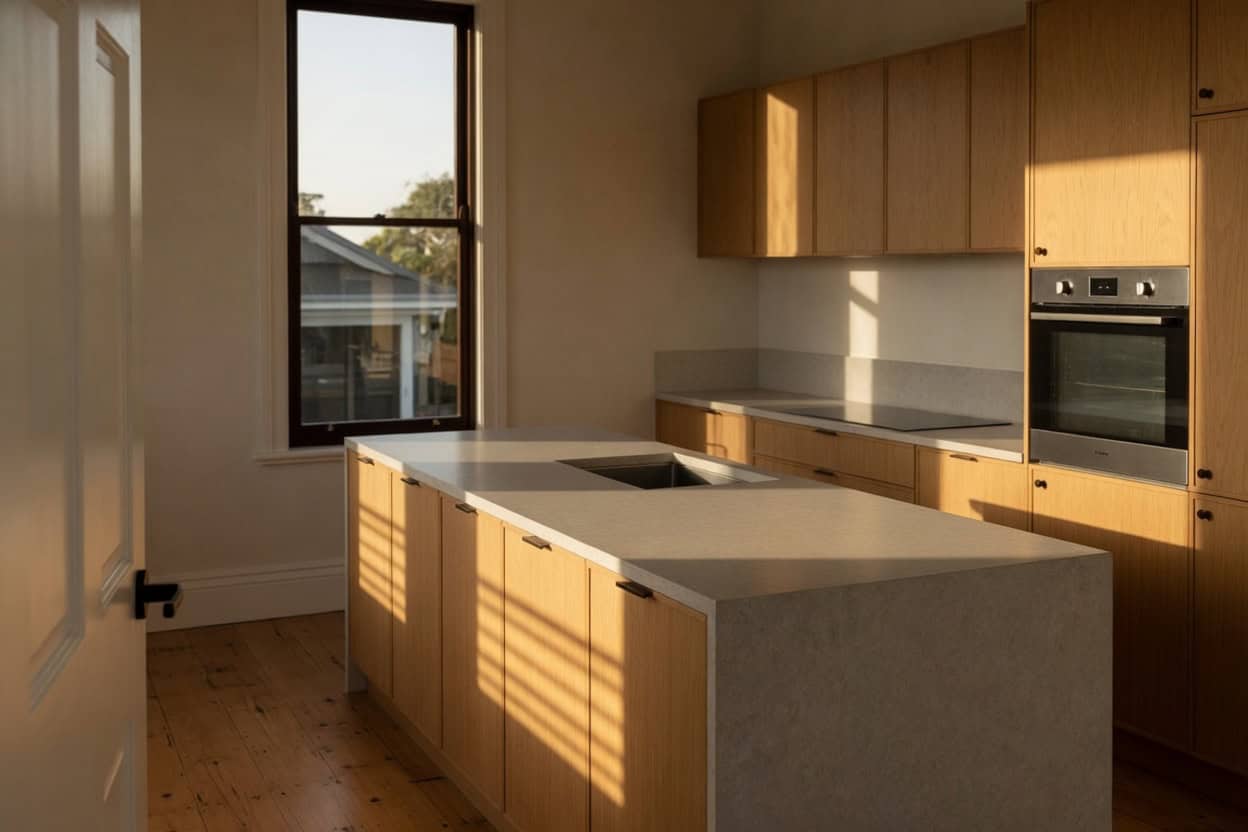
A custom kitchen is manufactured to the exact dimensions of your space. No fixed module menu. If your wall is 3,417mm, your cabinetry is built to 3,417mm — no fillers, no leftover gap, no compromise on where the drawers land.
That exact-fit principle is the whole point, and it changes far more than the look. It changes how much storage you actually get out of the footprint, how the corners are treated, how doors and drawers align across the run, and how the kitchen functions day to day. In a tight Auckland kitchen — and plenty of them are tight — the difference between “adapt to the modules” and “built to the millimetre” can be an entire extra cabinet of usable storage.
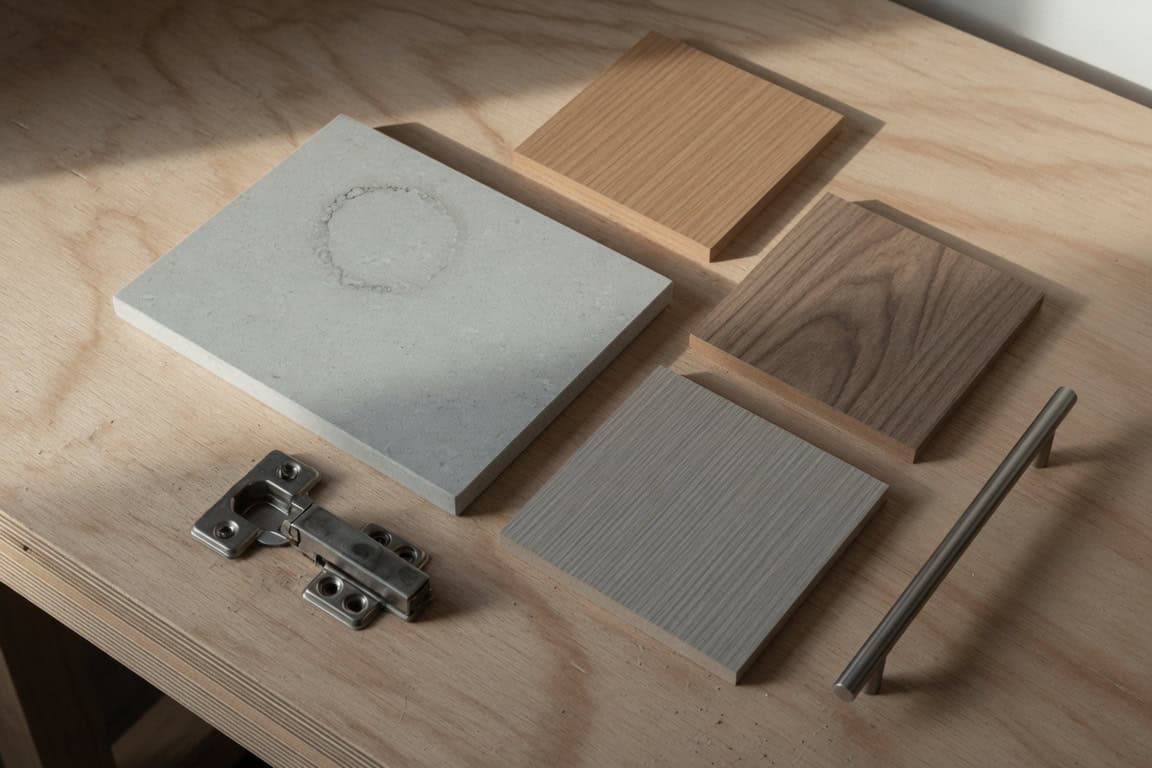
Custom also opens up the material and hardware range completely. You’re not limited to what a modular supplier stocks. That means the full spread of Laminex and Melteca boards, BLUM drawer systems, Häfele mechanisms, engineered-stone benchtops from Caesarstone NZ — specified for your kitchen rather than pulled off a shelf.
The middle nobody talks about: semi-custom
There’s a third option that gets skipped in most “modular vs custom” pieces, and it’s where a lot of sensible Auckland kitchens actually land. Semi-custom takes standard carcasses but adjusts sizing, fronts and internals to your space — better fit and finish than basic modular, without the full cost of bespoke. If you’re reading this trying to choose between two extremes, know that the middle exists.
Sound familiar so far? If you’ve already spotted your kitchen in one of these descriptions, the next section is where it gets real — the money.
💡 Design tip: When you get any kitchen quote, ask one question directly — “Is this priced for custom-dimensioned cabinets, or standard modules with fillers?” The answer tells you more about how your kitchen will look and function than the price alone ever will.
Now that the terms are clear, let’s put them head to head on the thing everyone asks about first.
The Cost Comparison: Real Auckland Price Tiers for 2026
Here’s where we get specific, because vague “costs vary” advice helps no one. These are cabinetry supply-and-install ranges for Auckland in 2026 — they exclude benchtops, appliances, and any plumbing or electrical work, which sit on top.
What each tier actually costs
| Tier | Typical Auckland Cost (cabinetry, supply + install) | Best For |
|---|---|---|
| Imported flat-pack / basic modular | $8,000 – $15,000 | Simple straight runs, rentals, square rooms, short-hold properties |
| Semi-custom (standard carcass, adjusted fit) | $15,000 – $25,000 | Most Auckland family kitchens — the sensible middle |
| Full custom (exact fit, tall units, premium finishes) | $25,000 – $45,000+ | Awkward spaces, integrated appliances, “forever” kitchens |
| The custom premium | Roughly 30–80% more than comparable modular | Depends heavily on layout complexity |
Custom cabinetry typically runs 30–80% more than comparable modular for the same footprint. That’s a real premium and we won’t dress it up. But the gap depends almost entirely on complexity — a simple straight run narrows it; a drawer-heavy L-shape with a tall pantry wall and corner solutions widens it, because that’s where custom earns its keep.
What actually drives the number (it’s not “custom vs modular”)
Here’s the thing most cost guides miss entirely. The custom-or-modular decision isn’t the biggest lever on your final price. Scope is.
Two kitchens with the same floor plan can quote $15,000 apart, and both can be completely legitimate. The drivers that quietly stack up: how many cabinets, your drawer-to-door ratio (drawers cost more than doors, and a pot-and-plate drawer bank adds up fast), tall pantry units, corner solutions, and finish choice. A run of soft-close BLUM drawers across a base cabinet costs considerably more than the same cabinet with a single door — but the daily usability is a different world.
Custom doesn’t automatically mean better, either. Poorly designed custom is just expensive poorly designed. The value in custom is the design quality and the exact fit — not the label. Pay for the millimetre-perfect fit and the clever storage, and it’s worth every dollar. Pay a custom premium for a bad layout, and you’ve spent more for the same frustration.
The wider market backdrop
Kitchen prices in Auckland have settled after three years of supply-chain turbulence. According to the Cordell Construction Cost Index published by Cotality in January 2026, residential construction costs rose 0.9% in the December 2025 quarter, with annual growth at 2.3% — well down from the 10%-plus peak of late 2022. Locally made cabinetry pricing has been broadly flat, as Auckland manufacturers absorb input costs through factory efficiency.
Whichever way you go, build in a 10–15% contingency — especially in older Auckland homes, where moving plumbing or electrical behind the cabinets adds cost quickly. For the full breakdown of what drives cabinetry pricing, our kitchen cabinet cost NZ guide goes deeper on every line item. And if a layout change is on the cards, our interest-free finance options can spread the cost of doing it once, properly.
💡 Design tip: Treat hardware as a system decision, not a series of one-off upgrades. Soft-close is close to standard now, but heavy-duty runners for wide pot drawers cost more — and multiplied across 15–30 cabinets, small hardware choices become a big line. Decide the spec once, up front.
Money sorted. But cost is only half the decision — the other half is whether the kitchen actually fits your house. That depends a lot on which Auckland home you’re standing in.
Fit, Function and Your Auckland Home: The Real Decider
This is the section the overseas comparison articles can’t write, because they don’t know Auckland housing stock. And housing stock is where the modular-versus-custom decision is genuinely made — more than budget, more than taste.
Villas and bungalows: where modular struggles
If you’re in a pre-1940s villa or bungalow — Ponsonby, Grey Lynn, Mt Eden, Devonport — your walls are almost certainly not square. A century of settling, re-piling and old renovations means corners that aren’t 90 degrees and walls that bow. We measured a Grey Lynn villa kitchen last year where one wall ran 22mm out over 3.6m. Doesn’t sound like much. In modular terms it’s the difference between clean cabinetry and a run of visible tapering gaps.
In an out-of-square room, standard modules fight the space and lose. The fillers get wider and more obvious, the benchtop overhang goes uneven, and the whole run reads as slightly “off” even to someone who can’t say why. Custom cabinetry is scribed to the actual wall — the cabinet backs and fillers are cut to follow the wall’s real line, so the fit stays tight and true. In character homes, this is usually where custom stops being a luxury and starts being the practical answer.
Apartments and micro-kitchens: every millimetre counts
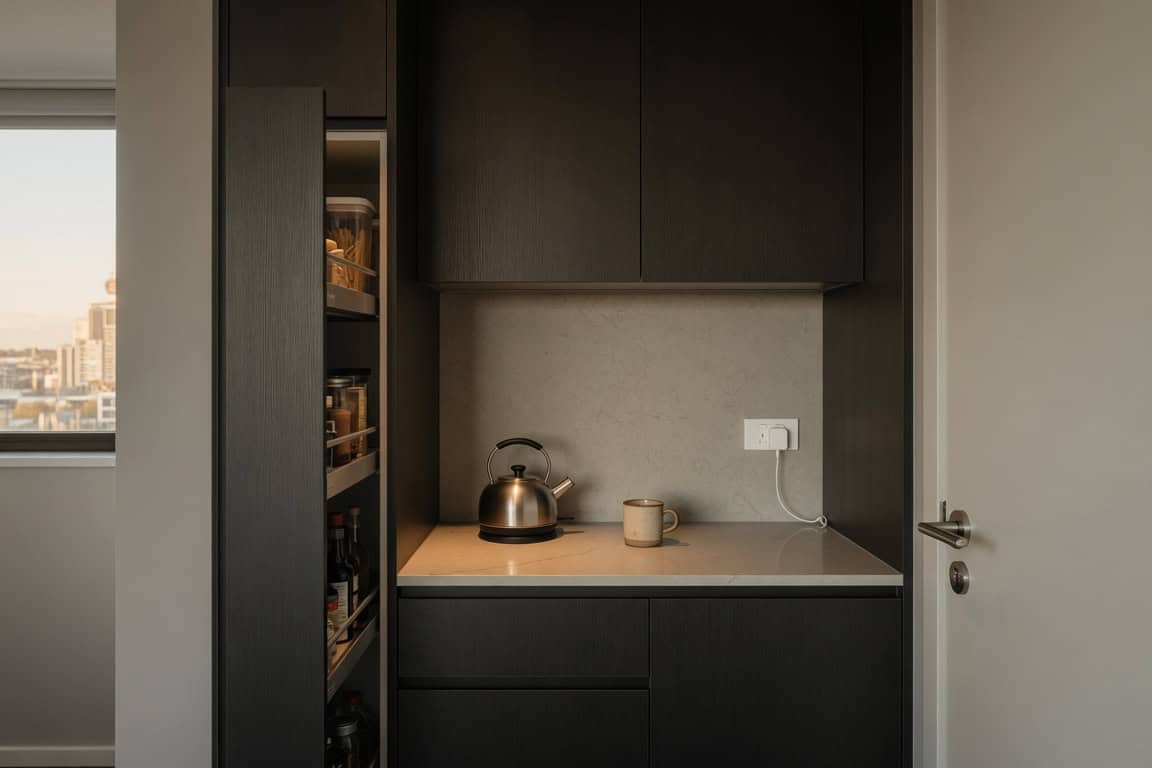
Auckland’s apartment boom — the CBD, Newmarket, Takapuna — has made small kitchens a fact of life for a lot of us. In a compact galley or a single-wall kitchen, you don’t have millimetres to waste on fillers. A standard module that’s 60mm too wide for the alcove means either a filler you can’t afford spatially, or a cabinet that won’t fit at all.
In micro-kitchens, custom’s exact fit often recovers a whole extra cabinet’s worth of storage — the difference between a pantry pull-out fitting and not. That said, for a straightforward rental apartment you’re holding short-term, a tidy locally made modular install can be exactly right. Renter-friendly, quick, and moisture-resistant board handles the humidity.
New builds and square rooms: modular’s home ground
If you’re in a newer subdivision — Hobsonville, Flat Bush, Millwater — your walls are likely plumb and square, and your room may well have been designed around standard dimensions in the first place. This is where modular performs at its best: the fillers stay minimal, the fit is clean, and you’re not paying a custom premium to solve problems your house doesn’t have.
Even here, though, the decision comes back to how long you’re staying and how you cook. A square room doesn’t stop you wanting a drawer-heavy layout, a proper scullery, or integrated appliances — and those pull you toward custom regardless of whether the walls cooperate.
The humidity factor
Auckland’s a humid city, and it matters for cabinetry. Unsealed MDF in a kitchen or laundry will swell at the edges over time. Whichever route you take, moisture-resistant board — sealed melamine like Melteca, or polyurethane finishes — is the sensible default here, and it’s now standard on most quality projects for exactly this reason. Cheap imported flat-pack is where you’re most likely to find a substrate that won’t cope with a Kiwi winter, so check the board spec, not just the price.
💡 Design tip: Before you decide modular vs custom, take a spirit level to your kitchen walls and a tape to the corners. If the walls bow or the corners aren’t square — common in any Auckland home built before the 1990s — factor the cost of fillers and compromise into the modular quote. It’s often closer to custom than the sticker suggests.
So custom clearly wins on fit in most older Auckland homes. Which leaves the objection we hear most: “but custom takes forever, right?” Not anymore. And that’s worth explaining properly.
Timelines and Quality: Why the Old “Custom Is Slow” Rule Has Broken
For years the trade-off was simple. Modular was fast — units in stock, installed in a couple of days. Custom was slow — weeks or months, because each piece was made from scratch, often by a joiner working through a queue.
That gap has closed dramatically, and it’s the single biggest thing that’s changed in this comparison. The reason is manufacturing. When custom cabinetry is made in an automated local factory rather than hand-built one piece at a time, the speed penalty largely disappears.
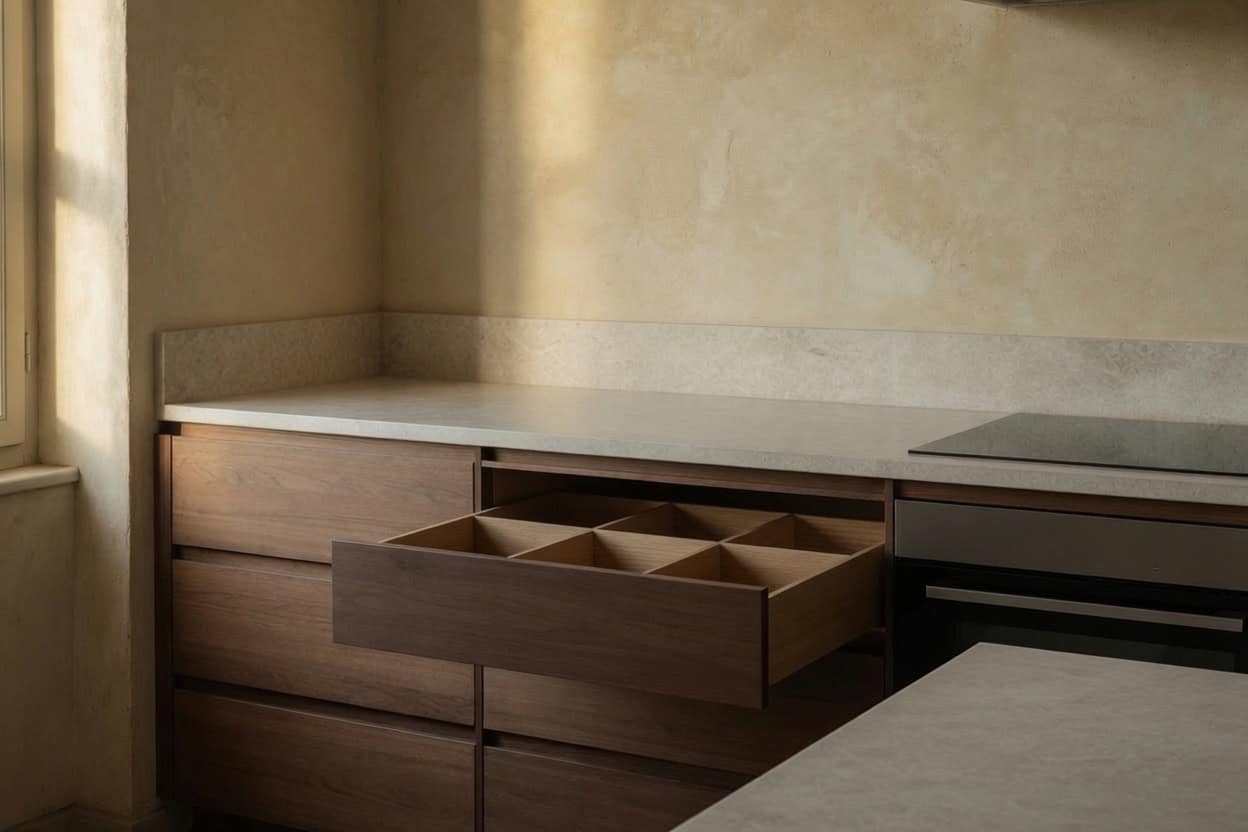
How local automated manufacturing changed the maths
Here’s how it works in our case, and it’s worth being specific. Once your design and materials are locked in, ordering the board takes about a week — we only use local suppliers, so there’s no offshore shipping wait. Manufacturing then runs through our factory in roughly one to two weeks. Installation is two to three days. All up, a custom kitchen replacement moves through in about three weeks.
Compare that to imported flat-pack, where the units themselves might be quick to install but the shipping and lead times can stretch out unpredictably — and if a panel arrives damaged, you’re waiting on a replacement from offshore. A local custom kitchen can genuinely land in your home in a comparable timeframe, sometimes faster.
“People still walk in expecting custom to mean a three-month wait. That was true when everything was hand-finished. With an automated factory here in Auckland, we’re handing over exact-fit custom kitchens in about three weeks — and we control the timeline because nothing’s sitting on a boat.”
— Little Giant Interiors Design Team
The German laser edge-bander and what it means for quality
Speed’s only worth having if the finish holds up, and this is where the technology earns its place. The final edge-finishing on our cabinetry is done on a German laser edge-bander. Instead of gluing the edge strip on — the traditional method, where the glue line can eventually yellow, collect grime or lift — the laser fuses the edge to the board. No visible glue line, no manual buffing, and an edge that resists moisture and daily wear far better.
This is the part that’s hard to replicate in hand-built or imported cabinetry. Automated laser cutting and edge-banding removes the human-error variables — the slightly-off cut, the uneven glue line, the door that doesn’t quite align. Every cabinet comes out to the same tolerance. For a design-literate client who’s going to open these drawers ten times a day for the next twenty years, that consistency is the difference you feel long after the price is forgotten.
How long each option really lasts
Quality cabinetry, cared for, should give you 20–30 years. Basic imported flat-pack won’t — hinges loosen, edges lift, substrates swell, and you’re often looking at replacement inside a decade. This is the hidden cost that never makes it into the sticker comparison: if a cheap kitchen needs replacing in eight years and a quality one lasts twenty-five, the “cheaper” option was never actually cheaper. It just deferred the bill.
That longevity feeds straight into resale, too. Properly fitted custom cabinetry — no fillers, clean alignment, quality hardware — reads as quality to a buyer walking through, and it’s one of the upgrades that genuinely helps a sale in the mid-to-premium Auckland market. To see how the design-and-build sequence actually runs from first measure to handover, have a look at our design and build process.
If your project is part of a larger renovation — moving walls, opening up to living, structural change — that’s where our group company Superior Renovations handles the full home reno, and we take care of the cabinetry inside it.
By now the pattern’s probably clear. Let’s turn it into a straight decision.
So Which Should You Choose? A Straight Decision Framework
No hedging. Here’s how we’d steer you, based on hundreds of Auckland kitchens.
Choose modular (or locally made modular) if:
Your kitchen is a simple, mostly straight run in a square room. You’re in a rental or an investment property you’ll hold short-term. Your budget is firm at the lower end and the space genuinely suits standard sizes. Or you need it done fast and cheap and you’ve accepted the trade-offs on fit and longevity. For a plumb-walled new-build kitchen you’re not planning to reconfigure, modular can be the smart, unsentimental choice — and locally made modular gives you enforceable warranty and NZ-rated board on top.
Choose custom if:
You’re in a villa, bungalow or any pre-1990s Auckland home with walls that aren’t square. Your space is awkward, compact, or has a tricky corner that standard modules can’t solve. You want integrated appliances, a drawer-heavy layout, a proper scullery, or tall pantry walls. This is your family home and you’re staying 10–20 years. Or the exact fit and the storage you’ll gain from it genuinely matter to how you live. In most character Auckland homes, custom isn’t the indulgent option — it’s the one that actually works.
Choose semi-custom if:
You want better fit and finish than basic modular but the full custom premium is a stretch. This is where a lot of sensible Auckland family kitchens land, and there’s no shame in the middle — it’s often the best value of the three.
The honest bottom line
The label matters less than two things: how well the kitchen fits your actual space, and how long you’re going to live with it. Get those right and the modular-versus-custom question mostly answers itself. A cheap kitchen in the wrong house is expensive. A well-designed kitchen — modular or custom — that suits your home and your life is money well spent.
The best way to know which camp your kitchen falls into is to have someone who measures Auckland homes for a living come and look at yours. That’s what our free in-home consultation is for — a designer comes to you, measures the space, and tells you honestly whether your walls need custom or whether modular will do the job. No pressure, and you’ll get a free preliminary 3D design either way.
➡ Book your free in-home design consultation with Little Giant Interiors
➡ See how our design and build process works
➡ Learn more about our custom kitchens in Auckland
Modular vs Custom Kitchens: Frequently Asked Questions
What is the difference between modular and custom kitchens?
A modular kitchen is built from standard-sized cabinet units (typically 30–90cm wide, 60cm deep) that you slot together to fit your room, with filler panels closing any leftover gaps. A custom kitchen is manufactured to your exact wall dimensions, so there are no fillers and no compromise on layout. Modular is cheaper and faster; custom fits precisely and usually delivers more usable storage, especially in older or awkwardly shaped Auckland homes.
Are custom kitchens worth the extra cost in NZ?
It depends on your home and how long you're staying. In pre-1990s Auckland homes with out-of-square walls — villas and bungalows in Ponsonby, Mt Eden, Grey Lynn — custom is usually worth it because standard modules leave visible gaps and wasted space. For a square-walled new build you'll hold short-term, modular can be the smarter spend. Custom typically costs 30–80% more but lasts 20–30 years and supports resale value in the mid-to-premium market.
How much do modular and custom kitchens cost in Auckland in 2026?
For cabinetry supply and install in Auckland (excluding benchtops and appliances): imported flat-pack or basic modular runs roughly $8,000–$15,000; semi-custom sits around $15,000–$25,000; full custom is $25,000–$45,000 or more. Your final number is driven less by the custom-or-modular choice than by scope — cabinet count, drawer-to-door ratio, tall units and finish. Always add a 10–15% contingency, especially in older homes.
How long does a custom kitchen take to make in Auckland?
With local automated manufacturing, far less time than people expect. In our case, once design and materials are confirmed, board ordering takes about a week, manufacturing runs one to two weeks in our Auckland factory, and installation is two to three days — around three weeks all up. Because we use local suppliers, there's no offshore shipping wait, so a custom kitchen can land in a timeframe comparable to imported flat-pack, sometimes faster.
Do modular kitchens work in old villas and character homes?
They can, but often not well. Pre-1940s villas and bungalows have walls that have shifted over a century, so corners aren't square and walls bow. Standard modules can't follow those irregularities, so you end up with wide, visible filler panels and uneven benchtop overhangs. Custom cabinetry is scribed to the actual wall line for a tight fit. In character Auckland homes, custom is usually the practical answer rather than a luxury.
What is a semi-custom kitchen?
Semi-custom uses standard cabinet carcasses but adjusts sizing, fronts and internal fit-out to suit your space. It gives you better fit and finish than basic modular without the full cost of bespoke, and it's where many Auckland family kitchens sensibly land. If you're torn between cheap flat-pack and full custom, semi-custom is the middle ground worth asking your designer about.
Do I need building consent for a kitchen renovation in NZ?
Most standard kitchen renovations — replacing cabinetry and benchtops in the same location — do not require building consent, because you're not altering the structure. Consent may be needed if you're moving load-bearing walls, significantly reconfiguring plumbing, or affecting the building's structure or weathertightness. Auckland Council is the definitive authority for your specific situation. For official guidance, see building.govt.nz, and check before any work begins.
Which lasts longer, modular or custom kitchens?
Quality cabinetry — custom or good locally made modular — should last 20–30 years with proper care. Cheap imported flat-pack often needs replacing within a decade as hinges loosen, edges lift and substrates swell in Auckland's humidity. This is the hidden cost of the cheapest option: if it needs replacing in eight years and a quality kitchen lasts twenty-five, it was never really the cheaper choice. Check the board substrate and hardware spec, not just the price.
Can custom cabinetry fit a small apartment kitchen?
Yes, and it's often where custom pays off most. In compact Auckland apartment and micro-kitchens, there's no room to waste on filler panels. A standard module that's slightly too wide for an alcove means either a gap you can't afford or a cabinet that won't fit. Custom's exact fit frequently recovers a whole extra cabinet's worth of storage — the difference between a pantry pull-out fitting your space or not.
Is flat-pack cabinetry any good these days?
It's improved a lot. Many modular ranges now offer moisture-resistant board, soft-close hardware and a reasonable spread of finishes — a long way from the chipboard of fifteen years ago. Locally made modular is the stronger option: NZ-rated board suited to our humidity and warranty you can actually enforce here. The weak point remains cheap imported flat-pack, where the substrate may not cope with a Kiwi winter. Always check the board spec.
Have you been putting off your kitchen renovation?
We offer flexible finance options to help you get your dream kitchen sooner. Learn more about our interest-free finance options.