

Last updated:
Small Kitchen Ideas: How to Make a Tight Auckland Kitchen Work Harder
Quick answer: The small kitchen ideas that actually work in Auckland homes are single-wall and L-shaped layouts with stacked appliances, pull-out storage and cabinets run to the ceiling — finished in light, reflective surfaces and sealed, moisture-resistant materials that handle our humidity.
Most Auckland kitchens aren’t big. A one-bedroom apartment off Britomart, a villa in Mt Eden carved up over a century, a townhouse in Parnell built tight to the section — the kitchen is usually the room that got squeezed. The good news is that a small kitchen designed properly works harder than a big one thrown together lazily.
We design, manufacture and install kitchens across Auckland from our own factory in Rosedale, and a fair share of them are small. So the small kitchen ideas in this guide aren’t lifted off an overseas Pinterest board — they’re what we’ve watched hold up in real Auckland homes, from the layouts that buy back floor space to the materials that survive a humid Grey Lynn summer. We’ll cover the layouts, the storage, the light and colour tricks, the materials, what it actually costs, and the mistakes that quietly make a tight kitchen feel tighter.
Try our cost calculators and get a baseline in about a minute
1. Custom Kitchen Cabinetry Cost Calculator
2. Custom Laundry Cost Calculator
3. Custom Wardrobe Cost Calculator

Small Kitchen Ideas That Start With the Layout
Before you think about colours or handles, get the layout right. A small kitchen wins on layout, not square metres — the right plan frees up the floor without moving a single wall. Three layouts do most of the work in Auckland homes, and which one suits you comes down to the shape of the room and the building you’re in.
Single-wall: the apartment workhorse
For apartments under roughly 6m² — think a skinny CBD or Grey Lynn one-bedroom, a single-wall run is usually the smartest move. Everything lives along one wall: a slim sink, the cooktop, and the fridge or a stacked washer-dryer. Stack what you can vertically, run a pull-out bench over the top for prep, and take the cabinetry to the ceiling so the wall earns its keep right up high. There’s no swing space wasted on a second run, which matters when the whole kitchen is the size of a hallway.
L-shaped: the villa and townhouse favourite
For villas and townhouses in the 6–10m² range, an L-shape is hard to beat. You wrap the bench around two walls, put the sink in the corner, stack the appliances, and run the cabinets up to the ceiling. An L-shape with a corner sink genuinely changes how a small Mt Eden villa kitchen feels day to day — fewer steps, more bench, and it reads as bigger than it measures. It also handles the awkward corner that defeats a lot of small kitchens, turning dead space into a working zone.
Galley: built for the long, narrow room
Plenty of Auckland kitchens are long and skinny — the classic Ponsonby villa where the kitchen runs off the hallway, or a Parnell townhouse with a corridor layout. A galley puts two parallel benches facing each other, which gives you a surprising amount of bench and storage in a tight strip. The one rule with a galley is clearance: leave enough room between the two runs so doors and drawers open without colliding.
U-shape and peninsula: the upper end of “small”
At the larger end of a small kitchen — say an open-plan area in a renovated Epsom bungalow, a tight U-shape or a peninsula starts to make sense. A peninsula gives you an extra run of bench and casual seating without the full floor cost of an island, and it can double as the divide between the kitchen and the living space. The catch is clearance again: a U-shape only works if the open end of the U leaves comfortable room to turn around, so it’s a layout for the bigger small kitchens, not the genuinely tiny ones.
One more option worth raising early: a scullery. In a lot of Auckland homes we’ll pull the messy work — the second sink, the small appliances, the bulk pantry, into a compact scullery tucked off the main kitchen. It lets the visible kitchen stay small, clean and calm while the storage and mess live next door, which is often the smartest fix when the kitchen itself simply can’t grow.
Matching the Layout to Your Square Metreage
The quickest way to narrow the small kitchen ideas worth chasing is to start from the floor area you’ve actually got. Kitchen designs for small kitchens tend to sort themselves by size, and knowing your band saves a lot of wasted planning.
- Under 5m² (studio and one-bedroom apartments): single-wall only. Stack the laundry or fridge, keep one continuous bench, and put every spare centimetre into full-height cabinetry.
- 5–8m² (most villa and townhouse kitchens): an L-shape earns its place here, with the sink in the corner and appliances stacked down one arm. This is the band most small kitchen ideas nz searches are really asking about, and it’s where a corner pull-out makes the biggest difference.
- 8–12m² (renovated bungalows and open-plan townhouses): a galley or a tight U-shape opens up, and a slim peninsula becomes an option for casual seating without an island’s floor cost.
Whatever the band, the finish decision runs in parallel — a handleless kitchen keeps sightlines clean in a tight space, and the right benchtop choice shapes the budget (our guide to kitchen benchtop costs in NZ breaks the options down). Once you know your band, you can plan the storage and surfaces around it rather than the other way round.
Standard Cabinet Sizes, and Why They Cost You Space in a Small Kitchen
Off-the-shelf cabinetry comes in fixed module widths. Kaboodle, the flatpack range sold through Bunnings here, publishes base cabinets at 150, 300, 400, 450, 600, 800, 900 and 1000mm. Those are perfectly sensible numbers, and they are the reason a modular kitchen wastes space in a small room.
Say a wall measures 2,340mm between a window reveal and a doorway. Modules will get you to 2,300mm at best, so the remaining 40mm becomes a filler panel: a strip of finished board that does nothing except cover a gap. In a nine-metre kitchen you would never notice. In a four-metre kitchen you have just lost a spice pull-out.
Now multiply that. A typical small kitchen has three or four of those junctions, at a corner, at an appliance, at a wall return and at a tall unit. Add the fillers up and it is common to lose 150 to 200mm of usable frontage to gaps, plus the dead space behind a corner module that no standard carcass reaches into.
Custom cabinetry does not remove the physics. What it removes is the rounding. We measure the opening, then build to it, so the 2,340mm wall gets 2,340mm of cabinet. That single difference is where most of the storage gain in a small kitchen actually comes from, and it is why a custom small kitchen usually holds noticeably more than a modular one of identical footprint. Our guide to how custom kitchen cabinets are made walks through the measure-to-machine part of that, and modular versus custom kitchens in NZ compares the two routes properly.
Kitchenettes, Mini Kitchens and Small Kitchen Units
Not every brief is a kitchen. A studio, a minor dwelling, a sleepout, an office tea point or a granny flat often needs a kitchenette instead, and the design rules genuinely change when you drop below about four square metres.
A kitchenette is a single continuous run with one bench, one sink, a bar fridge or an under-bench fridge, and either a two-burner cooktop or a benchtop appliance instead of an oven. There is no work triangle to speak of, because there is not enough length for a triangle, so the discipline moves to sequence: fridge, bench, sink, cooktop, in that order, left to right or right to left depending on which hand the door swings from.
Three things we would specify differently in a kitchenette than in a small kitchen:
- Drawers, not a cupboard under the sink. With one run you cannot afford a cupboard you have to crouch into. A pair of drawers either side of the waste trap gets you real access to every item.
- Full-height above, always. A kitchenette has so little frontage that stopping the overheads at standard height throws away the only storage volume you have. Take them to the ceiling and put the seldom-used things at the top.
- Plan the appliance you will actually buy. A benchtop oven and an air fryer need somewhere to live and somewhere to vent. Designing a kitchenette around an oven cavity you will never fill wastes the one bay you had.
If the kitchenette is going into a minor dwelling or a sleepout rather than an existing room, the plumbing and any new cooking appliance can bring consent obligations with them. That is a question for a Licensed Building Practitioner or Auckland Council rather than for us, and it is worth asking before the cabinetry is drawn, not after.
The work triangle still matters — maybe more
The old work-triangle idea — keeping the sink, cooktop and fridge in an easy loop, was never about big kitchens. In a small one it counts for more, because there’s less room to absorb a clumsy layout. Keep those three points close and you’re not crossing the room mid-cook with a hot pot. We’d steer you toward at least a metre of clear floor between opposing benches so two people aren’t doing a polite shuffle every time someone opens the dishwasher. It’s the kind of thing that looks fine on a plan and drives you mad in real life.
💡 Design tip: If you’re tempted to knock out a wall to open up the kitchen, check whether it’s load-bearing before you commit, a non-load-bearing wall or a half-wall drop is straightforward, but a structural change is a different job. We can tell you which one you’re dealing with at the design stage.
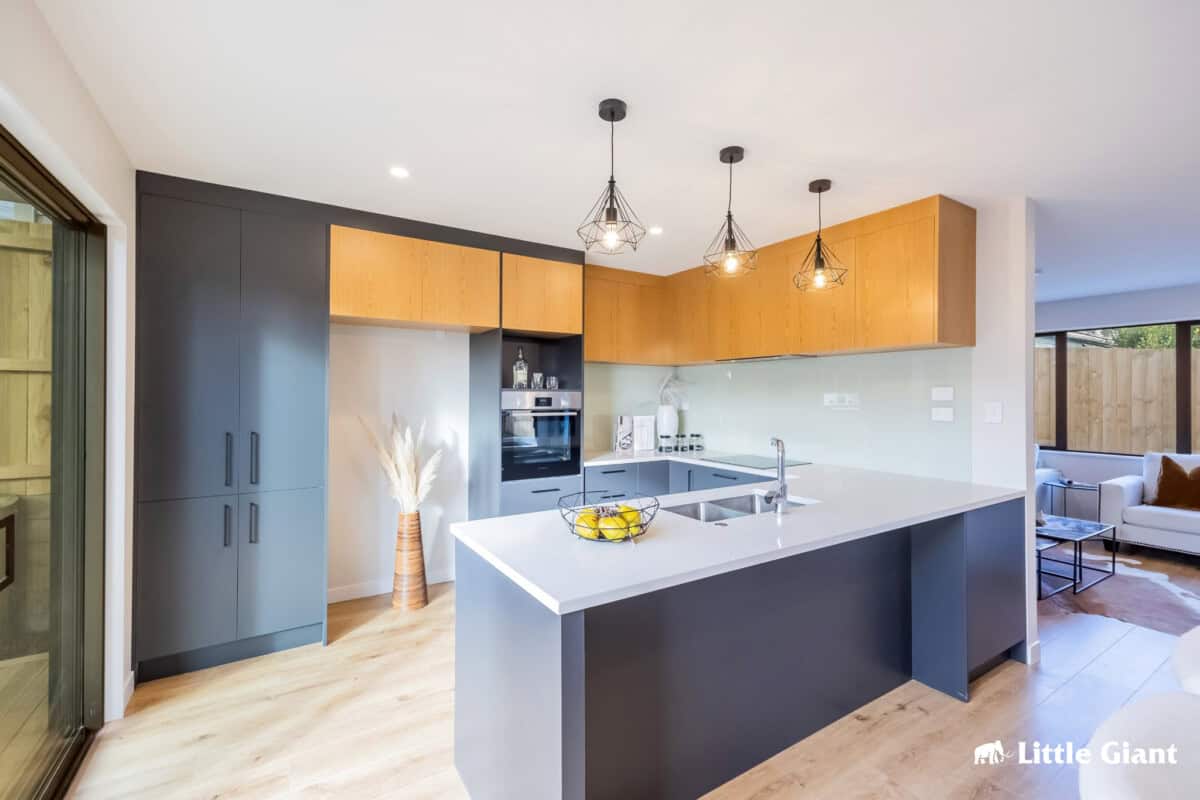
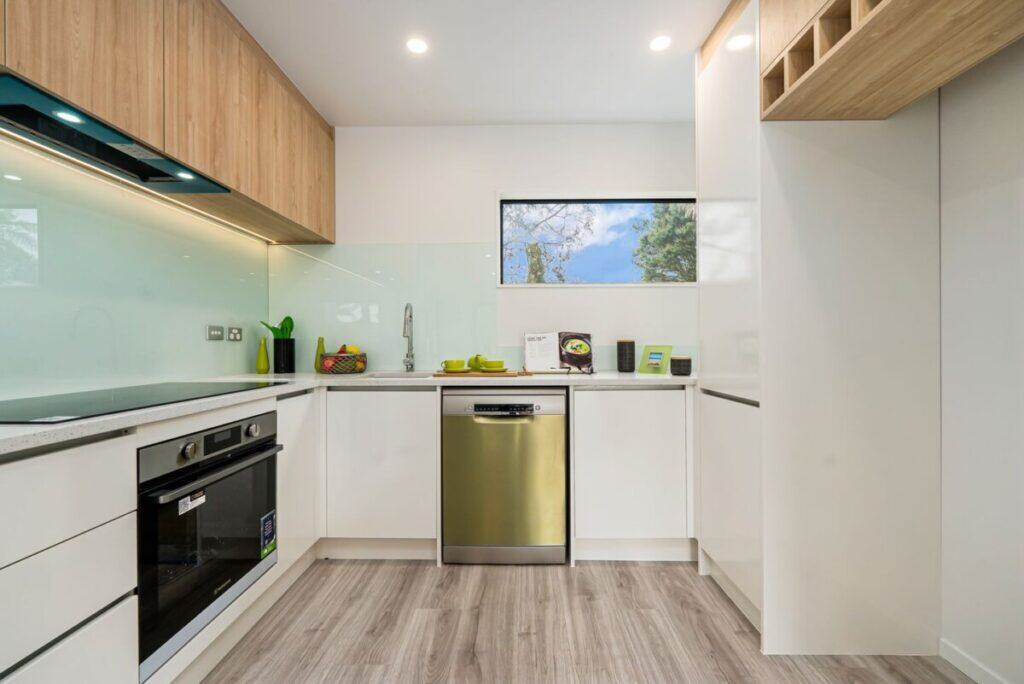
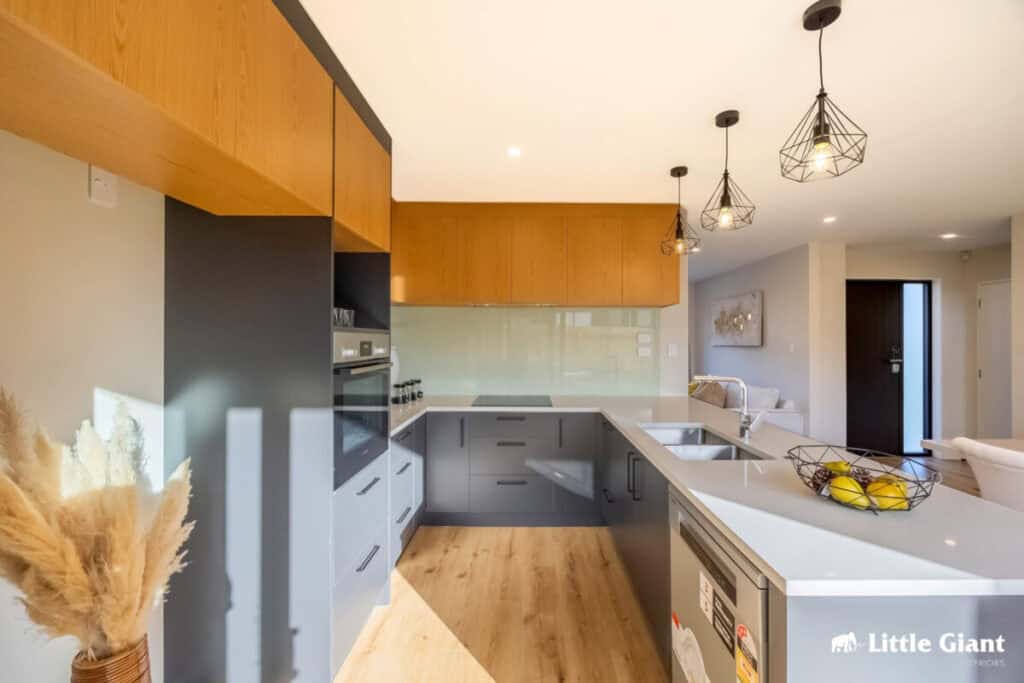
One small project we’ll point to: a tight footprint where the brief was proper storage and surface space without the room feeling boxed in. We used timber veneer on the overhead cabinets for a warm, earthy feel against a clean handleless base, an engineered stone benchtop, SPC waterproof flooring, and acrylic panels on the lower run. The footprint didn’t change — the way it worked did. If you’re weighing up your own layout, our tight, awkward Auckland kitchens are most of what we build service is built around exactly this kind of problem.
“Small kitchens win on layout, not size. A single-wall stack or a tight L-shape frees up the floor without touching a wall. We’ve built dozens of them across Ponsonby and Grey Lynn apartments, and the ones that work always start with the plan, not the finishes.”
, the Little Giant Interiors design team
Storage Ideas That Pull Their Weight in a Small Kitchen
Storage matters in any kitchen. In a small one it’s the difference between calm and chaos. Get the storage right and the kitchen feels twice the size it is; get it wrong and you’re stacking pots on the bench because there’s nowhere else for them. Here’s where we spend the most design effort on a compact kitchen.
Drawers beat fixed shelves, every time
A deep drawer shows you everything at once. A fixed shelf makes you crouch and dig to the back. In a small kitchen, swapping lower cupboards for full-extension drawers is the single best upgrade you can make. We build our drawer boxes with BLUM runners and soft-close as standard, so a loaded drawer of crockery glides shut instead of slamming — and because the cabinetry is cut and edge-banded on our German laser line, the boxes are square to the millimetre, which is what stops drawers dropping or rubbing a year down the track.
Sort the corners out
Dead corner cabinets waste serious space — you lose a whole chunk of cupboard to a black hole you can’t reach. A magic corner or a carousel pull-out drags that space back out into the open where you can actually use it. In a small kitchen, reclaiming a corner is like finding a cupboard you didn’t know you owned. The hardware does the heavy lifting here; the trick is specifying it before the cabinetry is built, not trying to retrofit it later.
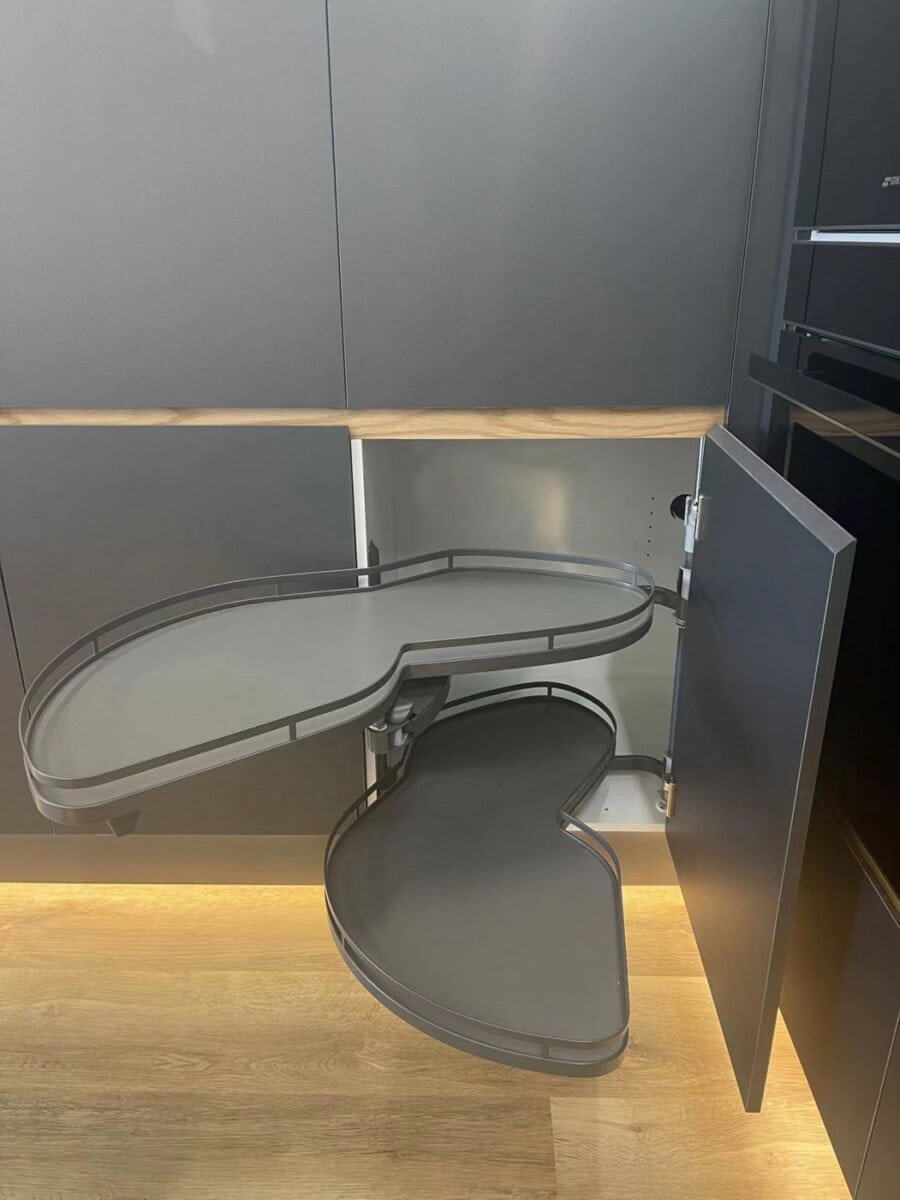
Divide the drawers, use the doors
A deep drawer with no dividers becomes a jumble within a week. Cutlery trays, peg-board dividers and knife blocks give everything a home, so you’re not rummaging. We’ll often build a narrow pull-out beside the cooktop just for oils and spices — a small move that clears the bench of clutter. The inside of cupboard doors earns its keep too: chopping-board racks, bin liners, a rail for tea towels.

Find storage where you’d least expect it
The best gains in a small kitchen often come from the spaces most people ignore. A tall pull-out larder packs a full pantry into a slot barely wider than a tea towel. An integrated bin system hides the rubbish and recycling inside a cabinet instead of parking a bin on the floor. Toe-kick drawers turn the dead gap under your base cabinets into a home for flat trays and platters — a whole drawer’s worth of storage you didn’t know you had. And an appliance garage, a cupboard at bench level with a roller or lift-up door, gets the toaster, kettle and coffee machine off the bench while keeping them plugged in and ready. In a small kitchen, every one of these is the difference between a clear bench and a cluttered one.
Go up the wall
Floor space is finite. Wall space usually isn’t. Cabinets to the ceiling, a rail of hooks, a shelf for the everyday gear — it all keeps the things you reach for daily within arm’s reach and off the bench. The top shelf of a ceiling-height cabinet is fine for the slow cooker you use twice a year; keep the prime real estate between knee and shoulder height for what you grab every day. If your storage problem spills past the kitchen, our wider custom cabinetry covers laundries, wardrobes and the rest of the house.
💡 Design tip: Be honest about what you actually own before we design the storage. We’d rather you tell us about the stand mixer, the air fryer and the 14 chopping boards up front than discover them on installation day. The storage plan is only as good as the inventory it’s built around.
How to Make a Small Kitchen Look Bigger
Light and colour do more for a small kitchen than almost anything else. Get them right and the room feels bigger than the tape measure says — no wall-moving required. A few moves carry most of the effect.
Light, reflective surfaces
Pale tones bounce light around; dark, matte surfaces soak it up. Whites, creams and soft greys on the walls and cabinets make a tight kitchen breathe. A polished engineered-stone or gloss-tile splashback throws daylight back into the room and adds a sense of depth that a flat matte finish can’t. We’d talk you out of a full mirror splashback — too much smudging and upkeep over a cooktop, but a gloss or satin finish on the upper cabinets gets you most of that lift, especially in a kitchen that doesn’t catch much sun.
Colour, used with intent
Light doesn’t have to mean bland. One considered accent — a splashback, the bar stools, a single feature run of colour, gives a small kitchen personality without closing it in. The discipline is restraint: one accent reads as designed, three reads as busy. If you’re stuck on where to start, our guide to kitchen colours NZ walks through palettes that suit Auckland homes and light.
Layer the lighting
One ceiling light won’t cut it in a small kitchen. You want layers: ambient light for the room, task light where you actually work, and a touch of accent to give it some warmth. Under-cabinet LED strips are the highest-value lighting move in a compact kitchen — they put light straight onto the bench where you prep, and they make the whole run feel deeper. Warm white around 2700K keeps the space cosy; if you want a crisper, more clinical feel, push toward 4000K. LED runs are efficient and last for years, so it’s a once-and-done job.
Integrate the appliances
Exposed appliances and bench clutter make a small kitchen feel closed-in and, frankly, smaller than it is. Running cabinetry over the dishwasher and fridge so they sit flush with the joinery calms the whole run down. A small kitchen that reads as one clean, continuous surface feels bigger than the same kitchen broken up by a fridge that sticks out and a microwave parked on the bench. Give the small appliances a cupboard home and let the eye travel without interruption.
Choose appliances that fit the footprint
Standard-depth appliances eat a small kitchen alive. The fix is to choose gear scaled to the room. A combination oven-microwave does two jobs in the space of one. A slim 450mm dishwasher, or a single Fisher & Paykel DishDrawer, suits a household that doesn’t run a full load every night. Induction cooktops sit flush and free up the bench when they’re off, and an integrated fridge disappears behind a cabinet door so the run stays unbroken. Going compact doesn’t mean going without — it means matching the appliance to the footprint instead of forcing a full-size kitchen’s gear into a quarter of the room.
Fold-away and mobile pieces
A small kitchen earns its keep when it changes shape to suit the moment. A wall-mounted table that folds flat frees the floor when you’re done eating. A mobile island gives you prep space, storage and seating you can roll out of the way when you need the room back. The point of both is the same: you reconfigure the space around the task instead of building the space around the worst-case crowd.
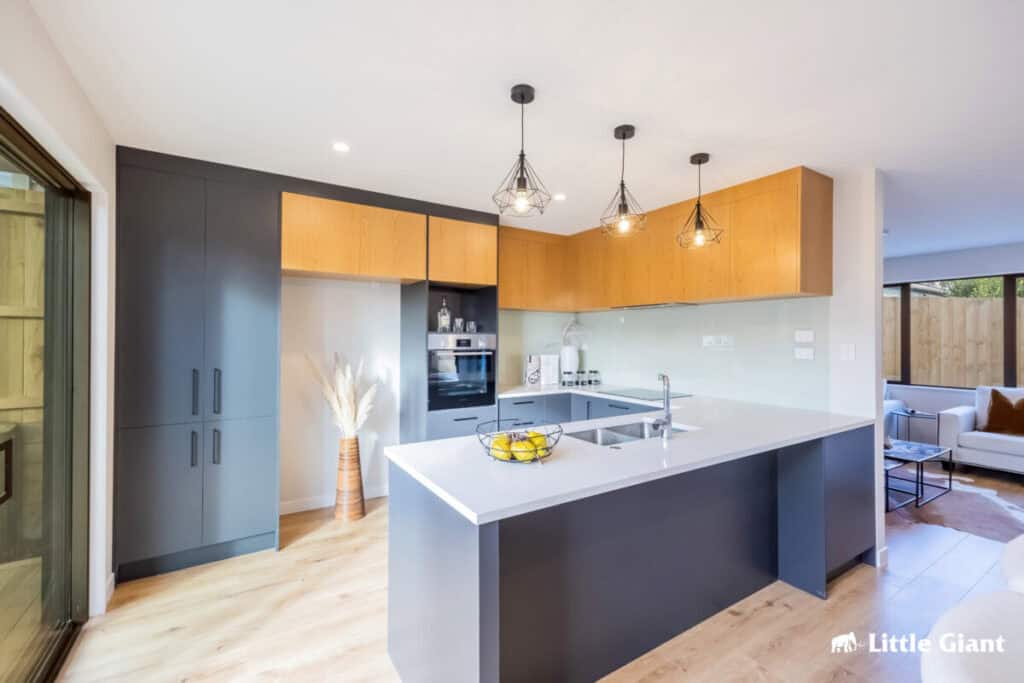
💡 Design tip: Keep the window clear. In a small kitchen, natural daylight is the cheapest way to make the space feel open — so resist the urge to fill the only window wall with overhead cabinets. We’ll work the storage around the light, not over it.
Small Kitchen Ideas by Auckland Home Type
A small kitchen in a 1910 villa is a different problem from a small kitchen in a 2022 apartment, even when the floor area is identical. The building you’re in shapes what’s possible — the walls you can touch, the ventilation you’re stuck with, the character you want to keep. Here’s how we approach the four most common Auckland situations.
Apartments, CBD, Britomart, Takapuna
Apartment kitchens come with hard constraints. The walls are usually concrete, so anything that fixes to them needs masonry anchors, not a couple of screws into GIB. There’s often only one external wall, which limits where the ventilation can go — and under the Building Code’s natural-ventilation rules for single-wall units, that’s a real design factor, not an afterthought. A single-wall or galley layout with everything integrated is almost always the right answer in an apartment, because it keeps the run tight and the sightlines clean. Body corporate rules can also dictate what you’re allowed to change, so it pays to check before you design, not after.
Villas and bungalows, Mt Eden, Ponsonby, Grey Lynn, Herne Bay
Character homes are our favourite small-kitchen puzzle. The kitchen is usually small because it was originally a service room, tucked at the back, with a separate scullery doing the heavy lifting. The floors slope, the walls aren’t square, and the ceilings are high. An L-shape that takes the cabinetry right up to those high ceilings gives you serious storage while keeping the character intact, and a reinstated scullery often solves the storage problem the original house already knew how to solve. The trick is marrying modern function — soft-close drawers, integrated appliances, sealed stone, to a room with period bones, so it feels like it belongs rather than like a kitchen dropped in from a showroom.

Townhouses — Parnell, Hobsonville, the inner suburbs
The modern townhouse kitchen is built to maximise the section, which usually means a narrow footprint open to the living area. Vertical is your friend here: cabinets to the ceiling, a galley or single-wall run, and integrated appliances so the kitchen reads as part of the living space rather than a separate cramped room. Because the kitchen is on show in an open-plan townhouse, the finish matters as much as the function — a clean, handleless run in a calm palette stops the kitchen shouting across the living room.
New builds and subdivisions, Flat Bush, Hobsonville, Millwater, Albany
New homes in Auckland’s growth suburbs usually arrive with a builder’s-grade kitchen — functional, but built to a price and rarely making the most of the space. That’s an opportunity. Swapping a standard builder’s kitchen for custom cabinetry is where you claw back the wasted fillers and dead corners that off-the-shelf cabinetry leaves behind, and it’s often the single change that lifts a new build from generic to genuinely yours. If you’re early enough in the build, we can design the cabinetry before the room is finished, which is the cleanest way to do it. Our drawn, cut and fitted to the room you actually have service covers all four of these situations.
💡 Design tip: If you’re in an apartment or a body-corporate townhouse, find out what you’re allowed to change before you fall in love with a design, relocating plumbing, altering ventilation, or touching common walls can need sign-off. We’d rather design within the real constraints from day one than redraw it later.
Materials That Survive an Auckland Kitchen
Auckland’s humidity is hard on the wrong materials, and if you’re near the water in Takapuna or Devonport, the salt air adds to it. In a small kitchen every surface is close at hand and getting touched constantly, so durability isn’t a nice-to-have — it’s the whole game. These are the materials we keep coming back to, and why.
Benchtops
Sealed engineered stone — Caesarstone and the like, is our default for a small kitchen benchtop. It’s non-porous, so it doesn’t drink up moisture or stain the way an unsealed surface does, and a matte finish hides the day-to-day marks. Laminate from Laminex is the budget-friendly option and has come a long way on looks; timber brings warmth but wants more care in a humid kitchen. Whatever you choose, sealing the edges is what keeps moisture out, an exposed, unsealed edge is where benchtops fail first.
Splashbacks and floors
Porcelain tile is a workhorse on both the wall and the floor — textured for non-slip underfoot, easy to wipe down behind the cooktop. The splash zone around a sink and cooktop is exactly where the Building Code cares about surfaces. New Zealand Building Code clause E3 requires surfaces in wet areas to be impervious and easily cleaned, which is the formal reason a sealed, wipeable splashback beats a porous one in a kitchen. Seal the grout to keep mould at bay and it’ll stay looking right for years.
Cabinetry
For the carcasses and doors, sealed-edge melamine or laminate boards — Melteca, Laminex, and the like, handle indoor humidity well and come in matte neutrals that bounce light around a small room. The detail that decides how long they last is the edge. Our cabinetry is edge-banded on a German laser line, which fuses the edge tape to the board with no glue line for moisture to creep into, the single biggest reason cheap cabinetry swells and peels in an Auckland kitchen. Hardware-wise, we build with BLUM and Häfele runners and hinges, soft-close as standard.
Don’t forget the ventilation
Materials only last if the moisture has somewhere to go. A small kitchen with no airflow traps steam and grease, and that’s what ages your cabinetry and grout prematurely. The Building Code takes this seriously: clause G4 requires kitchens to be ventilated, and where you use mechanical extract over a cooktop, it has to exhaust outside at no less than 50 litres per second. Natural ventilation needs openable windows or vents totalling at least 5% of the floor area. It’s not just compliance — BRANZ research has found roughly a third of New Zealand homes are under-ventilated, and a kitchen is the worst room to get it wrong in.
💡 Design tip: In an older Grey Lynn or Mt Eden villa, expect the floor to slope and the walls to be anything but square, they almost never are. That’s not a problem if your installer laser-levels the runs and scribes the cabinetry to the wall. It’s a problem if they don’t.
“In the Remuera and Mt Eden villas we laser-level every run and seal every edge before it leaves the floor. That’s what stops the warping and the dropped drawers you’d otherwise get through a humid Auckland summer. The finish you see is only as good as the prep you don’t.”
— the Little Giant Interiors design team
Keeping a Small Kitchen Looking Right
A small kitchen shows wear faster than a large one for the simple reason that every surface gets used. Our kitchen cabinet care guide covers what is safe on each finish, and the routine below is the short version.
A small kitchen gets used hard — every surface is within reach and getting touched, splashed and leaned on constantly. The upside of a compact kitchen is that maintenance is quick; the downside is that wear shows faster because there’s nowhere for it to hide. A little routine keeps it looking the way it did on handover day.
The simple routine
Most of it is light-touch. A wipe-down of the benchtop and splashback as you go, a proper clean of the cabinet fronts every month or so, and you’re most of the way there. Sealed engineered stone only needs warm soapy water — skip the harsh abrasives and bleach, which can dull the finish over time. Give the soft-close hinges and runners a check once or twice a year; a tiny amount of the right lubricant keeps everything gliding, and it’s a five-minute job that adds years to the hardware. If you’ve gone with a timber or timber-look element, keep an eye on the sealing and refresh it when it starts to look tired.
The two failures we see most
After years of building and installing small kitchens across Auckland, two problems come up again and again — and both are avoidable at the spec stage. The first is warping and swelling in unsealed or poorly edge-banded board, which our humid summers expose ruthlessly; it’s the single best argument for sealed edges and laser edge-banding rather than the cheapest board on the shelf. The second is drawers sagging or dropping because they’ve been overloaded onto runners that were never rated for the weight, the fix is specifying proper full-extension hardware up front, not discovering the limit with a drawer full of crockery. Get the spec right at the start and a small kitchen will hold up for 15 to 20 years without drama.
💡 Design tip: Keep a small offcut of your benchtop and a spare cabinet door from the build. If you ever need to test a cleaning product or colour-match a repair down the track, you’ll be glad you did, it’s the kind of thing nobody thinks of until they need it.
What a Small Kitchen Costs in Auckland
Cost comes down to layout, size and materials, so treat these as ballpark ranges to set expectations rather than a quote. A small kitchen costs less than a large one in raw materials, but the design thinking per square metre is often higher — because every centimetre has to earn its place. Here’s a rough breakdown for an Auckland small kitchen.
| Scope | Indicative Auckland range (NZD) | What’s included |
|---|---|---|
| DIY bench and sink swap | $900 – $2,200 | Surface and sink only, your own labour |
| Full custom cabinetry | $5,000 – $13,000 | Made-to-measure cabinetry, hardware, soft-close |
| Professional install | $1,800 – $4,500 | Removal, fit, levelling, finishing |
| Sealed stone benchtop | $900 – $3,200 | Engineered stone, small-kitchen run |
| Extractor / rangehood | $250 – $450 | Meets G4 ventilation when ducted outside |
To put real numbers on it, here’s how three common Auckland small kitchens tend to land: a single-wall Britomart apartment kitchen around 4m² sits roughly $3,200–$7,000; an L-shaped Mt Eden villa kitchen around 8m² runs about $6,000–$12,000; and a long Grey Lynn galley lands somewhere near $4,500–$10,000. Every one of those moves with your material choices and the condition of the room behind the old kitchen. For your own number, the kitchen cabinetry cost calculator emails you a baseline after a few questions, and we firm it up at the site visit.
Small kitchen ideas that don’t cost the earth
Custom doesn’t have to mean maxed-out. A small footprint is actually where a tighter budget stretches furthest, because there’s less of everything to pay for. The biggest lever is keeping the existing layout: if the sink and the plumbing stay where they are, you save the cost and the consent headache of moving services, and you put that money into the cabinetry and the benchtop where it shows.
The other levers are about where you spend. A quality laminate benchtop from Laminex looks sharp and costs a fraction of stone, so you can put the saving toward soft-close drawers that you’ll feel every day. A mix of open shelving and closed cabinetry costs less than a full wall of doors and keeps a small kitchen feeling open. And a phased approach — do the cabinetry and benchtop now, add the splashback or the feature lighting later, gets you a working custom kitchen without the whole spend landing at once. Our affordable kitchens Auckland page is built around exactly this: a custom result, spec’d smartly to the budget, rather than a flat-pack compromise.
We’ll be upfront — custom cabinetry isn’t the cheapest way to do a kitchen. But a well-designed small kitchen with smart storage and surfaces that don’t date reads as “ready to live in” to a buyer, and in suburbs like Ponsonby, Remuera and Herne Bay that’s a genuine selling point. If the budget is the sticking point rather than the design, our interest-free finance options spread the cost so you’re not putting the project off for another two years.
💡 Design tip: The calculator gives you a baseline. The site visit is where we catch the quirks, a sloping villa floor, a concrete apartment wall, an old waste pipe in the wrong spot, that change the real number. Budget a little contingency for the things no one can see until the old kitchen comes out.
The Small Kitchen Mistakes We See Most in Auckland
A handful of avoidable errors make a tight kitchen tighter. Most of them cost nothing to avoid at the design stage and a fortune to fix afterwards. These are the ones we run into again and again.
- Not measuring properly. Length, width, height — plus the position of doorways, windows, plumbing and the meter box. Everything downstream depends on getting this right first.
- Ignoring the work triangle. The path between sink, cooktop and fridge matters more in a small kitchen, not less. Keep the three close so you’re not crossing the room mid-cook.
- Skimping on ventilation. Poor airflow means lingering smells, grease build-up and tired cabinetry. A properly ducted rangehood that meets G4 clears it before it settles.
- Forgetting clearances. Aim for at least 90cm to a metre between opposing benchtops so doors and drawers open without a fight and two people can pass.
- Underestimating storage. Be honest about what you own and how you cook. Pull-out drawers, a tall pantry and vertical organisers earn their place fast in a small kitchen.
- Getting the scale wrong. Slim-line appliances and smaller-footprint furniture keep the room open. Oversized gear swallows a small kitchen whole.
- Skipping accessibility. Lower-set cabinets, pull-out shelves in the deep cupboards and clear floor space make the kitchen work for everyone who uses it.
- Too many closed cabinets. Storage is vital, but a solid wall of doors can feel boxed-in. A little open shelving or a glass-front cabinet lifts the room.
- Choosing looks over function. A small kitchen has to work hard. Durable, easy-clean surfaces and hardware that’s comfortable to use win over the long run.
- Going it completely alone. DIY has its place, but a designer who works in small kitchens daily will spot the layout gains — and the costly mistakes, before they happen.
Want to go deeper on the detail? Two of our guides pair well with this one: kitchen colours NZ for getting the palette right, and our rundown of kitchen cabinetry materials for choosing what your doors and benchtops are actually made of.
Small Kitchen Ideas, Built in Our Auckland Factory
We know the constraints of a small Auckland kitchen because we design and build them constantly — in apartments, villas and townhouses right across the city. Everything is made to measure in our own 700m² Rosedale factory on a German laser line, so the cabinetry that turns up on installation day is square, sealed and built for the room it’s going into, not pulled off a shelf and made to fit.
Every project starts with a free in-home consultation and a complimentary 3D design render, runs through our design and build process from estimate to handover on a fixed-price contract, and is backed by real warranty cover — a 10-year warranty on Laminex surfaces, lifetime cover on BLUM and Hettich mechanical hardware, and a 5-year guarantee on our installation. If your small kitchen is part of a bigger renovation, a full home, a bathroom, an extension, our group company Superior Renovations handles the build while we handle the cabinetry, so it’s one accountable team across the lot. If you are weighing two or three quotes for the same small kitchen, our guide to comparing kitchen quotes in New Zealand sets out what has to be held constant for the comparison to mean anything. Start with the numbers, then talk to us about the layout.
➡ Book your free in-home design consultation with Little Giant Interiors
➡ See how our design and build process works
➡ See how we plan a small kitchen from the first measure
What is the best layout for a small kitchen in Auckland?
For apartments under about 6m², a single-wall layout with stacked appliances, a pull-out bench and vertical storage works best. For villas and townhouses around 6–10m², an L-shape with a corner sink and ceiling-height cabinets makes the most of the footprint. Long, narrow rooms — common in Ponsonby and Parnell, suit a galley layout with parallel benches. The right choice comes down to the shape of the room and the building you're in.
How much does a small kitchen cost in Auckland?
As a guide, a DIY bench and sink swap runs around $900–$2,200, full custom cabinetry sits between $5,000 and $13,000, and a professional install adds roughly $1,800–$4,500. A sealed stone benchtop for a small run is about $900–$3,200. The final figure depends on your layout, size and materials, so our kitchen cabinetry cost calculator emails you a baseline after a few questions and we firm it up at the site visit.
How do I make a small kitchen look bigger?
Run the cabinets to the ceiling, keep the palette light and reflective, layer in under-cabinet LED lighting, and use a gloss or polished splashback to bounce daylight around. Integrating the appliances behind flush joinery makes the run read as one calm, continuous surface, which feels larger than a kitchen broken up by a protruding fridge and bench clutter. Keeping the window clear of overhead cabinets helps most of all.
What materials hold up best in an Auckland kitchen?
Sealed engineered stone benchtops, porcelain tile splashbacks and floors, stainless steel sinks, and moisture-resistant sealed-edge cabinetry. Auckland's humidity and coastal salt air are hard on anything unsealed, so sealing edges and grout is what makes a kitchen last. Building Code clause E3 requires surfaces in wet areas to be impervious and easily cleaned, which is the formal reason a sealed, wipeable splashback is the right call over a porous one.
Do I need building consent for a small kitchen renovation?
A like-for-like kitchen refit usually doesn't need building consent, but work that involves structural changes, relocating plumbing or drainage, or altering load-bearing walls often does. Always check with Auckland Council before you start. We can tell you where your project is likely to sit during the design stage so there are no surprises once the work begins.
What is the minimum clearance between benchtops in a small kitchen?
Aim for at least 90cm to a metre between opposing benchtops so cabinet doors, drawers and appliance doors open comfortably and more than one person can move through. Tighter than that and the kitchen starts to feel cramped in everyday use, and you end up doing a constant shuffle every time someone opens the dishwasher or the oven.
Is an island a good idea in a small kitchen?
A fixed island often eats too much floor in a small kitchen and chokes the walkways. A mobile island is usually the smarter move, it gives you prep space, storage and seating you can roll out of the way when you need the floor back. If you're set on a fixed island, the room generally needs to be larger than people expect to keep the clearances workable.
How does ventilation work in a small kitchen?
A small kitchen needs proper airflow to clear steam and grease before it ages your cabinetry and grout. Building Code clause G4 requires kitchens to be ventilated, and mechanical extract over a cooktop must exhaust outside at no less than 50 litres per second. Natural ventilation needs openable windows or vents of at least 5% of the floor area. A ducted rangehood that vents outside, not a recirculating one, is the reliable option.
How long does a small kitchen renovation take?
Once the design is signed off and the cabinetry is manufactured, a small kitchen install is generally quicker than a large one, typically a matter of weeks rather than months, depending on scope and any structural or plumbing work. Because we manufacture in our own Auckland factory, lead times are tighter than relying on imported cabinetry. We give you a clear schedule at the design stage rather than a generic guess.
Are custom cabinets worth it in a small kitchen?
In a small kitchen, yes, more so than in a large one. Off-the-shelf cabinetry comes in fixed sizes, so you lose space to fillers and awkward gaps. Custom cabinetry is built to the exact dimensions of your room, which is where the storage gains in a tight space come from. It also lets you specify the corner solutions, pull-outs and ceiling-height runs that make a small kitchen work. We build every cabinet to measure in our Rosedale factory.
What size counts as a small kitchen in New Zealand?
There is no official definition, so we work from floor area rather than a label. Under about 5 square metres you are realistically looking at a single-wall run, which is most studio and one-bedroom apartments. Roughly 5 to 8 square metres opens up an L-shape or a galley, and that band covers most villa and townhouse kitchens in Auckland. From about 8 to 12 square metres a U-shape or a small peninsula becomes possible. The number that matters more than total area is the clear floor width between opposing runs, because that is what sets whether two people can be in the room at once.
What are the standard kitchen cabinet sizes in NZ?
Off-the-shelf ranges work in fixed module widths. Kaboodle, the flatpack range sold through Bunnings in New Zealand, publishes base cabinets at 150, 300, 400, 450, 600, 800, 900 and 1000mm. Because walls rarely land on those numbers, the leftover becomes a filler panel, and in a small kitchen those fillers add up to storage you have paid for and cannot use. Custom cabinetry is built to the measured opening instead, which is where most of the storage gain in a small kitchen comes from rather than from any clever accessory.
What is the difference between a small kitchen and a kitchenette?
A kitchenette is a single run with one bench, one sink, an under-bench or bar fridge and either a two-burner cooktop or a benchtop appliance rather than a full oven. Below about four square metres that is usually what the space will actually take. The design discipline changes with it: there is no work triangle, so you plan by sequence instead, running fridge, bench, sink, cooktop in one direction. Kitchenettes turn up most often in studios, sleepouts, minor dwellings and office tea points. If the kitchenette is going into a new minor dwelling rather than an existing room, ask a Licensed Building Practitioner or Auckland Council about consent before the cabinetry is drawn.
What kitchen layout works best in a long narrow room?
A galley, meaning two parallel runs, if the room is wide enough to keep a clear walkway between them, and a single-wall run with a tall bank of storage at one end if it is not. The mistake we see most in narrow rooms is splitting the two runs unevenly, so one side ends up too shallow to be useful. Keep the working side at full bench depth and use the opposite wall for tall storage or a shallower run of drawers rather than trying to make both sides do the same job.
Can you fit a dishwasher and a full oven into a small Auckland kitchen?
Usually yes, but not both plus everything else, and that is the honest conversation to have early. In a small kitchen every appliance you commit to removes a cabinet bay. A dishwasher takes a 600mm bay, a freestanding cooker takes another, and a tall fridge takes a third. Once you have spent three bays out of six or seven, storage becomes the constraint. The two swaps that free up the most space are a slimline dishwasher drawer instead of a full unit, and a wall oven stacked over a warming drawer instead of a freestanding range. Decide the appliance list before the layout, not after.
Have you been putting off your kitchen renovation?
We offer flexible finance options to help you get your dream kitchen sooner. Learn more about our interest-free finance options.