

Last updated:
Wardrobe Cost Calculator NZ: Estimate Your Wardrobe Price in 2 Minutes
Quick answer: Our free wardrobe cost calculator NZ gives you a ballpark in about two minutes. As a guide, wardrobes in Auckland run from around $1,800 for a basic built-in to $20,000+ for a full walk-in — size, materials, hardware and layout do most of the moving.
Wardrobes are one of the few things in a house with no sticker price. You know roughly what a fridge costs, or a couch, or a new oven. A wardrobe? People have no idea — and that’s exactly why you’ve landed here.
So we built a calculator to give you a number. It won’t replace a proper quote, but it’ll get you in the right ballpark before you commit to anything. Punch in your space, your door style and your fit-out, and you’ll see roughly where your project sits. Most people are surprised in both directions — a tidy built-in is cheaper than they feared, and a fully kitted walk-in is more than they hoped.
We’re custom wardrobe makers in Auckland — we design, build and install from our own 700m² factory — so the figures below come from real jobs, not a guess off the internet. Below the calculator, we’ll walk you through what actually drives the price, what each calculator question is really asking, and when a rough estimate stops being enough.
➡ Take me straight to the wardrobe cost calculator
How Much Does a Wardrobe Cost in NZ? (2026 Price Bands)
Let’s start with the honest version: “it depends” is true, but useless when you’re trying to set a budget. So here’s where wardrobes actually land in Auckland right now, based on the projects we quote and build week to week.
Across the board, expect somewhere between $1,800 and $20,000-plus. That’s a huge range, and the reason it’s so wide is that a “wardrobe” can mean a 1.8m reach-in behind a couple of sliding doors, or a walk-in dressing room with drawers, shelving towers, a dresser and integrated lighting. Same word, very different builds.
Here’s how the three common tiers break down. These are guide figures for a fitted, installed wardrobe — not flat-pack you assemble yourself.
| Wardrobe type | Typical Auckland range (2026) | What you get |
|---|---|---|
| Reach-in / standard built-in | $1,800 – $4,500 | 1.8–2.4m wide, melamine carcass, sliding or hinged doors, basic shelf-and-rail fit-out |
| Mid-range built-in | $4,500 – $9,000 | Full-height, soft-close drawers, better internal layout, upgraded door finish |
| Walk-in / dressing room | $9,000 – $20,000+ | Custom joinery on multiple walls, drawer banks, shelving towers, premium hardware, lighting |
| Most common LGI job | $5,000 – $11,000 | A considered built-in or modest walk-in, soft-close throughout |
Important note: The calculator works on averages and assumes a fairly standard build. Treat the number as a research figure, not a budget you commit to. An accurate price needs someone on site with a tape measure.
Why the range is so wide
Two wardrobes the same width can quote thousands apart. We see it all the time. The difference is almost never the box — it’s what goes inside and how the doors work. A reach-in with two shelves and a rail is a quick build. The same opening, fitted with a six-drawer bank, a shoe rack, double-hang rails and soft-close runners, is a different animal entirely.
Auckland’s housing stock pushes this around too. A 1970s brick-and-tile in Pakuranga usually has square, generous bedrooms that take a standard built-in nicely. A villa in Ponsonby or a bungalow in Mt Eden often has a sloping ceiling, a chimney breast or a weird nook — and custom joinery to work around it costs more than a straight run. Sound familiar?
💡 Design tip: Before you price anything, measure the wall width and ceiling height, and note any obstacles — skirting, architraves, a sloping ceiling. Those three numbers change a quote more than the door colour ever will.
What Our Wardrobe Cost Calculator Asks — and Why Each Answer Moves the Price
The wardrobe cost calculator asks a handful of simple questions. Each one maps to a real cost driver, and knowing why helps you read your estimate properly instead of just staring at the total. Here’s what’s going on under the hood.
1. Size and layout
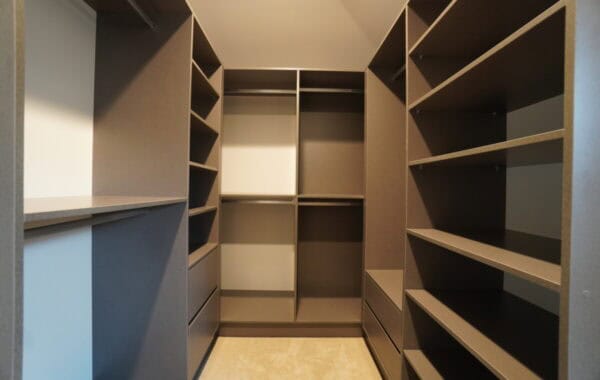
Width is the obvious one — more linear metres, more materials and labour. But layout matters just as much. A single straight run is the cheapest shape; an L-return or a U-shaped walk-in adds corners, and corners are where time and money go.
As a rough planning rule, allow a minimum of 1.8m of wall for a usable reach-in, and around 2.4m of wall space per person for a walk-in. Hanging needs about 600mm of depth for the clothes, plus a bit for access — so a wardrobe shallower than 700mm starts to compromise. A client in Hobsonville recently wanted a walk-in squeezed into a 1.9m alcove; it worked, but only by going to floor-to-ceiling shelving on one wall and dropping the second hang rail.
2. Carcass and door material
The carcass — the box itself — is usually melamine board, and that’s the sensible default. It’s tough, moisture-tolerant and comes in dozens of finishes. We mostly use Melteca and Laminex boards, which carry long manufacturer warranties and hold up to NZ humidity well.
Doors are where the price climbs. A flat melamine sliding door is the budget-friendly choice. Step up to a profiled or painted door, a mirrored slider, or a thermoformed finish and the cost rises with it. Glass and aluminium-framed doors sit at the top. The board you choose for the carcass barely moves the needle next to the door decision.
💡 Design tip: Spend on the doors and the drawer fronts — the bits you see and touch every day — and keep the internal carcass to a good-value melamine. That’s where the money earns its keep.
3. Hardware and mechanisms
This is the quiet cost that catches people out. Hinges, runners and sliding gear are easy to ignore on a drawing, but they add up fast across a full wardrobe — and they’re the difference between something that feels cheap and something that feels built to last.
We run soft-close hardware as standard, mostly BLUM runners and hinges, with Häfele for sliding systems and specialty fittings. A six-drawer bank on soft-close runners costs real money. So do pull-out shoe racks, soft-close sliding doors and a lift-up valet rail. None of it is essential. All of it is nice. Hardware can swing a wardrobe by $1,500 or more on its own.
4. Internal fit-out
An empty box is cheap. A box that actually organises your life costs more, because every drawer, shelf, basket and rail is more material and more labour. The trick is matching the fit-out to what you own. Long dresses need full-height hanging; shirts and folded clothes want shelves and drawers; shoes want their own home or they end up on the floor.
Over-speccing the inside is the most common budget blowout we see. People tick every option in the calculator, then wonder why the number jumped. You rarely need all of it — you need the right bits for your gear.
Reach-In, Built-In or Walk-In: What You’re Actually Pricing
Before you trust any estimate, it helps to know which of these you’re actually buying — because they sit in very different price brackets and the calculator treats them differently.
Reach-in and standard built-in
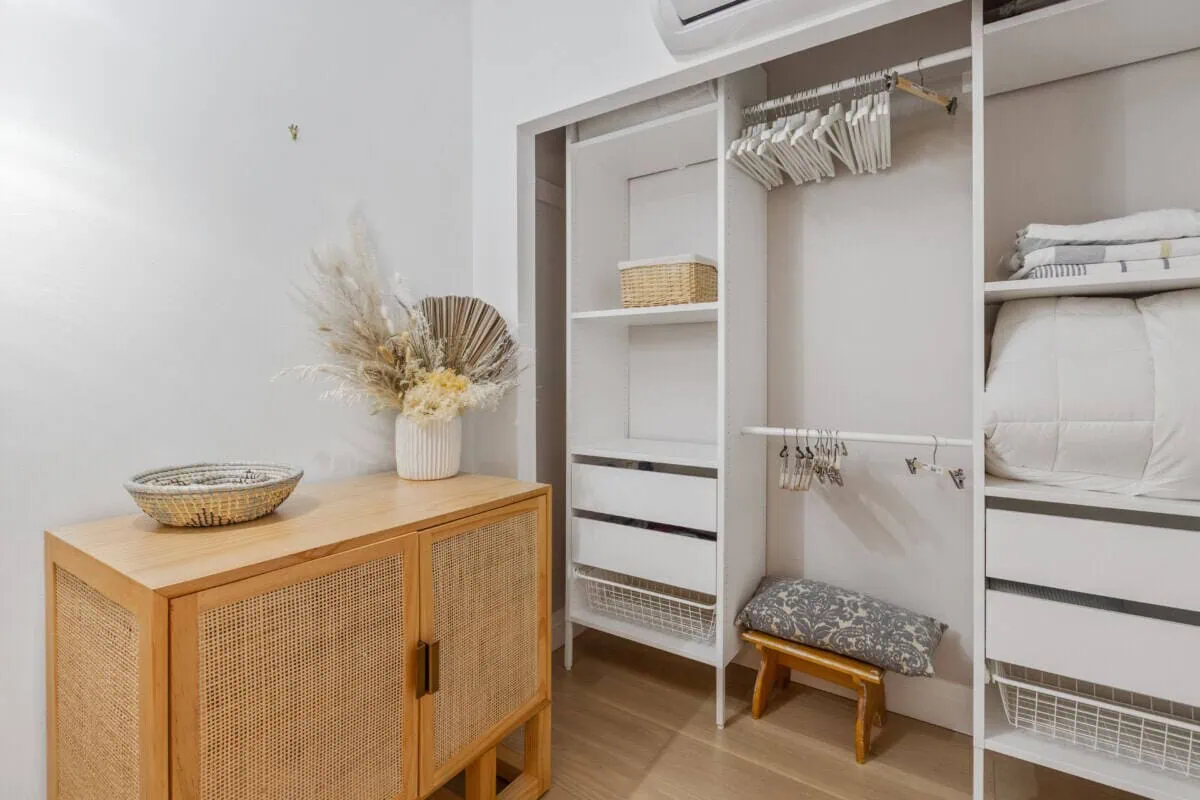
This is the everyday Kiwi wardrobe: a recess in the bedroom wall, fitted with shelving, a rail or two and a set of doors. It’s the most cost-effective option and the right call for most bedrooms, especially in newer subdivisions out at Flat Bush or Albany where the rooms are already built to take one. If you just want tidy, functional storage that looks sharp, a built-in is almost always the smart spend.
Walk-in wardrobe and dressing room
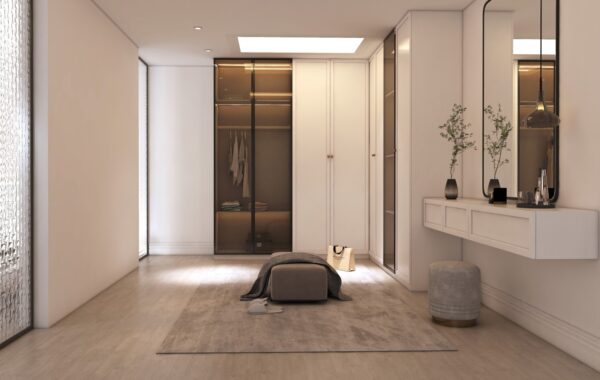
A walk-in is a small room you stand inside, with joinery on two or three walls. It’s the dream for a lot of people — and it’s where budgets stretch, because you’re often pricing joinery on multiple walls plus drawers, shelving towers and lighting. We did a walk-in for a renovated villa in Remuera last year that came in near the top of the range, mostly because the owners wanted a full dresser island and feature lighting. Worth it for them. Not for everyone.
“The honest truth is most people don’t need a walk-in — they need a well-designed built-in. We’ve watched clients halve their budget and end up happier, because a smart internal layout beats square metres every time.”
— Little Giant Interiors Design Team
Where the calculator fits in
Pick your type, answer honestly about the fit-out, and the calculator gives you a figure that’s genuinely close for a standard build. It’s the fastest way to find out whether your idea matches your budget before anyone visits. If you want the long version of how these numbers are built up — materials, labour, regional differences — we’ve laid it all out in our full custom wardrobe cost breakdown.
➡ Run your numbers through the wardrobe cost calculator
Using the Wardrobe Cost Calculator NZ (and What It Can’t Tell You)
The calculator is built to be quick. Three or four answers and you’ve got a number. Here’s how to get the most honest result out of it — and where it stops.
How to get an accurate estimate
Measure first. A rough guess at the width throws everything off, so grab a tape and get the wall measurement and ceiling height before you start. Then be realistic about the fit-out — tick what you’ll actually use, not the full wish list. Garbage in, garbage out applies to wardrobes as much as anything.
What the calculator can’t see
A tool can’t spot the things that move a real quote. It doesn’t know your villa has a 1920s skirting board that needs scribing around, or that your apartment in the city has a body corporate rule about drilling into a shared wall, or that the floor in your Grey Lynn do-up slopes by 15mm. Those are the details our designer picks up in five minutes on site — and they’re the difference between an estimate and a quote you can sign.
That’s also why we don’t charge for the visit. You get a free in-home consultation, a preliminary 3D design, and a fixed-price estimate broken down line by line. No surprises later. If you want to see how the whole thing runs from first measure to install, our 6-step design and build process lays out every stage.
💡 Design tip: Use the calculator to sanity-check your idea, then book the free consultation to lock in a real number. The estimate tells you if you’re in the game; the consult tells you the score.
While you’re sorting storage
If the wardrobe’s part of a bigger tidy-up, the same thinking applies to the rest of the house. Plenty of our wardrobe clients come back for their laundry once they’ve seen what proper cabinetry does to a room — our laundry cabinet NZ ideas are a good place to start if that’s on your list. And because we design, manufacture and install everything in-house, doing two rooms together usually works out tidier than two separate jobs.
Get a Real Number, Not Just a Calculator Estimate
The calculator gets you a ballpark in two minutes, and for a lot of people that’s enough to decide whether to go ahead. But a wardrobe is a fitted thing, built to your walls and your gear, and the only way to get a price you can rely on is to have someone measure up and talk it through. That part’s free, and there’s no obligation to go further.
We’re an Auckland custom cabinetry company — kitchens, wardrobes, laundries and more — building from our own factory with German laser technology so the finish is precise every time. Whether you’re after a simple built-in in a North Shore townhouse or a full walk-in in a Herne Bay renovation, we’ll design it around your space and quote it fixed.
➡ Book your free in-home design consultation with Little Giant Interiors
➡ Try the wardrobe cost calculator
➡ Learn more about our custom wardrobes in Auckland
How much does a wardrobe cost in NZ?
A fitted wardrobe in Auckland typically costs between $1,800 and $20,000-plus. A basic reach-in or standard built-in (1.8–2.4m, melamine, basic fit-out) runs roughly $1,800–$4,500; a mid-range full-height built-in with soft-close drawers sits around $4,500–$9,000; and a custom walk-in or dressing room runs $9,000–$20,000-plus. Size, door style, hardware and internal fit-out drive most of the difference. Our free wardrobe cost calculator gives you a tailored ballpark in about two minutes.
Is the wardrobe cost calculator free to use?
Yes. The Little Giant Interiors wardrobe cost calculator is free, takes about two minutes, and asks nothing more than your space, door style and fit-out. It gives you a rough estimate for research only — it's not a quote and shouldn't be used for final budgeting. For an accurate, fixed price we recommend a free in-home consultation, where our designer measures up and produces a preliminary 3D design and a line-by-line estimate.
What does a built-in wardrobe cost in Auckland?
A standard built-in wardrobe in Auckland generally costs $1,800–$4,500 for a 1.8–2.4m reach-in with a melamine carcass, sliding or hinged doors and a basic shelf-and-rail fit-out. Move to a full-height build with soft-close drawers, a better internal layout and an upgraded door finish and you're looking at roughly $4,500–$9,000. The biggest variables are the doors and the internal drawers, not the box itself.
How much does a walk-in wardrobe cost in NZ?
Custom walk-in wardrobes in NZ usually cost $9,000–$20,000 or more. You're pricing joinery across two or three walls, plus drawer banks, shelving towers, premium soft-close hardware and often integrated lighting. A modest walk-in with a sensible fit-out can land near the bottom of that range; a full dressing room with a dresser island and feature lighting sits at the top. Layout and the number of corners affect the price as much as the floor area.
What makes a wardrobe more expensive?
Four things, in order of impact: layout (straight runs are cheapest, corners and walk-ins cost more), door style (flat melamine is budget-friendly; mirrored, painted, profiled or glass doors climb), hardware (soft-close drawers and sliders, pull-out racks and lift rails add up), and internal fit-out (every drawer, shelf and basket is more material and labour). The carcass material itself barely moves the total compared with these.
How accurate is an online wardrobe cost calculator?
An online wardrobe cost calculator is accurate enough for a research ballpark, usually within a sensible range for a standard build, but it can't see the things that move a real quote — a sloping ceiling, an awkward villa nook, body corporate rules in an apartment, or an out-of-level floor. Treat the estimate as a sanity check on your idea, then confirm with an on-site measure. The figure tells you if you're in the right budget bracket, not the final price.
Are sliding doors more expensive than hinged wardrobe doors?
It depends on the door, not the action. A basic melamine sliding door is comparable to a hinged one and saves floor space, which is why it's popular in tight Auckland bedrooms and apartments. The cost climbs with the finish and the running gear: soft-close sliding systems, mirrored panels and aluminium-framed glass doors all add to the price. Hinged doors with premium soft-close hinges can also add up, so the smarter question is which door finish and hardware you choose.
How long does a custom wardrobe take to make?
From the free consultation to install, a custom wardrobe usually takes a few weeks, depending on our production schedule and the complexity of the build. The process runs consultation, then estimate, then custom design and a 3D render, then manufacturing in our Auckland factory, then installation and handover. Because we design, build and install in-house rather than outsourcing, lead times are shorter and there's a single point of accountability.
Do I need a building consent for a new wardrobe in Auckland?
In most cases, no. Installing or replacing a wardrobe is non-structural joinery, so it usually doesn't require a building consent. Consent only tends to come into play if you're moving or removing walls to create the space — for example, knocking through to build a walk-in. If your project involves structural changes, check with Auckland Council before you start. For a straightforward built-in or walk-in fit-out within an existing room, you're generally fine to go ahead.
What is the most popular wardrobe material in NZ?
Melamine board is the most popular wardrobe material in New Zealand — brands like Melteca and Laminex — because it's durable, moisture-tolerant, available in dozens of finishes and carries long manufacturer warranties. MDF is common for painted or profiled doors. Solid timber and timber-veneer finishes sit at the premium end for feature pieces. For the carcass, a quality melamine is the sensible default in almost every wardrobe we build.
Have you been putting off your kitchen renovation?
We offer flexible finance options to help you get your dream kitchen sooner. Learn more about our interest-free finance options.