

Last updated:
Quick answer: Kitchen cabinets in NZ typically cost between $8,000 and $35,000+ for a full set, supply and install. The cheapest flat-pack kitchens start around $8,000, most Auckland family kitchens land in the $15,000–$28,000 range for cabinetry alone, and run length, finish, drawer count and custom versus modular decide where yours sits.
Most kitchen cabinet price guides give you a number without telling you why, and a number on its own is close to useless. Two kitchens with the same floor plan can have cabinetry quotes $15,000 apart — and both can be completely legitimate.
So rather than throwing ranges at you, we’ll show you what actually moves a cabinet quote in New Zealand: materials, finish types, hardware, run length, custom versus modular, and what to check when you compare quotes. We build kitchens across Auckland, from compact apartments to large open-plan family homes, and the same questions come up again and again. This is our attempt to answer them properly.
We manufacture all our cabinetry in our own 700m² factory in Rosedale, on Auckland’s North Shore, using fully automatic German machinery. That means we control the quality from board to bench, and we can tell you with real confidence what good cabinetry costs and why.
Whether you’re doing a full kitchen renovation or replacing existing cabinets, this guide will give you the framework to understand what you’re being quoted, ask the right questions, and make a decision you won’t regret in five years.
Kitchen Cabinet Costs NZ: The 2026 Price Ranges You Can Actually Use
The single most important thing to understand about kitchen cabinet pricing in NZ is that “cabinetry” doesn’t mean just the boxes — it means boxes, doors, drawer fronts, hardware, and installation, and the cost of each component varies enormously.
Most homeowners search for a price per linear metre, and while that figure does exist, it’s genuinely misleading without context. A straight run of base cabinets with standard melamine doors is a completely different product to an L-shaped layout with full-height uppers, drawer-heavy base units, and a pull-out pantry system. Both are “kitchen cabinetry.” They’re not even close in price.
With that said, here are realistic 2026 Auckland price ranges for kitchen cabinetry supply and installation, excluding benchtops and appliances:
| Cabinetry Tier | Typical Range (Auckland) | What’s Included |
|---|---|---|
| Budget / Flat-pack modular | $8,000–$14,000 | Standard melamine, basic hardware, simple layout |
| Mid-range custom | $15,000–$24,000 | Custom-sized cabinets, Melteca or moisture-resistant board, Blum or Hettich soft-close |
| Upper mid / premium | $25,000–$35,000 | Full-height cabinets, polyurethane or veneer finish, drawer-heavy, pantry systems, integrated hardware |
| High-end / bespoke | $35,000–$55,000+ | Handleless profiles, premium veneer or lacquer, full-extension pull-outs, integrated appliance panels |
Note: These are cabinetry-only figures. Add benchtops ($2,000–$12,000+ depending on material; our benchtop cost guide breaks those down), appliances ($3,000–$20,000+), and trade work for plumbing and electrical. A 10–15% contingency buffer on top of your cabinetry quote is sensible — especially in older Auckland homes where walls are rarely perfectly square.
New Kitchen Cost NZ: Adding Up the Whole Room
Cabinetry is the biggest single line in a new kitchen, but it isn’t the whole bill. If you’re trying to work out what a new kitchen costs in total, add the pieces up in this order:
| Line item | Range on our figures | What moves it |
|---|---|---|
| Cabinetry (supply and install) | $8,000–$55,000+ | Tier, run length, drawers, finish, corners |
| Benchtops | $2,000–$12,000+ | Material, length, edge profile, sink and hob cut-outs |
| Appliances | $3,000–$20,000+ | Brand, integrated or freestanding, how many |
| Plumbing and electrical | Quoted per job | Whether the sink, hob or power points move |
| Contingency | 10–15% of the cabinetry quote | Age of the house, what’s behind the old kitchen |
A worked example using those bands: a $20,000 mid-range cabinetry quote, a $5,000 benchtop and a $6,000 appliance package come to $31,000. Add a 10–15% contingency on the cabinetry ($2,000–$3,000) and you’re at $33,000–$34,000 before the plumber and electrician. Swap in your own numbers, or run them through our kitchen cost calculator for a whole-kitchen range, and use the cabinetry cost calculator if you only want the cabinet line.
What “Custom” Actually Means in NZ
The word “custom” gets used a lot in the kitchen industry, and it doesn’t always mean the same thing. True custom cabinetry means every cabinet is manufactured to the exact dimensions of your space — not a standard 600mm module with a filler panel wedged in to hide the gap.
At Little Giant Interiors, everything we make is custom to your kitchen. We don’t carry stock cabinets or sell off-the-shelf solutions. When we take site measurements before manufacturing, we’re building cabinets that fit your actual walls — with your actual ceiling height, your actual corner angles, and your actual plumbing positions accounted for.
This matters more than people realise. A kitchen that’s fitted with exact-dimension cabinets will look fundamentally different to one built around standard modules. The difference shows up in the reveals, the corner treatments, the way doors and drawers align, and in how the space actually functions day to day.
💡 Design tip: When getting quotes for kitchen cabinets NZ, always ask whether the price is for custom-dimensioned cabinets or standard modular sizes with fillers. The difference in how your kitchen looks and functions is significant — and worth asking about before you compare prices.
The Hidden Cost Driver: Drawer Configuration
Most cost guides skip this one entirely: your drawer vs door ratio is one of the biggest variables in your cabinetry budget. A base cabinet with a single door costs considerably less than the same cabinet fitted with three soft-close drawers. And a drawer-heavy kitchen, which almost every designer will tell you is far more functional, can add $3,000–$8,000 to your cabinetry cost depending on run length.
We typically recommend a drawer-forward approach for base cabinets wherever the budget allows. The reason is purely practical. Drawers give you full-width, full-depth access to the entire cabinet interior. Doors give you a dark hole where pots disappear. Once you’ve cooked in a kitchen with deep pot drawers, you won’t want to go back.
Blum and Hettich are the hardware brands we use at Little Giant Interiors. Blum New Zealand’s warranty and maintenance statement says its box and runner systems are tested up to 100,000 opening movements and its hinges up to 200,000, against a kitchen lifetime it puts at around 20 years. These aren’t components you’ll be replacing in five years. The cost is a one-time investment in something you interact with every single day.
Cabinet Doors: Cost Ranges by Material Type
Cabinet doors are where most of the visible cost difference lies. Our guide to kitchen cabinet doors covers how each type is made, edged and warranted, and the thermoform door guide goes deeper on vinyl-wrapped fronts. This table is about what each does to the price:
| Door Material | Approx. Cost per Door (Supply) | Best For |
|---|---|---|
| Melamine (Melteca) | $60–$110 | Budget-to-mid range, excellent durability, NZ-made |
| Thermowrap / vinyl wrap (Dezignatek) | $90–$140 | Mid-range, seamless finish, routed profiles |
| Polyurethane (2-pot lacquer) | $140–$200+ | Premium smooth finish, matte or gloss, coastal-resistant |
| Timber veneer | $160–$240+ | Warm, natural grain, high-end look |
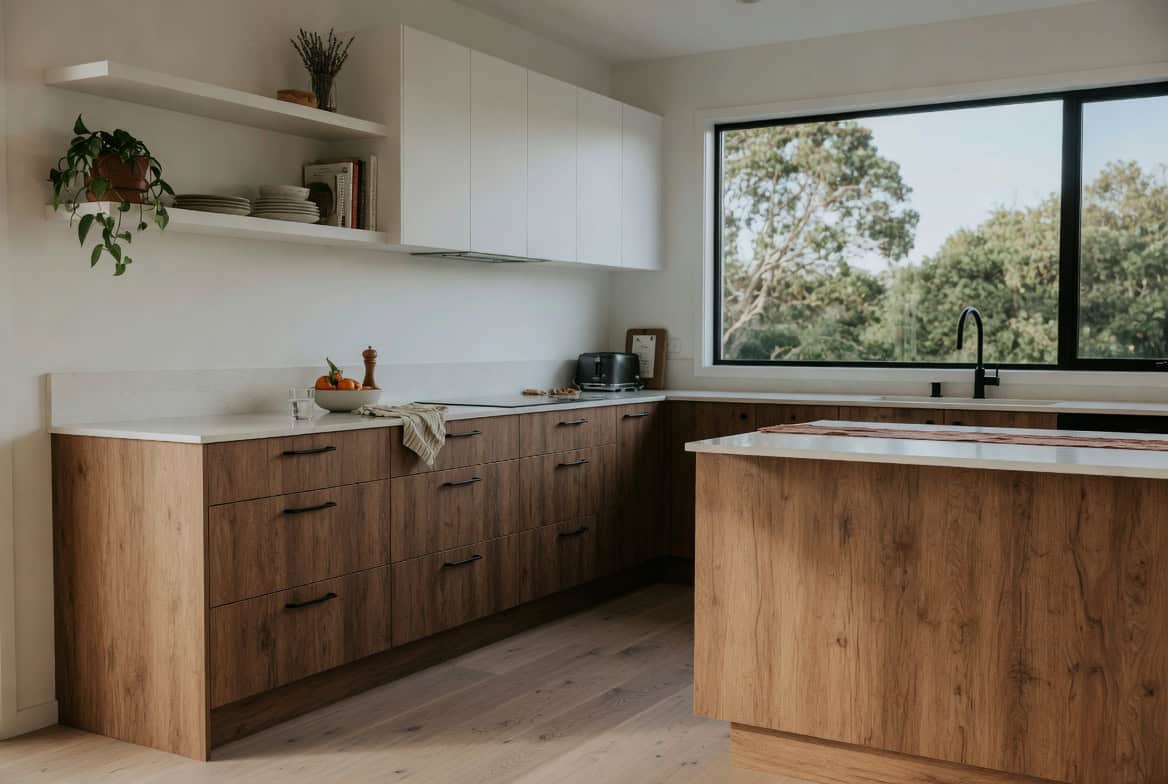
For most Auckland homeowners, a Melteca melamine finish represents outstanding value. Laminex has made it in New Zealand for over 40 years, the range runs from solid colours to very convincing timber woodgrains, and it’s genuinely durable in the steamy conditions Auckland kitchens see. We use it extensively at Little Giant Interiors because it performs.
“The material finish is what clients see every day, but the hardware is what they feel. We’ve found that most Auckland homeowners who went for soft-close drawers, even on a tighter budget, don’t regret it. The ones who skipped it to save money often wish they hadn’t.”
— Little Giant Interiors Design Team
Custom Kitchen Cabinets Auckland: What Drives the Price Higher Than You Think
Most people expect layout to drive cost. It does — but not in the way they expect. Corner solutions, tall pantry units, and full-height uppers add more to a budget than adding extra standard-width cabinets along a wall.
We build kitchens for Auckland homeowners every week, and the projects that end up significantly over initial budget expectations almost always have one or more of these cost escalators: complex corner treatments, integrated appliance panels, or a late decision to go full-height on the upper cabinets. None of these are bad decisions. They’re just worth knowing about before you start.
Corner Cabinets and Why They Cost More
Corners in kitchens are expensive. Not because they’re especially hard to build, but because making them genuinely functional requires more hardware and more ingenuity. A basic corner cabinet with a fixed shelf leaves the back of the cupboard out of reach. A proper corner solution, such as a pull-out corner unit, a carousel or a diagonal corner cabinet, reclaims that space and costs more to achieve it.
In a typical Auckland kitchen with two corners, the difference between a basic fixed-shelf solution and a full pull-out corner system is $800–$2,000 per corner. That sounds significant. But consider that corner cabinets often represent the largest single storage volume in your kitchen — and if you can’t easily access what’s in there, that space effectively doesn’t exist.
Full-Height Upper Cabinets vs Standard Height
One of the biggest storage wins in any Auckland kitchen is going full-height on the upper cabinets — taking the wall cabinets all the way to the ceiling rather than stopping short with a dust-collecting gap or a bulkhead. Depending on ceiling height, that’s often a whole extra shelf row across the run.
In newer homes with 2.7m studs, full-height uppers make a big difference. Many older villas have higher ceilings again, which means more storage and a sensible conversation about what goes on the top shelf.
The cost implication is real: full-height uppers require taller panels, additional shelving, and more careful installation to get level across an uneven ceiling. Budget an additional $2,000–$5,000 depending on run length, ceiling height, and whether any bulkheads need to be built.
💡 Design tip: If your ceiling height is 2.4m or above, full-height upper cabinets are almost always worth the extra cost. The storage gain is significant, and the visual effect (a clean, uninterrupted wall of cabinetry) makes smaller kitchens look far more polished.
Integrated Appliance Panels
Integrated appliances, where your dishwasher, fridge, or oven is concealed behind a matching cabinet panel, are one of the most popular premium kitchen requests we receive. They look spectacular. They also add cost in a few ways: the cabinetry itself needs to be built around specific appliance dimensions, the panels need to be made to match the door fronts, and the installation requires more precision.
A single integrated appliance panel (say, for a dishwasher) typically adds $400–$800 to the cabinetry cost. A fully integrated fridge-freezer with custom panels can be $1,500–$3,000 more. These figures don’t include the appliances themselves — just the cabinetry work to make them disappear into your design.
The Soft-Close Hardware Investment
Every kitchen we build at Little Giant Interiors uses Blum or Hettich soft-close hardware throughout. We won’t use anything less. The reason isn’t just about the satisfying thud-free close — it’s about longevity. Soft-close mechanisms protect both the cabinet box and the door front from impact fatigue. In kitchens that get used daily, this extends the practical lifespan of the cabinetry significantly.
Blum puts its fittings on a limited lifetime manufacturer’s warranty in New Zealand, and our guarantee page lists lifetime warranties on both Blum and Hettich hardware. Neither brand is cheap, but both are hardware you fit once. Our guide to soft-close kitchen drawers goes through the runner types if you want the detail.
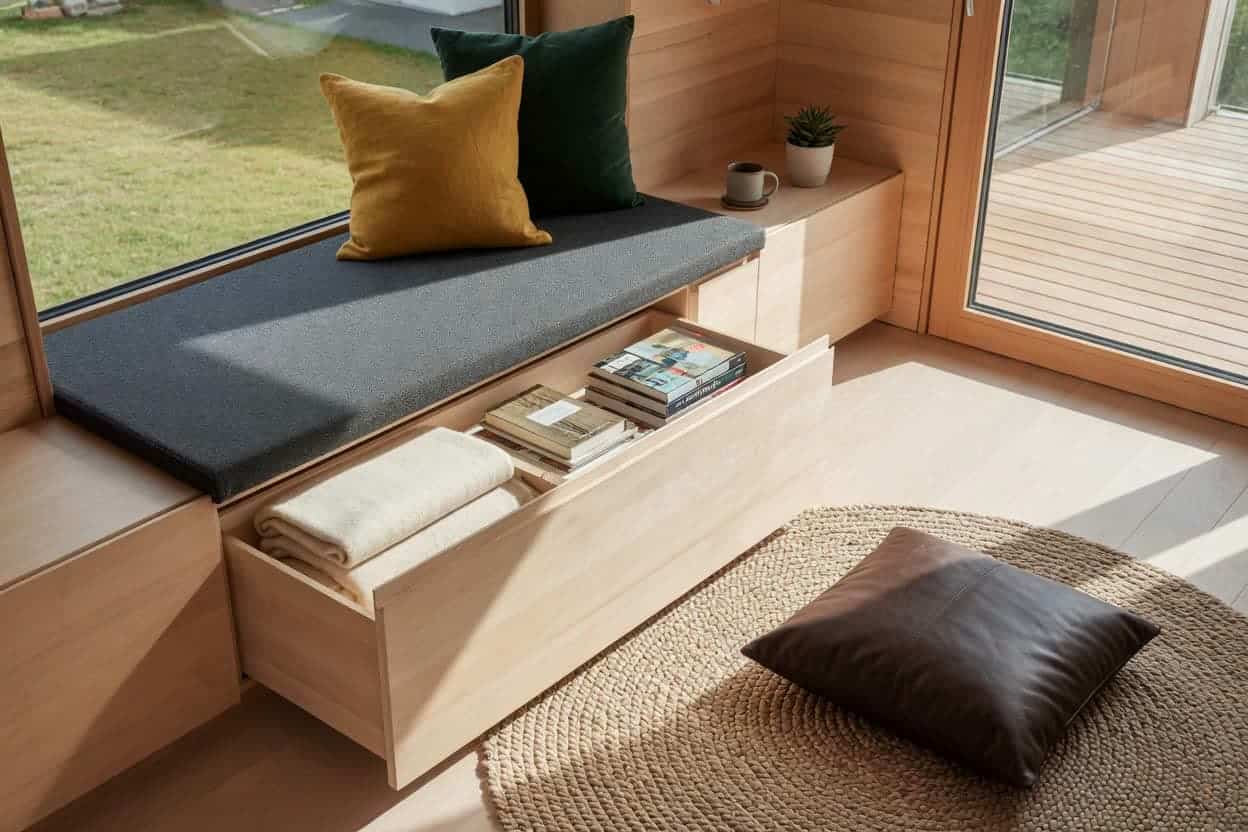
“The hardware is what separates a kitchen that still works perfectly in fifteen years from one that’s started rattling and sticking in five. We specify Blum and Hettich on every project, not because they’re flashy brands, but because they perform.”
— Little Giant Interiors Design Team
Cheap Kitchen Cabinets NZ: What You’re Actually Giving Up (And When It’s Fine)
There’s no shame in a budget kitchen — but you need to know what you’re trading away, because some of those trade-offs bite you five years later and some don’t matter at all.
We’re not going to tell you that cheap cabinets are always bad. Sometimes the budget is what it is, and a clean, functional flat-pack kitchen with decent hardware is genuinely better than a more expensive kitchen that stretches you financially and creates stress. What we will tell you is what the real trade-offs look like, so you can make an informed decision rather than an optimistic one.
Flat-Pack vs Custom: The Real Comparison
Flat-pack kitchen cabinets, the kind available through hardware and home improvement retailers, start from around $8,000–$14,000 for a full kitchen supply and install. They’re built on a modular system: standard widths (usually 300mm, 400mm, 500mm, 600mm), standard heights, and standard depths. You fit your kitchen to the modules, not the modules to your kitchen.
The consequences of this approach are visible in the details: filler panels where the modules don’t quite reach the wall, visible gaps at ceiling height, and compromises on storage configuration because the module dimensions don’t match your actual space.
That said, flat-pack cabinetry has genuinely improved over the last decade. Some modular systems now offer moisture-resistant board substrates, soft-close hardware options, and a reasonable range of finishes. If your kitchen is a simple straight run in a rental property or an investment property you’re holding for a few years, flat-pack may be the right call.
If it’s your family home and you’re planning to live with this kitchen for 10–20 years, custom cabinetry almost always represents better long-term value.
Flat-Pack Kitchen Cabinets NZ: Five Checks Before You Buy
If you’re buying kitchen cupboards off the shelf, these five checks separate the flat-pack kitchens that hold up from the ones that don’t:
- What’s the carcass board? Ask whether the boxes are moisture-resistant board or standard particleboard. The sink cupboard and the one beside the dishwasher are where standard board swells first.
- Look at a cut edge. Thin edge tape on the carcass lets moisture into the core over time. A thicker, well-bonded edge on every exposed side is what you want.
- Which hinges and runners, and what warranty? Get the brand in writing. Blum and Hettich both publish their warranty terms; an unbranded runner with no stated warranty is the part most likely to fail.
- Who installs and levels it? Flat-pack goes wrong at install more often than in the box. Auckland walls and floors are rarely square, and a carcass that isn’t levelled properly throws every door out of line.
- What’s not in the price? End panels, kickboards, fillers, scribes, benchtop, sink and installation are often extras. Compare the finished kitchen, not the box price.
If the answers are good, flat-pack can be a sound buy for a rental or a simple straight run. If they’re vague, the saving usually comes back later as swollen boxes and sagging doors.
Affordable Kitchen Cabinets Without the Flat-Pack Trade-Offs
There’s a middle path between the cheapest modular kitchen and a premium custom one. These are the moves that bring a made-to-measure kitchen down in price without cutting the parts that matter:
- Keep the layout simple. A straight or galley run needs no corner hardware and fewer end panels than an L or U shape.
- Choose Melteca over paint or veneer. It’s the biggest single saving in the door line, and it’s the most durable of the budget options.
- Put drawers where you cook, doors where you don’t. Pot drawers beside the hob earn their cost. The cupboard at the far end that holds the platters doesn’t need them.
- Leave the plumbing where it is. Keeping the sink and dishwasher in place cuts plumbing and drainage work. If you are thinking of moving them, check with a Licensed Building Practitioner or Auckland Council whether the change needs consent before the design is locked.
- Stop the uppers where they make sense. Full height is a great upgrade, but standard-height uppers with a clean finish on top are a reasonable place to save.
That’s most of how the lower-cost made-to-measure kitchens we build come together: the same factory, board and hardware, with the design doing the saving.
What “Budget Cabinetry” Often Means for Auckland Homes
Auckland’s climate is a legitimate consideration when speccing kitchen cabinetry. Auckland kitchens take a lot of moisture: steam from cooking and the dishwasher, damp winters, and older villas without modern ventilation. Standard particleboard, the substrate used in most budget flat-pack cabinets, absorbs moisture over time, causing swelling, delamination, and hinge failure.
Moisture-resistant (MR) board costs more. It’s worth it for Auckland kitchens. Every cabinet we manufacture at Little Giant Interiors uses moisture-resistant substrate — it’s not optional for us. The difference in cost between standard and MR board at a kitchen scale is typically $800–$2,000. The difference in how the cabinets look and function in ten years is much larger than that.
💡 Design tip: Always confirm with your cabinet supplier whether they’re using moisture-resistant (MR) substrate for Auckland kitchens. If they’re not, especially for under-sink cabinets and anything near the dishwasher, it’s worth pushing back or choosing a different supplier.
Refacing vs Full Replacement: When Refacing Makes Sense
Cabinet refacing, replacing doors and drawer fronts while keeping existing carcasses, sits in an interesting middle ground. If your existing cabinet boxes are structurally sound and moisture-free, refacing can refresh the look of your kitchen for $2,000–$6,000 rather than $15,000–$35,000 for a full replacement.
The catch is that refacing only works if the existing boxes are genuinely good. If the carcasses are swollen, the hinge plates are stripped, or the internal shelving is sagging, refacing is false economy — you’re putting a new face on a failing body. We’re honest with clients when we see this situation: a full replacement is the right answer, even though it costs more.
For kitchens less than 15 years old with solid, dry carcasses and functional drawer mechanisms, refacing deserves serious consideration. For kitchens from the 1990s or earlier, we’d recommend a full replacement in most cases.
Kitchen Cabinetry Materials NZ: Which Finish Is Right for Your Auckland Home
The material finish you choose for your kitchen cabinets affects not just how they look on day one, but how they perform over 10, 15, and 20 years in Auckland’s humidity-variable climate. This is a decision worth spending time on.
Melteca Melamine: The NZ Default for Good Reason
Laminex makes Melteca at its Hamilton plant and says the MDF used in Melteca board (excluding fire-rated MDF) is FSC-certified. It’s the finish we specify most often at the mid-range price point, and for good reason. Our kitchen cabinet materials guide compares it with the other substrates side by side.
What makes Melteca stand out isn’t just the price point. It’s the combination of durability, colour range, and environmental credentials. Melteca comes in solid colours, woodgrains and textured finishes, and the newer Organic finish range does an excellent job of replicating the look and feel of real timber at a fraction of the cost and maintenance burden.
For Auckland kitchens, we specify Melteca on moisture-resistant (MR) board as standard. The MR substrate significantly reduces swelling risk in humid conditions, and the melamine surface itself is non-porous and easy to clean — important in a kitchen environment.
Polyurethane (2-Pot Lacquer): Premium Finish, Premium Investment
Polyurethane-painted cabinet fronts are the premium choice for Auckland homeowners who want a smooth, even, contemporary look. The finish is applied in a spray booth environment, creating a seamless surface with no visible substrate texture — unlike even the best melamine options, which have a very slight texture when viewed in raking light.
Two-pot polyurethane is also exceptionally durable when properly applied — it cures by chemical reaction rather than simply drying, which gives a hard, sealed surface that stands up well to moisture and cleaning. For coastal homes where salt air is hard on finishes, polyurethane is often the upgrade we suggest.
The cost premium is real — expect to pay 30–50% more for polyurethane-fronted cabinets compared to equivalent Melteca. For a full kitchen this typically means $4,000–$8,000 more in the door/drawer-front line item. Whether that premium is worth it depends on your budget, how long you plan to stay, and how important a smooth, even finish is to you.
Timber Veneer: Warmth That Melamine Can’t Fully Replicate
Timber veneer cabinet fronts, using real wood sliced thin and applied to an MDF or particleboard substrate, occupy the top end of the NZ cabinet material spectrum. They deliver genuine warmth and grain variation that no synthetic finish can fully replicate.
We see timber veneer most often in high-end kitchens where the brief includes natural materials throughout and budget isn’t the primary constraint. Oak, walnut, and ash veneer are the most popular requests currently.
Veneer requires more maintenance than melamine or polyurethane (it needs sealing and should be kept dry at the edges), but well-maintained veneer cabinets look better as they age rather than worse. That’s a quality very few materials can claim.
💡 Design tip: You don’t have to commit to one material for your entire kitchen. Mixing Melteca on cabinet carcasses with polyurethane or veneer on door fronts is a popular approach at Little Giant Interiors — it gives you the premium look where it’s visible, and keeps overall cost manageable.
The Cabinetry Cost Breakdown: Where Your Money Actually Goes
Within a typical mid-range cabinetry quote, the money splits roughly like this on our own quoting. The mix moves with the design, so treat it as a guide to where the levers are:
| Cost Component | Approximate % of Cabinetry Budget |
|---|---|
| Cabinet carcasses (boxes) | 35–40% |
| Door and drawer fronts | 25–35% |
| Hardware (hinges, runners, handles) | 10–15% |
| Specialty storage (pull-outs, corner systems) | 8–15% |
| Installation labour | 15–20% |
| Total (plus 10–15% contingency) | 100% + buffer |
How to Get the Best Value on Kitchen Cabinets in Auckland
Getting good value on kitchen cabinetry isn’t about finding the lowest price. It’s about making sure every dollar is spent on something that’ll still be working well in fifteen years. The kitchens we’re proudest of at Little Giant Interiors aren’t the most expensive ones we’ve built. They’re the ones where the brief was clear, the priorities were right, and the result genuinely improved how the family uses their home.
Lock Decisions Early
Changes after manufacturing begins are expensive. Once a cabinet box is cut and edged, changing its dimensions means starting again. Changes to door sizes, handle positions, or drawer configurations mid-project can add $1,000–$5,000 depending on how far through the process you are.
This is why our process at Little Giant Interiors includes a detailed design stage, with accurate 3D renderings and detailed material selections, before any manufacturing begins. Our design and build process is specifically designed to get all those decisions made properly before we cut a single panel.
Prioritise the Things You Touch Every Day
If you’re working within a budget, spend it on drawers, hardware, and the materials you interact with most. The inside of the base cabinets (the drawers, the pull-outs, the runners) is where your daily experience of the kitchen lives. A kitchen with mid-range door fronts and outstanding drawer hardware will serve you better than one with beautiful door fronts and cheap runners that start sticking in eighteen months.
Splurge on one focal point if budget allows — a statement island in a contrasting finish, or a full-height pantry cabinet in a bold colour. Keep the rest clean and consistent. That approach consistently delivers kitchens that look more expensive than they are.
Compare Quotes Line by Line
Two cabinet quotes with the same total can buy very different kitchens. Line them up on board, edging, hardware brand, number of drawers, end panels and installation before you compare the bottom line. Our guide to comparing kitchen quotes has the full checklist.
Resale: Spend Where Buyers Notice
A kitchen is one of the first rooms buyers judge, and dated, swollen or badly fitted cabinetry is hard to hide at an open home. We don’t publish a return-per-dollar figure, because we haven’t seen one for Auckland we’d stand behind. Ask a local agent what buyers in your area expect before you set the budget. What we can say is that money spent on fit, hardware and a moisture-resistant substrate lasts longer than money spent on a finish that dates.
If you want to explore what a custom kitchen renovation might look like for your Auckland home, start with a free in-home consultation. We’ll take a look at your space, understand what you want, and put together an honest estimate — no pressure, no hard sell.
➡ Book your free in-home kitchen cabinet consultation with Little Giant Interiors
➡ See how our design and build process works
➡ Learn more about our custom kitchen renovation Auckland service
How much do kitchen cabinets cost in NZ in 2026?
Kitchen cabinets in NZ typically cost between $8,000 and $35,000+ for supply and installation, excluding benchtops and appliances. Budget flat-pack options start from around $8,000–$14,000. Mid-range custom cabinetry, the most common choice for Auckland family homes, sits between $15,000 and $24,000. Premium and high-end custom kitchens run $25,000–$55,000+. Always add a 10–15% contingency buffer.
What is the difference between custom and flat-pack kitchen cabinets NZ?
Custom kitchen cabinets are manufactured to the exact dimensions of your space, resulting in a precise fit with no fillers or visible gaps. Flat-pack modular cabinets use standard widths and heights, requiring you to adapt your kitchen to their dimensions. On our figures, mid-range custom cabinetry ($15,000–$24,000) starts about where flat-pack tops out ($8,000–$14,000), and it delivers a better fit and more usable storage, especially in kitchens with non-standard layouts or dimensions.
How long do kitchen cabinets last in NZ?
Blum New Zealand designs its fittings around a kitchen lifetime of about 20 years, testing hinges up to 200,000 opening movements and runners up to 100,000. A kitchen on moisture-resistant board with quality hardware and a durable door finish should see that out. The early failures we see are swollen particleboard boxes under the sink and beside the dishwasher, and cheap runners that start sticking.
What material is best for kitchen cabinets in NZ?
For most Auckland homeowners, Melteca melamine on moisture-resistant (MR) board is the best balance of durability, cost, and appearance. Laminex has made it in New Zealand for over 40 years, it comes in a wide range of colours and woodgrains, and it handles the steamy conditions common in Auckland kitchens. Polyurethane paint is a premium upgrade for a smooth, even finish. Timber veneer delivers unmatched natural warmth but requires more maintenance.
How much do kitchen cabinet doors cost NZ?
Kitchen cabinet door costs in NZ range from approximately $60–$110 per door for melamine, $90–$140 for vinyl-wrapped (thermowrap), and $140–$200+ per door for polyurethane-painted finishes. Timber veneer doors can cost $160–$240 or more per door. These are supply-only figures — installation labour is additional. The type of door finish is one of the biggest variables in your overall cabinetry budget.
Do new kitchen cabinets add value to my Auckland home?
They can, because a kitchen is one of the first rooms buyers judge and dated or swollen cabinetry is hard to hide. We don't quote a return-per-dollar figure because we haven't seen a reliable one for Auckland. Ask a local agent what buyers in your area expect, then spend on fit, hardware and a moisture-resistant substrate rather than a finish that dates.
How long does it take to get kitchen cabinets made in Auckland?
After the in-home consultation we send an estimate and a preliminary 3D design within 1–2 days. Once the design and materials are locked in you get a fixed quote, and the cabinetry is made in our Rosedale factory. Installation itself takes 1–2 days, then the benchtops are templated and fitted about 10 days later. The overall timeline depends mostly on how quickly the design decisions are made, and your quote confirms it.
What is the most popular kitchen cabinet style in NZ?
Shaker-style cabinets remain the most popular kitchen cabinet choice in New Zealand — their five-piece recessed panel design works across a wide range of kitchen styles from traditional to contemporary. Handleless flat-panel cabinets are the fastest-growing style choice in Auckland new builds and renovations, particularly in open-plan homes where a minimal, clean look is the priority.
Should I get soft-close hinges and drawers for my kitchen cabinets?
Yes, for any kitchen you plan to use daily, soft-close hardware is worth the investment. Blum and Hettich soft-close systems protect cabinet boxes and door fronts from impact fatigue, significantly extending the practical lifespan of the cabinetry. The cost premium for soft-close hardware across a full kitchen is typically $800–$2,000, a modest addition to a $15,000–$30,000 cabinetry investment.
Can I reface my existing kitchen cabinets instead of replacing them?
Yes, if your existing cabinet carcasses are structurally sound and free from moisture damage. Refacing, replacing door and drawer fronts while keeping existing boxes, costs approximately $2,000–$6,000 versus $15,000+ for a full replacement. It works best for kitchens less than 15 years old with solid, dry carcasses. For older Auckland kitchens from the 1990s or earlier, a full replacement is usually the better long-term investment.
How much does a new kitchen cost in NZ in total?
Cabinetry is the biggest single line. On our figures cabinetry runs $8,000 to $55,000+ supplied and installed, benchtops add $2,000 to $12,000+ and appliances $3,000 to $20,000+, before plumbing and electrical. As a worked example, a $20,000 mid-range cabinetry quote with a $5,000 benchtop and $6,000 of appliances comes to $31,000 before trade work and contingency.
What is the cheapest way to get new kitchen cabinets?
If the existing carcasses are dry and sound, refacing the doors and drawer fronts (about $2,000 to $6,000 on our figures) is the cheapest route to a new-looking kitchen. For new cabinets, flat-pack modular starts from around $8,000 to $14,000 supply and install. With custom cabinetry, a straight or galley layout, Melteca doors and drawers only where you cook keep the price down without the flat-pack trade-offs.
Have you been putting off your kitchen renovation?
We offer flexible finance options to help you get your dream kitchen sooner. Learn more about our interest-free finance options.