

Last updated:
Laundry Design NZ: The 2026 Renovation Guide for Auckland Homes
Quick answer: A good laundry design in NZ comes down to three things — a layout that flows, moisture-resistant materials that meet Building Code clause E3, and storage that earns its keep. Get those right and even a 1.5m nook can run a busy Auckland household without a fight.
Picture a wet Saturday in West Auckland. The kids have tracked mud down the hall, the dog’s rolled in something off, and every damp towel in the house has ended up in one room. The laundry. In most NZ homes it’s the hardest-working space and the least planned — dark, cramped, and bolted onto the back door as an afterthought.
It doesn’t have to be that way. A considered laundry design changes how a whole household runs, and you don’t need a big footprint to get there. We’ve turned a 1.1m² alcove in a Grey Lynn apartment into a full laundry, and we’ve built family-sized utility rooms in Mt Eden bungalows that handle the washing, the dog, and the school-bag chaos in one go. Same principles, very different spaces.
This guide covers everything that matters for a laundry renovation in 2026 — layouts that make sense, benchtops and cabinetry that survive NZ’s damp winters, splashbacks and colour that give the room some character, and the multi-purpose thinking that turns a chore corner into a genuine utility space. We’ll keep it grounded in what works here: the Building Code rules that govern wet areas, real Auckland project costs, and the materials we specify and install every week. Whether you’re in a compact apartment in the city or a larger home further out, the thinking carries across.
At Little Giant Interiors, we design, manufacture, and install custom laundry cabinetry from our 700m² Auckland factory, using German laser edge-banding for a finish that shrugs off years of moisture and daily use. Every project starts with a free in-home consultation and a 3D design. Here’s how to get your laundry design right the first time.

Planning Your Laundry Layout — Where Good Design Starts
The layout is the foundation of any laundry design. It needs to suit how you actually move, wash, and live — not how a showroom photo looks. Before you fall in love with a splashback tile, get the bones right: where the machines sit, where you fold, and how you move between the two without doing a sideways shuffle past an open door.
The must-haves no laundry should skip
Five things do the heavy lifting in every laundry we build. Skip them and you’ll feel it within a week.
- Storage that hides the clutter. Detergents, pegs, the iron, the lint roller you forgot you owned. Tall cabinets with adjustable shelves and deep pull-out drawers keep it all out of sight. A built-in hamper inside a cabinet is the single best upgrade most people skip.
- A benchtop you can work on. Folding, sorting, soaking, the occasional wrestle with a king-size duvet. Aim for at least 60cm of depth where the space allows.
- Good light. Natural light is ideal, but back it with bright LED task lighting. Spotting grass stains on white school shirts under a single dim bulb is nobody’s idea of a good time.
- Ventilation. NZ’s humidity turns a sealed-up laundry into mould territory fast. An extractor fan or a window that genuinely opens isn’t optional — it’s a Building Code requirement, which we’ll come back to.
- Clear floor space. Leave at least 90cm in front of appliances so you can open doors and pull out baskets without a fight.
💡 Design tip: Before anything else, find your plumbing and power points and mark them on a sketch. Keeping the sink and machines near existing services is the easiest way to control cost — moving them is where laundry budgets quietly blow out.
Choosing a layout that fits your space
There’s no single “best” layout — there’s the one that fits your room. Here’s how the four common options stack up.
| Layout | Best for | What to watch |
|---|---|---|
| U-shaped | Dedicated rooms with space — sink one side, machines opposite, bench between | Leave at least 1m clear in the centre so two people aren’t elbowing walls |
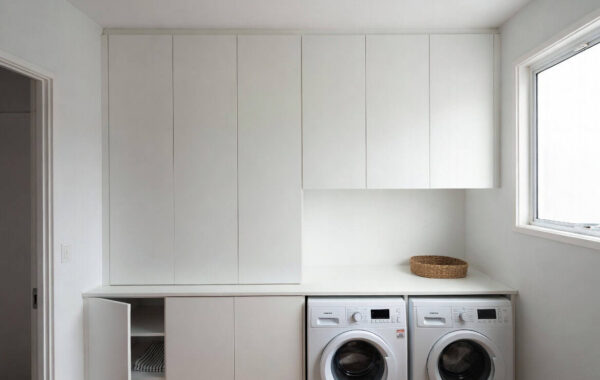
| Single-wall | Apartments, narrow homes, hallway nooks — everything on one run | Stack the machines and add a fold-down bench to claw back surface |
| Galley | Long, skinny rooms — appliances one side, bench and sink the other | A sliding door keeps it tidy when you’re not using it |
| Corner | Odd-shaped spaces — machines tucked in, benchtop wrapping around | Plan the corner join carefully so you don’t lose usable bench |
A good rule of thumb: if you’ve got the room, the U-shape keeps everything within arm’s reach and suits busy families juggling washing and life. If you’re tight, a single-wall run does more with less than people expect.

Small laundries and apartment setups
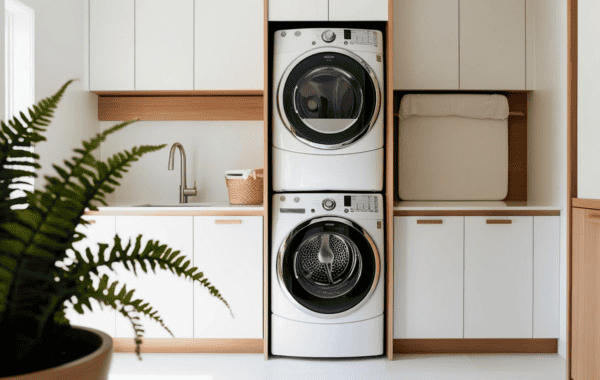
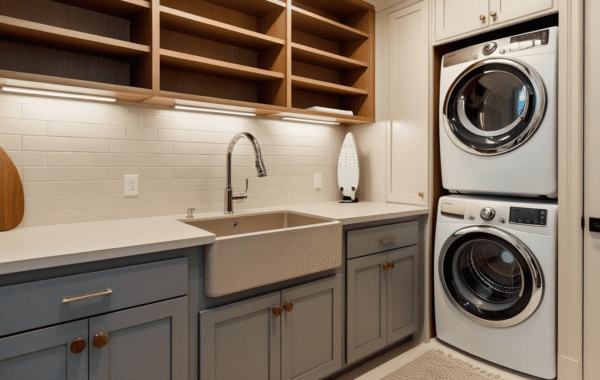
Small laundry design is where we do some of our best work. The trick is to think vertically and make every piece multi-task. Stack the washer and dryer, fit a slim benchtop over the top for folding, and use the wall above for storage. A pull-down or wall-mounted drying rack keeps air-drying off the floor, and a fold-flat ironing board tucked into a drawer saves a surprising amount of room.
For apartments — central city, the Viaduct fringe, Takapuna — concealment is everything. Sliding panels or a bifold cabinet in frosted glass or a timber-look finish hide the machines when they’re not running, so the laundry disappears into the room. A compact 30cm square sink mounted over the washer handles soaking without taking a footprint of its own.
A real one: we recently took a 1.1m² alcove in a Grey Lynn one-bedroom apartment and turned it into a full laundry — stacked machines, a pull-out bench, and a ceiling pulley for drying. The owner later told us the room finally pulls its weight instead of being a glorified cupboard. For more on tight spaces, see our small laundry design ideas and our guide to laundry cabinet NZ ideas — both go deeper on storage in small rooms.
“People assume an apartment can’t have a proper laundry. It can. A sliding door and a slim sink over the washer turn a 1m strip into something genuinely usable — and because it stays sealed and ventilated, it meets the moisture rules without a fuss.”
— the Little Giant Interiors design team
Want us to work out what fits your space? You can run the numbers on our laundry cabinetry cost calculator, or book a custom laundry renovation in Auckland consultation and we’ll measure it up properly. Once the layout’s sorted, the next decision is what it’s all made of.
Materials, Benchtops and Cabinetry Built for NZ Conditions
Your laundry takes a beating — water, detergents, bleach, the odd mystery stain from last weekend’s BBQ. Materials need to be tough first and good-looking second. In a climate like ours, the wrong board or a cheap edge finish doesn’t last; it swells, peels, and dates the whole room.
Benchtops: stainless, engineered stone or laminate
Three benchtop materials cover almost every NZ laundry we build. Here’s how they compare.
| Material | Strengths | Best suited to |
|---|---|---|
| Stainless steel | Near indestructible, shrugs off water and bleach, wipes clean in seconds | Heavy-duty use, pet-washing, an industrial look |
| Engineered stone | Non-porous, durable, polished finish in a wide colour range | Laundries that double as a presentable space off the kitchen |
| Timber-look laminate | Warmth of wood without the upkeep, handles moisture and scratches | Budget-conscious renos that still want a quality feel |
For a hard-working family laundry, stainless is hard to beat. If the room is on show — open off a hallway or kitchen — engineered stone earns its place. Caesarstone NZ has a deep range of non-porous surfaces that suit laundries as well as kitchens. For laminate, Laminex and Melteca carry timber-look options that hold up well in damp conditions.
Cabinetry that survives the damp
This is where most of the long-term performance lives, and where the cheap option costs you later. We build laundry cabinetry from moisture-resistant board — melamine or polyurethane finishes — and the part that matters most is the edge. A poorly edge-banded cabinet lets moisture creep into the board, and in a laundry that’s the beginning of the end. Our German laser edge-banding bonds the edge to the board with no visible glue line and no gap for water to get in, which is exactly why it holds up in the one room where humidity never really lets go.
For the working parts — drawers, hinges, pull-outs — we specify BLUM and Häfele soft-close systems. They’re quiet, they don’t wear out, and they make a small laundry feel considered rather than cobbled together. Polytec is another solid option for melamine and veneer-look doors. Cheap hardware is a false economy — there’s nothing worse than a wobbly drawer mid-cycle, and replacing it later costs more than doing it once.
💡 Design tip: Spec a pull-out laundry basket on soft-close runners inside a cabinet. It hides the mess and keeps dirty clothes off the floor.
Flooring and finishes
Underfoot, porcelain tiles or luxury vinyl planks handle wet boots and spilled rinse water without complaint. Textured porcelain gives you slip resistance, and a darker grout hides the dirt between mops — a small thing that makes a busy household look tidier than it is. For 2026, we’re seeing more mixed textures: a matte stone benchtop against glossy cabinet doors, or a rugged tile floor under smooth timber-look panels. It adds depth without making the room busy.
“The laundry is the room people under-build. They’ll spend on the kitchen and treat the laundry like a cupboard — then it’s the room that fails first. Get the edge-banding and the ventilation right and you’ve solved 80% of what goes wrong in here.”
— the Little Giant Interiors design team
Materials set the durability. The next layer — splashbacks, sinks, colour, and hardware — is where the room gets its personality. We design and build all of it together, so you can see how it works as a whole through our design and build process.
Splashbacks, Sinks, Colour and Hardware — The Character Layer
This is the part people enjoy. With the bones sorted, splashbacks, sinks, and colour are where a laundry stops being purely functional and starts being a room you don’t mind spending time in. The only rule: durability still comes first. Everything here has to handle moisture and the odd bleach splash.
Splashbacks that protect and set the tone
A splashback saves your walls and sets the mood in one move. NZ homeowners are getting bolder with them — geometric or subway tiles in deep greens, terracotta, or soft mustard; matte ceramic in charcoal or sage for an understated look; waterproof timber-look panels for warmth without the upkeep. Some run the splashback full-height for a clean, modern finish that’s as practical as it is striking.
Whatever the look, stick to materials that take moisture — porcelain, glass, or sealed laminate. A herringbone tile in a deep blue with white grout can turn a plain wall into the best feature in the room.
Sinks and tapware for real laundry work
Your laundry sink cops more than any other in the house — muddy boots, pet messes, the soaking pile. A deep, wide sink (40cm or more) is worth it if you’ll ever rinse gumboots or bathe the dog. Stainless is the reliable pick; for a cleaner look, an undermount sink sits flush with the benchtop so you can sweep water straight in. Matte black and concrete-look sinks are showing up in 2026 designs for households that want a statement.
Pair it with a mixer tap with a pull-out spout for reach — handy for filling buckets or rinsing delicates. Keep the sink near existing plumbing to control cost. Reece has a strong range of sinks and tapware that suit laundry duty rather than just looking the part.
💡 Design tip: If your laundry doubles as the pet-wash zone, ask for a sink with a built-in draining board and a low pull-out sprayer. It’s the detail that makes a Howick or Pakuranga family home actually work on a muddy winter morning.
Colour schemes that read well in Auckland light
Colour is where your laundry shows some personality, and 2026 palettes balance calm with character. A few directions worth considering:
- Neutral base with a pop. Crisp whites, soft greys, or warm taupes make small spaces feel bigger — a real advantage in Epsom apartments and townhouses — then layer in a forest-green splashback or mustard handles.
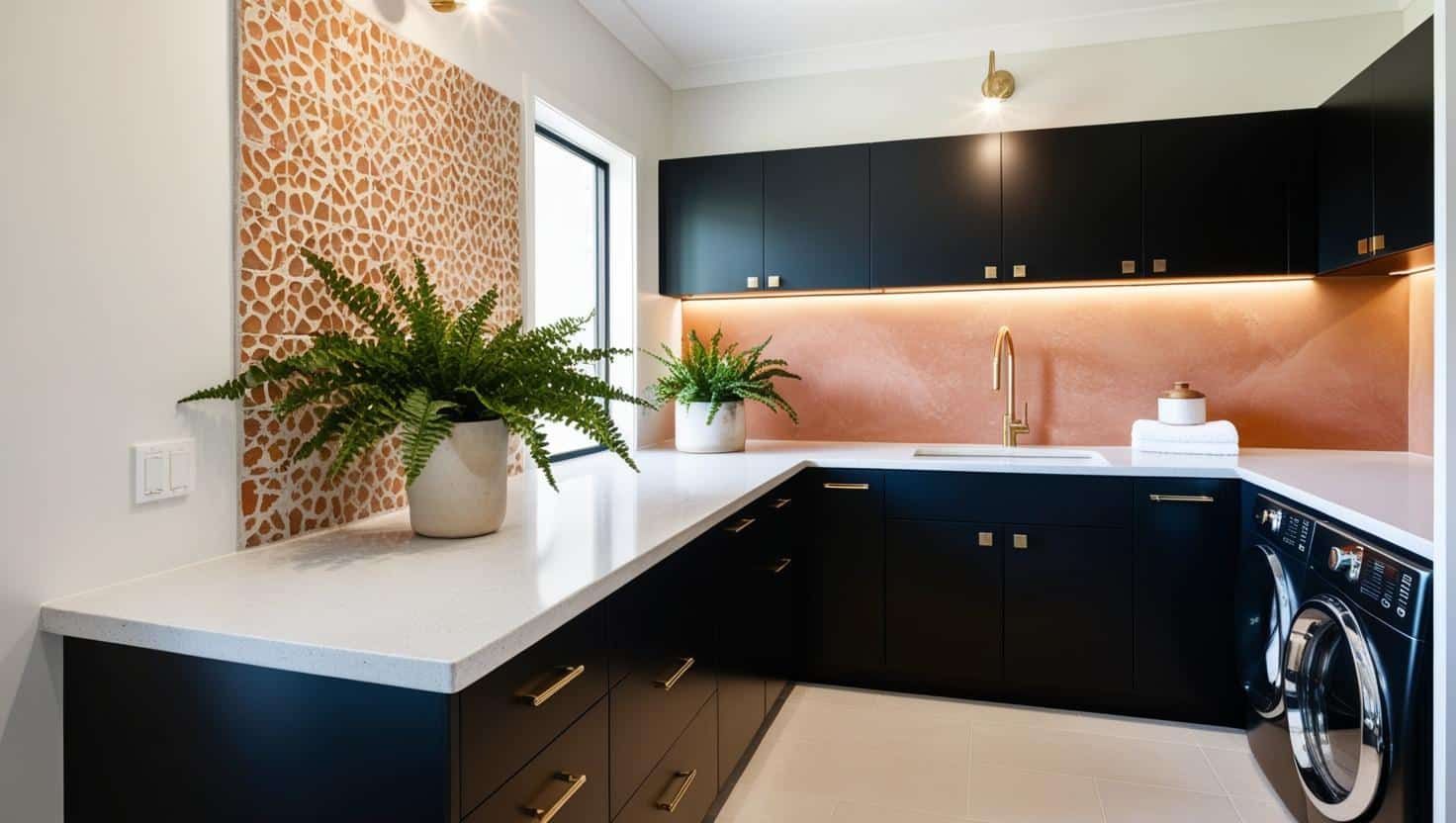
- Earthy tones. Terracotta, sage, and dusty blue reference the NZ landscape and feel grounded. A terracotta splashback against white cabinetry is a warm, fresh combination.
- Monochrome. Matte black cabinets with a stainless sink, or glossy white throughout. Add texture — ribbed tiles, for instance — so it doesn’t read flat.
One thing people forget: test your scheme in your own light. NZ’s bright summers and grey winters change how a colour reads through the day, and a sample that looked great in the showroom can fall flat by your back window. Use semi-gloss or satin paint in wet areas — it handles moisture far better than a flat finish.

Hardware and the finishing details
Handles and hardware are the unsung heroes. Brushed brass or matte black handles lift even simple cabinets; push-to-open mechanisms give you a clean, handle-free look that’s handy in tight spaces. Soft-close on everything — doors, drawers, fold-down benches — makes the room feel built rather than assembled. Mix finishes for a custom feel (brass handles with black hinges), or keep it uniform for something streamlined. Either way, put the budget into quality: in a working laundry, the cheap stuff fails first.
With the character layer locked in, there’s one more way to get more out of the room — making it do more than one job.
Multi-Purpose Laundries, Compliance and Future-Proofing
In NZ, the laundry rarely does just one job. It’s the washing hub, the mudroom, the pet zone, and sometimes the spot where the gardening gear lives. Designing for that from the start is the difference between a room that copes and one that’s always cluttered. This is also where the rules come in — get the compliance right and you avoid the problems that quietly wreck a laundry over time.
Designing for double duty
A few moves turn a single-purpose laundry into a genuine utility room:
- Pet station. A deep sink with a pull-out sprayer and a low drawer for towels and grooming gear, with a waterproof mat underfoot.
- Mudroom blend. Wall hooks or a bench with cubbies for gumboots and jackets — close to essential for rainy Auckland days and homes further out toward Henderson.
- Utility hub. A wide bench and extra storage that double as a spot for DIY or kids’ projects, kept tidy with baskets and bins.
The way to make it work is to zone it: appliances in one area, sink in another, a bench tying them together. Durable surfaces — stainless or tile — keep it practical no matter the mess. A Mt Eden family we worked with combined a single-wall stack with a wall-mounted folding board and a modular storage grid, and cut their laundry floor clutter dramatically by giving everything a home off the floor.
Meeting the Building Code: moisture, ventilation and safety
This is the part the design listicles skip, and it’s the part that protects your renovation. In NZ, laundries are wet areas under Building Code clause E3 (Internal Moisture), and the rules are specific. building.govt.nz sets out that laundries need an adequate combination of ventilation, thermal resistance, and temperature (E3.3.1); safe disposal of any accidental overflow (E3.3.2); and floor surfaces in spaces with sanitary fixtures that are impervious and easily cleaned (E3.3.3). In plain terms: seal your wet surfaces, vent the moisture, and don’t let an overflow wreck the room.
We design every laundry around those requirements — impervious splashbacks and flooring, and either an extractor fan or an openable window so the room can dry out. In Auckland’s damp climate that’s not box-ticking; it’s the single biggest factor in whether a laundry stays mould-free.
Important note: If your renovation relocates plumbing or drainage, or changes the structure, you may need a building consent — and some of the work is Restricted Building Work that must be done or supervised by a Licensed Building Practitioner. Like-for-like cabinetry swaps usually don’t need consent, but check with Auckland Council before you start so there are no surprises.
One more safety detail people miss: if you’re stacking a washer and dryer, the stack has to be secured. Manufacturer stacking kits include tensioning strips or brackets that anchor the units so they can’t move or tip during a fast spin cycle. We follow that guidance on every install — it’s a five-minute job that prevents a genuinely dangerous problem.
Energy and running costs
The laundry is one of the more energy-hungry rooms once you add a dryer, and with electricity at around 32 cents per kWh on average across NZ, the choices add up. According to EECA, heat-pump dryers are the most energy-efficient type and deliver the highest savings. Designing in a pull-out or ceiling-mounted drying rack lets you air-dry the easy loads and save the dryer for when you actually need it.
If you’ve been weighing up timing, the cost backdrop is reasonably settled. Stats NZ’s construction price indexes have shown only marginal movement through 2025, and building activity has eased rather than surged — which means material and fit-out pricing has been stable rather than climbing. It’s a fair window to invest in quality moisture-resistant materials rather than patching with cheap ones. For a full picture of what a project runs, see our breakdown of laundry renovation cost in NZ. If your laundry is part of a larger bathroom or whole-home project, our group renovation team at Superior Renovations handles the build side around our cabinetry.
Future-proofing your laundry
A well-designed laundry shouldn’t need a redo in five years. Build in flexibility: adjustable shelves and modular cabinets that adapt as needs change, a capped-off water line so you can add a second sink or outdoor hose later without opening walls, and proven materials — stainless, engineered stone, porcelain — that wear well and don’t date. Keep the trend-driven choices to the easily-swapped bits, like handles. Smart appliances earn their place when they solve a real annoyance: a Fisher & Paykel washer that pings your phone when the load’s done beats one that forgets it for three days. Don’t over-do the tech — one or two upgrades that fix an actual problem, not a gadget for its own sake.
Real results from recent Little Giant Auckland laundries
- Grey Lynn apartment (2025): a 1.1m² alcove converted into a full laundry with stacked machines, a pull-out bench, and a ceiling pulley. Cost $4,800. After we added vented cabinet doors and an air-drying rack, the owner measured around a 35% drop in dryer runtime via a smart plug.
- Ponsonby villa hallway nook (late 2025): a U-shaped layout with a deep stainless sink, tiled splashback, and soft-close drawers. Cost $7,200. The owners sold a few months later, and their agent’s feedback was that a tidy, functional laundry was a genuine tick for buyers who notice the wet rooms.
- Mt Eden family home (early 2026): a single-wall stack with a wall-mounted folding board and modular grid. Cost $3,900. The family of four reported roughly 70% less laundry floor clutter, and no mould issues through their first winter — a direct result of getting the ventilation and sealed surfaces right.
Bringing Your Laundry Design Together
The best laundries aren’t the biggest or the most expensive. They’re the ones where someone thought about how the room actually gets used — then chose materials that last, a layout that flows, and storage that keeps the clutter out of sight. Do that, and the room that nobody photographs quietly becomes one of the hardest-working spaces in the house. That’s the whole point.
If you’ve been putting yours off, that’s usually the sign it’s worth doing properly. We’ll measure it up, show you a 3D design, and build it to fit your space and your life — not a template.
➡ Book your free in-home design consultation with Little Giant Interiors
➡ See how our design and build process works
➡ Learn more about our custom laundry renovations in Auckland
What makes a good laundry design in NZ?
A good laundry design in NZ balances three things: a layout that flows, moisture-resistant materials that meet Building Code clause E3, and storage that keeps clutter off the floor. Ventilation is non-negotiable in our damp climate — an extractor fan or openable window prevents mould. Get the layout, materials and ventilation right and even a small nook can run a busy household comfortably.
How much does a laundry renovation cost in NZ?
It depends on size, layout and materials. Our recent Auckland laundry projects have run from around $3,900 for a single-wall family laundry to $7,200 for a U-shaped fit-out with a stainless sink and soft-close drawers. A compact apartment conversion sat around $4,800. For a quick estimate on your space, try our laundry cabinetry cost calculator, or book a free consultation for a fixed-price quote.
How do I design a small laundry in Auckland?
Think vertically and make every piece multi-task. Stack the washer and dryer, fit a slim benchtop over the top, and use wall-mounted or pull-down drying racks to keep air-drying off the floor. Slim tall cabinets store supplies, and sliding or bifold doors hide the machines in apartments. We've turned a 1.1m² Grey Lynn alcove into a fully functional laundry using exactly this approach.
What's the best benchtop material for a laundry in NZ?
Stainless steel is the most durable — it shrugs off water and bleach and wipes clean fast, ideal for heavy use or pet-washing. Engineered stone (like Caesarstone) is non-porous with a polished finish for laundries that are on show. Timber-look laminate from Laminex or Melteca gives warmth at a lower cost while handling NZ's damp conditions. All three suit a laundry; the right one depends on budget and how hard you'll use it.
Do I need building consent for a laundry renovation?
Often not. Like-for-like cabinetry swaps usually don't require consent. But if you relocate plumbing or drainage, or make structural changes, you may need a building consent — and some work is Restricted Building Work that must be done or supervised by a Licensed Building Practitioner. Always check with Auckland Council before you start. Building.govt.nz has the detail on consent thresholds and LBP requirements.
How do I stop my laundry getting mouldy?
Ventilation and sealed surfaces. Under Building Code clause E3, laundries need adequate ventilation — an extractor fan or openable window — to clear the moisture that drives mould. Use impervious, easily cleaned surfaces for splashbacks and flooring. If you run a vented dryer, EECA notes it must be vented outside, or the moisture stays in the room and causes damp. In Auckland's humidity this is the single biggest factor in a healthy laundry.
What size should a laundry be?
A dedicated NZ laundry is typically 4–6m², while a laundry nook can work in as little as 1.5m x 2m. Auckland homes, especially pre-1980 bungalows, often have compact spaces integrated into a bathroom or hallway. Good design makes even a 3m² laundry highly functional through vertical storage, stacked appliances and careful layout — size matters less than planning.
Can a laundry be multi-purpose?
Yes, and in NZ homes it usually should be. A deep sink and pull-out sprayer turn it into a pet-wash zone; wall hooks and bench cubbies add a mudroom for gumboots and jackets; a wide bench doubles as a craft or utility space. The key is zoning — appliances in one area, sink in another, bench tying them together — with durable surfaces that handle whatever gets thrown at them.
Are stacked washers and dryers safe?
Yes, when installed correctly. Use a manufacturer stacking kit designed for your specific models, make sure the washer sits perfectly level, and secure the stack with the tensioning strips or brackets supplied so it can't move or tip during a spin cycle. We follow manufacturer guidance on every stacked install. A wobbly or unsecured stack is the main safety risk, and it's easily avoided.
How long does a custom laundry take to design and build?
For a standalone laundry, most projects run around 4 to 8 weeks from design sign-off to installation, depending on scope and material lead times. At Little Giant Interiors it starts with a free in-home consultation and a 3D design, then manufacturing in our 700m² Auckland factory, then install. Larger or combined bathroom-and-laundry projects take longer. We confirm the timeline in your fixed-price quote.
Have you been putting off your kitchen renovation?
We offer flexible finance options to help you get your dream kitchen sooner. Learn more about our interest-free finance options.