

Last reviewed: 29 Jul 2026 — figures verified against BRANZ House Condition Survey, Tenancy Services Healthy Homes Standards, and current Little Giant Interiors project costing.
Quick answer: custom laundry cabinets in Auckland run from around $5,000 for a compact melamine fit-out to $25,000+ for a premium laundry with a stone benchtop and integrated appliances. What decides whether that cabinetry survives is not the finish. It is the substrate, the edge sealing and the ventilation.
The laundry is the room people stop thinking about right after they sign off on the kitchen. It shouldn’t be. In a small Auckland home, the laundry takes more abuse per square metre than any other space — wet washing, hot dryer exhaust, detergent spills, foot traffic from the back door. Get the cabinetry wrong and you’ll see it inside two winters.
This guide covers the laundry cabinet decisions that matter for small Auckland spaces — what holds up, what doesn’t, what we specify at Little Giant Interiors, and what a custom laundry actually costs once you stop comparing flat-pack quotes.
Why Auckland laundries fail before they’re a year old
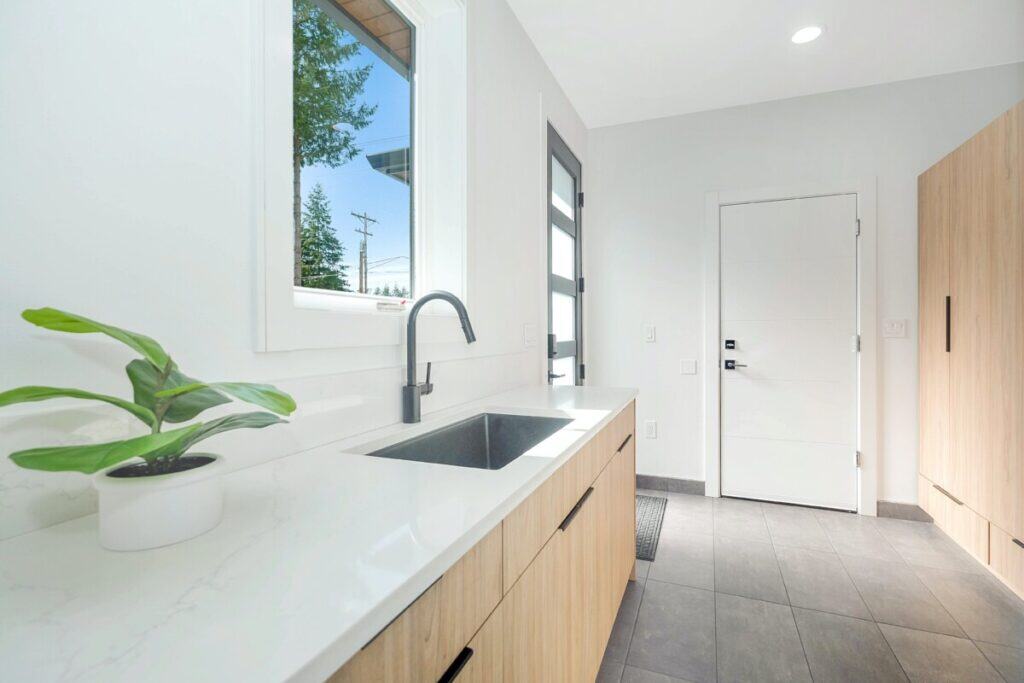
The 2015 BRANZ House Condition Survey found visible mould in 49% of New Zealand homes, with bathrooms the most affected room. Laundries get grouped into the same wet-area category, and Auckland’s subtropical climate makes that risk worse than further south. NIWA’s regional climatology describes Auckland summers as warm and humid; winters as mild but damp.
That’s the room your cabinetry has to survive. The failure points we see most often when we’re called in to replace a one or two-year-old laundry:
- Raw chipboard edges. Cheap flat-pack cabinetry uses iron-on edge tape. After eighteen months of detergent splash and humidity, the tape lifts at the corners. Water gets behind it and the chipboard swells — the cabinet door front bows outwards and won’t close flush.
- Hinges that aren’t soft-close. Doors get slammed against carriers thirty times a week. Standard hinges loosen and sag within a year.
- Particleboard carcasses sitting on the floor. One leak from a poorly fitted washing machine hose and the bottom 50mm of the cabinet swells permanently.
- No ventilation pathway. A small enclosed laundry with a dryer and no extractor is a mould chamber.
At Little Giant we manufacture cabinetry in our 700m² Rosedale factory with German laser edge-banding. The edge tape is fused to the substrate at temperature, not glued on with an iron in a back shed. There’s no seam for water to get behind. That’s not marketing. It is the single technical reason a cheap laundry cabinet fails at the edge inside two winters and a properly banded one doesn’t.
“Half the laundry replacements we quote are jobs that should never have failed. The cabinetry was wrong for the room from day one. No edge sealing, no soft-close, no thought given to where the dryer vents. Get the spec right and you don’t redo it in five years.” — the Little Giant Interiors design team
The seven decisions that shape a small laundry
Most small Auckland laundries are between 2m² and 6m². Every centimetre is a decision. Work through these seven before you talk to a cabinet maker.
1. Walk the room first
Measure the wall lengths, the ceiling height, where the door swings, where the window sits, and where the existing plumbing and electrical comes in. Mark the location of the meter board and any switchboards — they can’t be built over. Photograph the back wall from three angles. Most “we couldn’t fit it” surprises happen because someone designed off floor-plan dimensions without checking what’s actually in the wall.
2. Choose your machine layout
You have three options in a small space:
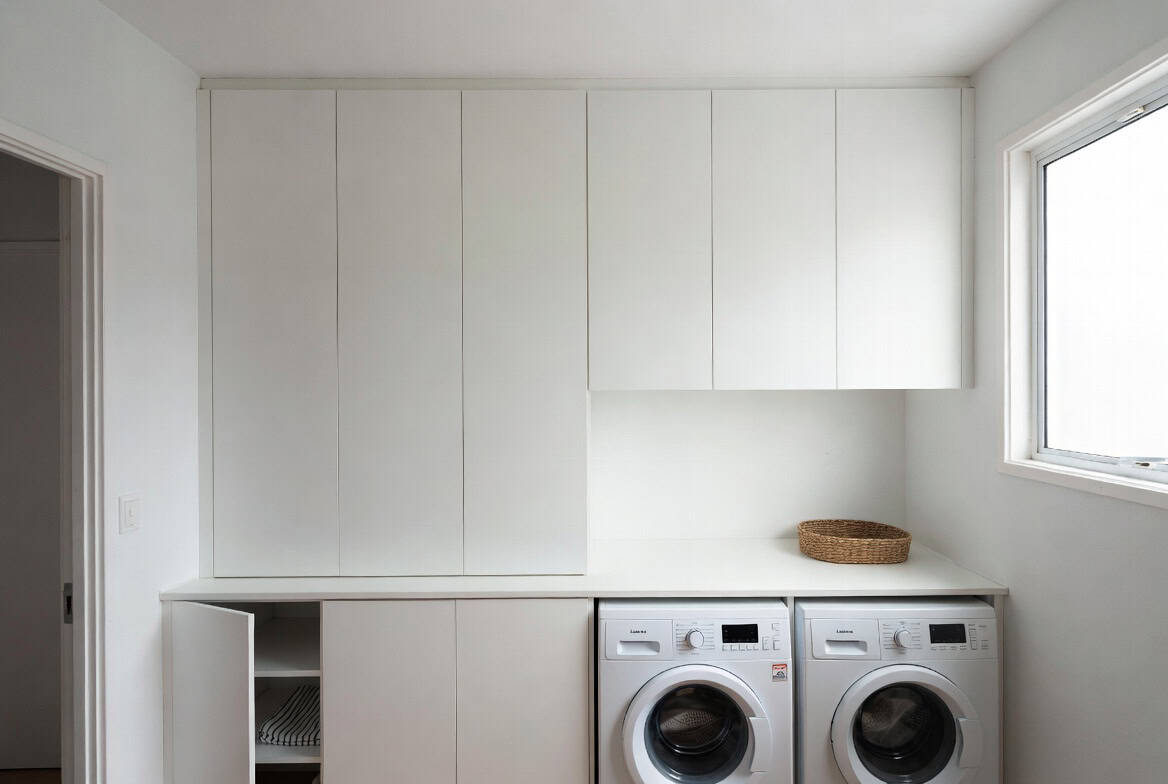
- Side-by-side — washer and dryer next to each other under the benchtop. Needs ~1.3m of wall length. Easiest to use.
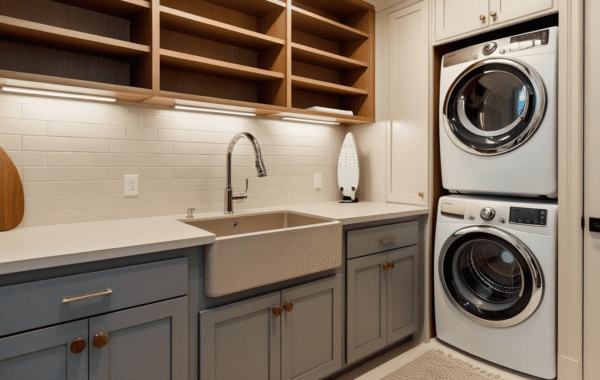
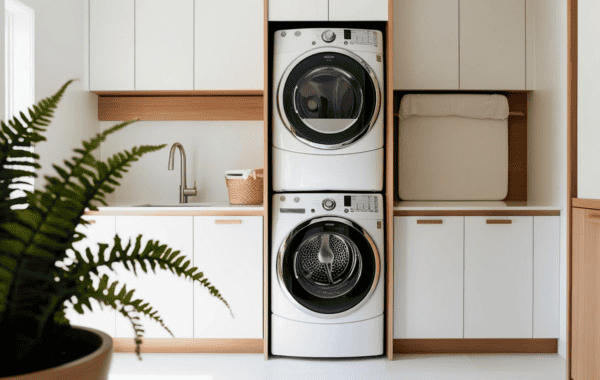
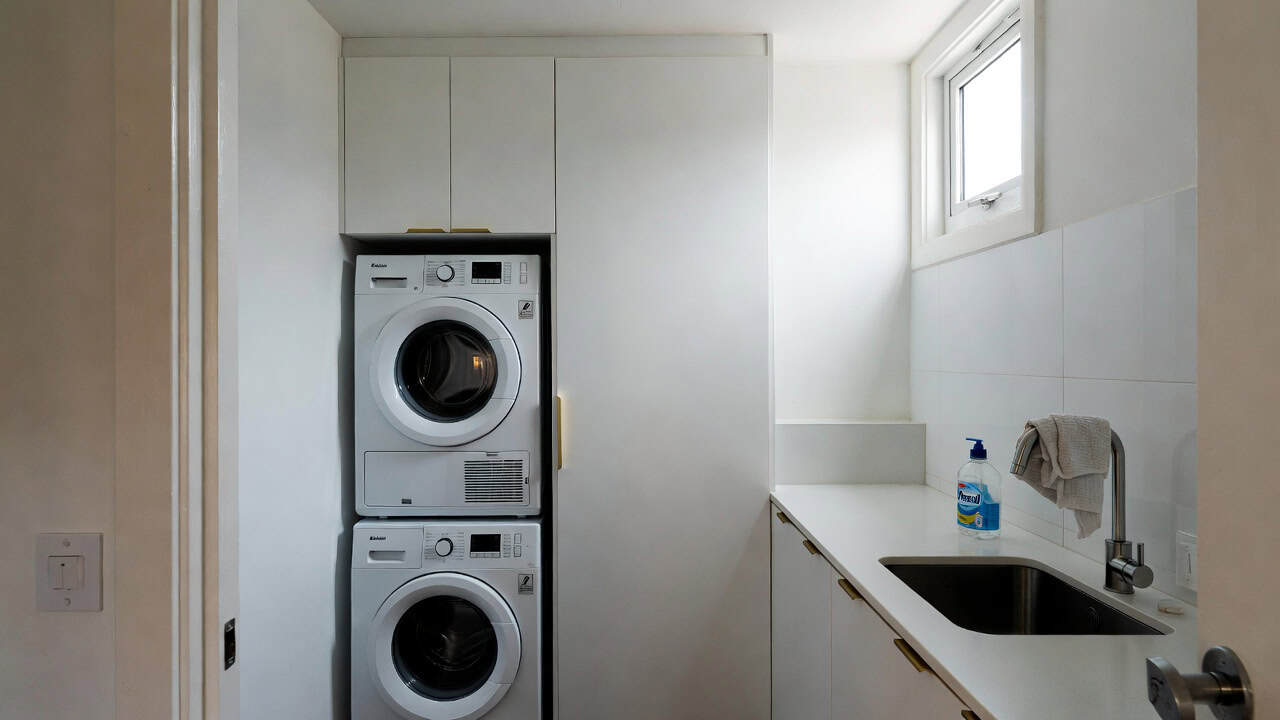
- Stacked — dryer mounted on top of the washer with a stacking kit. Frees up roughly 600mm of floor for a tall cupboard or sink. Best small-space move we know.
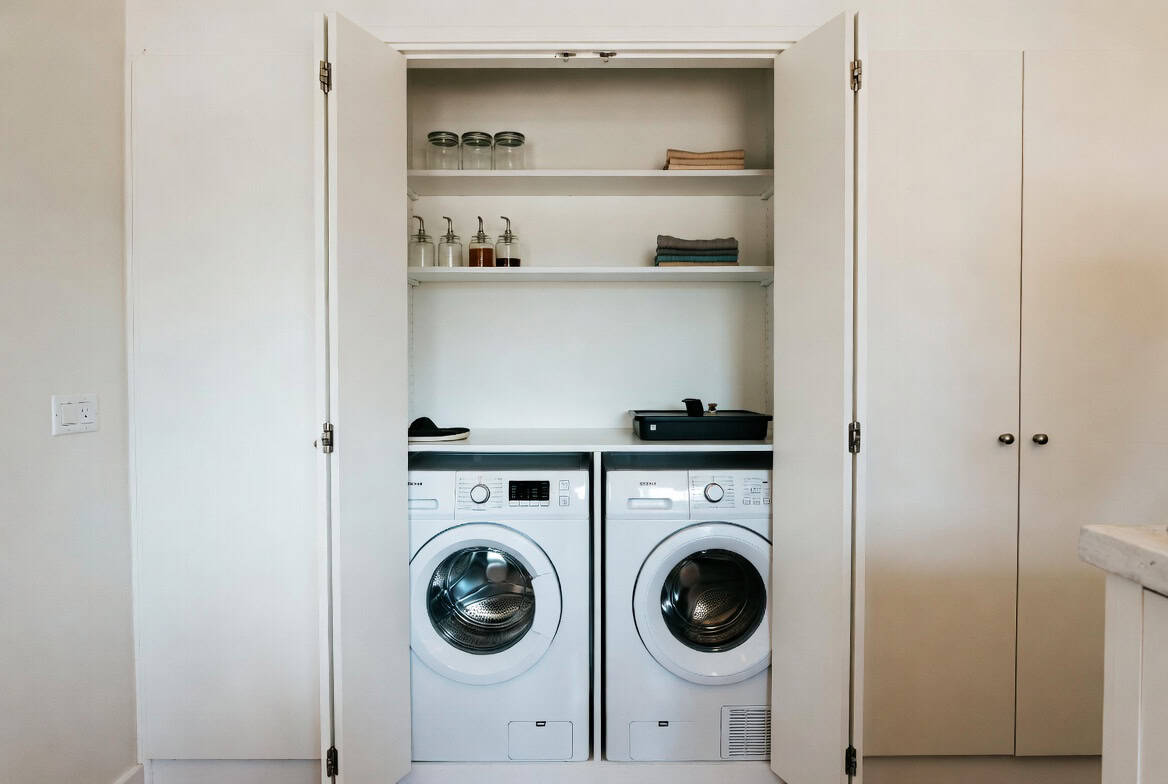
- Hidden — washer-dryer combo behind a cabinet door. Lowest visible footprint but you give up wash capacity and the unit costs more.
Stacked is what we specify most often in small Auckland apartments and townhouses. It opens up a full vertical cabinet run beside the appliances — somewhere between 60 and 110 additional towels and linen items, depending on width.
3. Plan the workflow
Sort → wash → dry → fold → store. Each step needs its own zone, even in 3m². If you’re folding on top of the dryer, that’s already two zones working as one. If you have a separate sink for hand-washing, that’s a third. Make sure there’s bench space between the appliances and where you’re folding, otherwise wet clothes go straight onto a worktop that wasn’t designed for it.
4. Pick your benchtop and sink
Laundry benchtops take more punishment than you’d expect. Hot dryer-warm clothes, bleach splashes, detergent spills. We specify Laminex postformed laminate or Caesarstone engineered stone for laundry benchtops — both are non-porous and clean up with a soft cloth.
A single deep stainless tub sink (around 450mm deep) handles hand-wash, soaking, and the occasional bucket fill. If you have under 4m² of laundry, consider skipping the sink entirely — a lot of small Auckland laundries don’t have one and don’t miss it.
5. Get the ventilation right
Healthy Homes Standards under the Residential Tenancies Act apply specifically to kitchens and bathrooms, not laundries — so there’s no legal minimum for the laundry itself. But the principles transfer. Tenancy Services requires bathroom extractor fans installed after 1 July 2019 to have a minimum 120mm duct diameter or 25 L/s exhaust capacity. We apply at least that standard in any enclosed laundry we design, and 50 L/s where the dryer doesn’t vent externally.
If your dryer is a condenser or heat-pump model, you avoid the vent problem entirely. Moisture gets collected and drained. If it’s a traditional vented dryer, the duct has to run to outside air, not into the roof cavity. We’ve seen too many roofs with rotted timbers from that exact mistake.
6. Plan storage by frequency of use
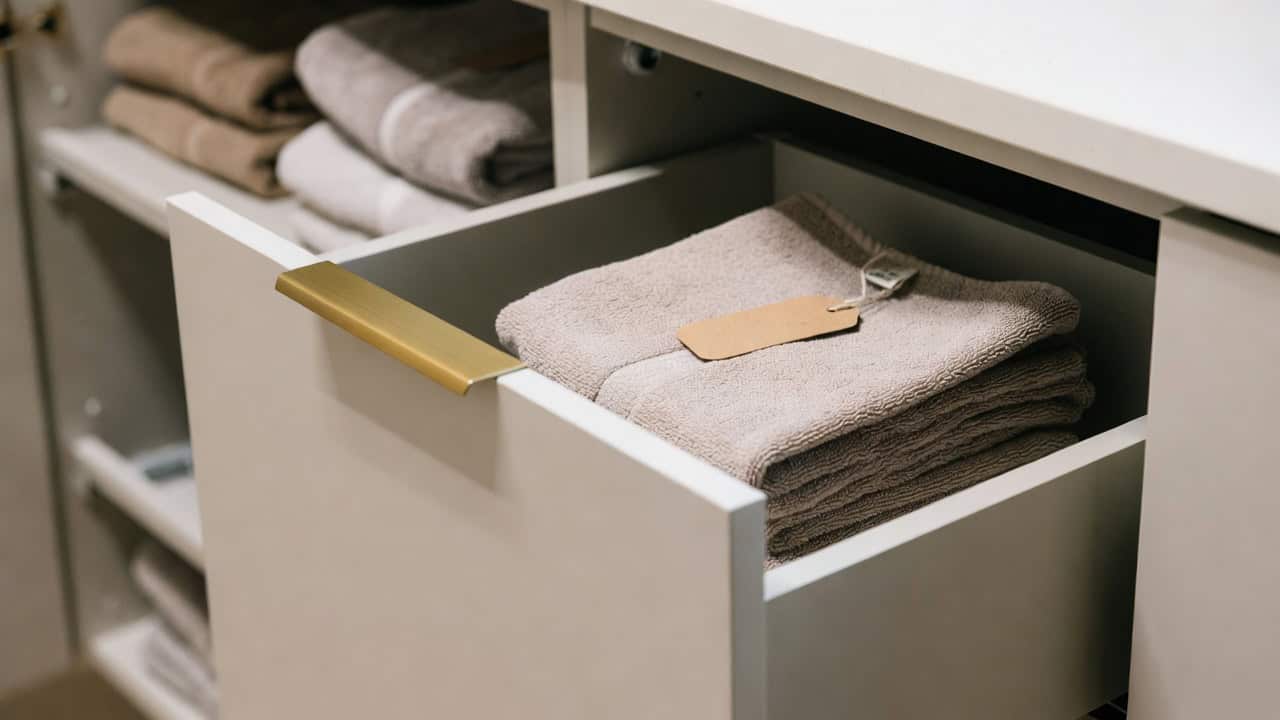
Daily items at bench height. Weekly items in the high cupboards above the benchtop. Bulk storage (spare detergent, bedlinen rotation) in the top sections you need a step to reach. Cleaning chemicals get their own zone — high enough to be out of reach of small children, low enough that you don’t dread getting them out.
7. Pick a cabinet finish that survives Auckland humidity
This is where the budget conversation gets honest. We cover materials in the next section.
Cabinet types for small Auckland laundries
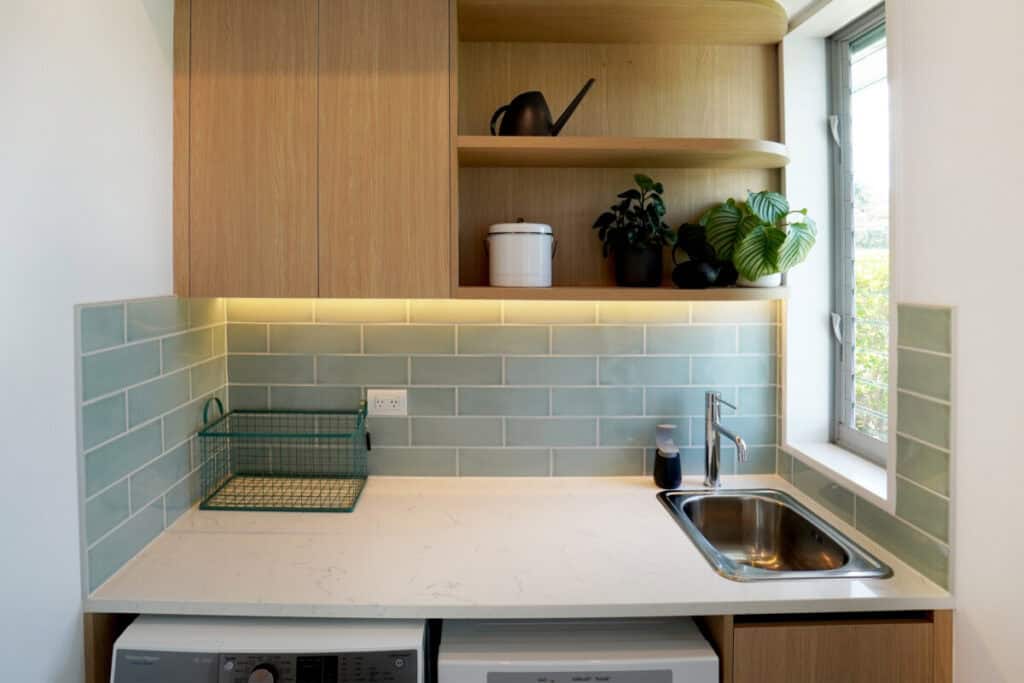
The mistake we see most: people fit the same cabinet types they’d put in a kitchen, scaled down. Laundries have different demands. Here’s what we actually use.
Full-height wall units
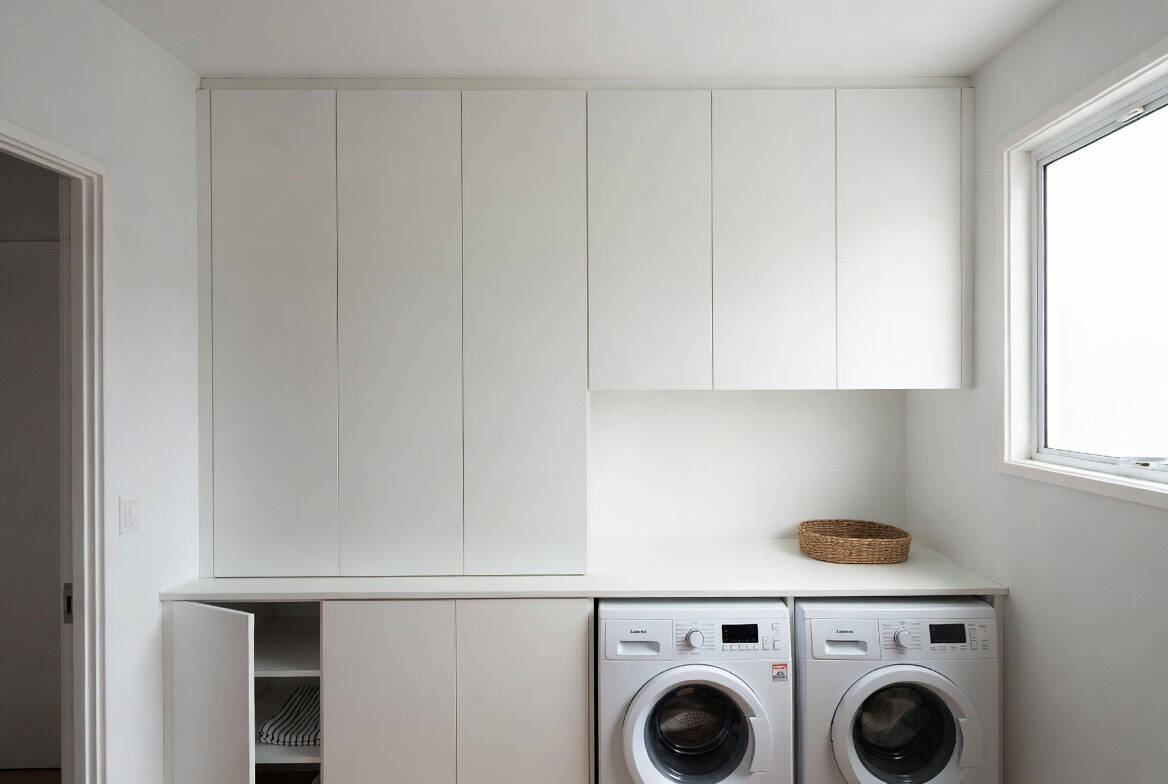
Floor-to-ceiling cabinetry on one or two walls. The single biggest space gain in a small laundry — you’re using the airspace between 2.1m (standard wall cabinet height) and your ceiling, which is usually 2.4m or 2.7m. That recovered 300–600mm of vertical space holds a surprising amount.
Base cabinets with internal pull-outs
Standard 600mm base cabinets get more useful when you put pull-out baskets or wire trays inside. BLUM-rated drawer runners handle up to 70kg — enough for a stack of bath towels and folded linen. Pull-outs beat fixed shelves for one reason: you can see what’s at the back without unpacking the front.
Tall pull-out broom and ironing cupboards
A 300mm-wide tall cupboard fits a vacuum, mop, broom, and ironing board vertically. Door pulls out the lot together. Massively underused in NZ laundry design — most homes still put the broom behind the back door.
Standard laundry cabinet and cupboard sizes in NZ
Most NZ laundry cabinetry gets built off kitchen dimensions, which is part of why so much of it fits the room badly. The numbers we actually work to:
- Base cabinets — 720mm high before the benchtop goes on, 560–580mm deep. A cabinet that has to house a front-loader needs 600–650mm of internal depth, so appliance recesses get built deeper than the run beside them.
- Benchtop height — 900mm finished is standard. We’ll take it to 920–950mm for a tall household, because folding at the wrong height is what makes a laundry tiring to use.
- Wall cabinets — 300–350mm deep, 600–900mm high, hung so the underside sits 500–600mm clear of the benchtop. Any deeper and you’ll hit your head reaching into the tub.
- Tall broom cupboards — 300–450mm wide, full height, 560mm deep. Enough for a vacuum, mop and ironing board standing up.
- Laundry cupboard (European laundry) — allow a minimum internal 1,300mm wide by 700mm deep for a side-by-side washer and dryer, or roughly 700mm by 700mm if you’re stacking them.
Custom cabinetry doesn’t have to obey any of these. That’s the point of it. But knowing the standard numbers tells you quickly whether a stock module is ever going to fit your room, or whether you’re about to pay for filler panels.
Open shelving
Works for decorative folded linen or jars of decanted detergent. Doesn’t work for half-empty fabric softener bottles and tangled extension cords. Use it sparingly and only above the benchtop, never below.
Hidden / behind-door storage
The back of a tall cupboard door fits a slim wire organiser for stain removers, brushes, and dryer balls. Cheap to add at manufacture, hard to retrofit. Ask for it in the design brief.
Stacker units above appliances
The cabinet that sits directly above the washer-dryer recess. Critical detail: build it tall enough to clear the door fully open. Front-loaders need at least 600mm of clearance above the appliance lid line, otherwise the cabinet has to be cut short and the storage value is gone.
“In a 4m² Auckland apartment laundry, the difference between a designer who knows what they’re doing and one who doesn’t is about 40% of usable storage volume. Same room, same budget, very different outcome. It’s all in where the pull-outs go and how the vertical space gets carved up.” — the Little Giant Interiors design team
Materials that actually last in NZ laundries
The internet will tell you there are ten cabinet materials to choose from. We use four. The rest don’t belong in a laundry.
Melamine on MDF or moisture-resistant board (Laminex, Melteca, Bestwood)
This is our default specification for laundries. Laminex and Melteca melamine boards are durable, easy to clean, and covered by a Laminex product warranty of up to 10 years on premium ranges when installed correctly. The “when installed correctly” matters — that’s where edge-banding and substrate quality come in. We use moisture-resistant MDF substrate in the bottom 200mm of every laundry cabinet by default, even if the rest is standard MDF, because that’s the splash zone.
Acrylic and polyurethane
For homeowners who want a high-gloss or premium matte finish, acrylic and 2-pack polyurethane upgrade the look significantly. They’re both more expensive than melamine and worth it in feature areas — a laundry that’s visible from the kitchen, or a butler’s pantry that doubles as laundry storage. The trade-offs between them are covered in detail in our acrylic vs laminate guide.
Solid timber accents
Used sparingly — open shelves, a single feature panel, a benchtop edge. Solid timber in a laundry is high-maintenance and we don’t recommend it for whole cabinet runs. It looks great for three years and then asks for resealing every winter.
Laundry benchtop options and what they suit
The benchtop is where a laundry budget most often gets trimmed, and it’s usually the wrong place to trim it. What we specify, roughly in order of cost:
- Postformed laminate (Laminex, Melteca) — the default for most laundries. Non-porous surface, a large colour range, and the rolled front edge means there’s no seam for water to sit in.
- Compact laminate — a solid laminate slab with no separate substrate to swell. Worth the step up for a laundry with a top-loader or a deep tub, where standing water is a fact of life.
- Engineered stone (Caesarstone) — specified where the laundry is visible from the kitchen and the two spaces need to read as one. Overkill in a hidden 2m² laundry cupboard.
- Stainless steel — the practical option nobody asks for. Tub and benchtop welded as one piece, nothing to seal, nothing to swell. It reads industrial rather than residential, which is why it stays niche.
- Solid timber — we usually talk clients out of it. Constant water plus Auckland humidity means resealing on a schedule, and a laundry is not the room to give yourself another maintenance job.
Whatever the material, the detail that decides its life is what happens where the benchtop meets the wall and where it meets the tub. Silicone on its own fails. A proper upstand or a sealed junction is what keeps water out of the substrate underneath.
What we don’t specify for laundries
Solid wood doors throughout (movement, sealing maintenance). Untreated MDF (will swell). Vinyl-wrapped doors (the wrap lifts at the edges with steam). Painted MDF doors finished on-site rather than factory (paint adhesion fails). Particleboard with iron-on edge tape (the failure mode we opened with).
Small laundry layouts that work
Five layouts cover roughly 90% of small Auckland laundries.
Galley laundry
Single line of cabinetry along one wall. Cleanest, simplest, easiest to manufacture and install. Works in widths from 1.6m up. Best layout for a laundry that has to also be a pathway — back door at one end, internal door at the other.
L-shape laundry
Cabinetry along two adjacent walls. Gives you more bench length, fits a sink + appliance + dedicated folding zone. Needs at least 2m × 1.5m of floor space.
European laundry (laundry in a cupboard)
A washing machine and dryer hidden behind bi-fold or pocket doors in a hallway, kitchen, or bathroom. No dedicated laundry room. Common in central Auckland apartments. Done well it’s invisible. Done badly the doors warp from the steam.
Combined laundry / scullery
The laundry doubles as the kitchen’s back-of-house — bulk dry storage, secondary fridge, washing machine. Increasingly common in renovated villas where the original laundry was an exterior lean-to.
Combined laundry / mudroom
Bench seat with shoe storage under, hooks for wet jackets above, then the laundry cabinetry continues along the next wall. Suits families with kids, dogs, or both. Works best where the laundry is between the back door and the rest of the house.
Hardware that earns its keep
The hardware inside the cabinets is what separates a laundry that still feels new at year ten from one that’s been jammed and rattling since year two.
BLUM soft-close — what we spec as standard
Every Little Giant laundry uses BLUM soft-close hinges and drawer runners as the default specification. We cover why we spec BLUM specifically in our kitchen drawers guide, but the short version is: in 1,000+ installs we’ve never replaced a failed BLUM mechanism within warranty period. Cheaper hardware has a fail rate that costs more in service calls than the upfront saving.
Pull-out baskets and bins
A pull-out laundry hamper inside a base cabinet keeps dirty washing out of sight without dedicated floor space. Two-basket pull-outs (whites + darks) are the most-requested upgrade we see on small laundries.
Hidden ironing board
A fold-down ironing board inside a tall cabinet — pulls out, locks horizontal, folds back when you’re done. Adds maybe $400–$600 to the cabinet cost but removes the need for floor storage. Worth it in any laundry under 4m².
Wall-mounted drying rails
Häfele and Eureka both make wall-mounted fold-down drying rails that take 8–15m of line when deployed and sit flat against the wall when not in use. Better than a freestanding airer in a small room because you can fold it away the second the washing’s dry.
What a custom Auckland laundry actually costs
Custom laundry cabinetry in Auckland sits in three rough tiers, depending on size, materials, and hardware:
- Compact (under 4m², melamine, basic hardware): from around $5,000–$8,000
- Standard (4–6m², melamine with feature elements, BLUM hardware): $8,000–$15,000
- Premium (full polyurethane or acrylic, integrated appliances, stone benchtop, full hardware spec): $15,000–$25,000+
If you’re weighing up the whole room rather than just the cabinetry, our guide to what a laundry renovation costs in NZ covers plumbing, flooring and the trades alongside the joinery. For the cabinetry alone, our laundry cabinetry cost calculator takes about a minute and returns a tailored range rather than a generic figure. Worth doing before you talk to any cabinet maker.
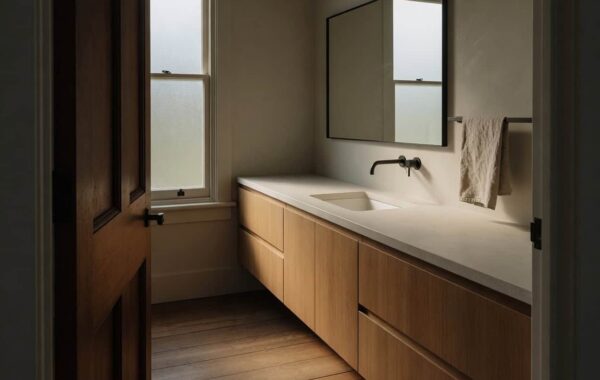
One honest note: cheap flat-pack laundry cabinetry can be had for $2,000–$3,000 from the big box stores. We don’t compete with that and we don’t try to. The cost difference between flat-pack and custom is real, but so is the failure-rate difference, and so is the storage-volume difference for the same wall length. If your priority is the lowest possible upfront cost, custom isn’t the right fit. If your priority is a laundry that still works at year ten, it is. The same logic applies next door: it is the reason we build custom bathroom vanities the same way, out of the same moisture-resistant substrate.
Flat-pack, pre-made or custom laundry cabinets?
There are three ways to buy laundry cabinetry in New Zealand and they suit genuinely different situations. We build custom, so weigh our view accordingly — but the honest comparison is more useful to you than a sales pitch.
Flat-pack laundry cabinets
Boxed, unassembled carcasses in fixed module widths, usually 300, 450, 600 and 900mm, that you assemble and install yourself. Cheapest by a wide margin. The catch in a small laundry is the module grid: if your wall measures 1,780mm you fit 1,650mm of cabinetry and lose the balance to filler panels. In a 2m² room that is a meaningful amount of storage gone. Check the substrate as well, because most budget flat-pack uses standard particleboard with iron-on edge tape, which is the failure mode this guide opened with.
Pre-made and assembled laundry units
The same fixed module grid, delivered already built. You skip the assembly, which is worth something if a cam-lock and a cordless drill aren’t your idea of a good Saturday, but you’re still designing around stock widths and you still need someone to fit, level and scribe them to the wall. Pre-made units are a fair answer for a rental, a bach laundry, or a European laundry cupboard where the run is short and simple.
DIY laundry cabinets
Fitting the cabinetry yourself is genuinely doable for a straightforward galley run on flat walls. Two things catch people out. Laundry walls are rarely square, so scribing the filler strips takes more patience than the install itself. And the plumbing and electrical work still has to be done by a registered plumber or electrician no matter who builds the boxes.
Custom laundry cabinets
Manufactured to your exact wall lengths and ceiling height, which removes both the filler panels and the dead space above standard wall cabinets. You choose the substrate, the hardware and the internal fit-out. It is the most expensive of the three and the only one that solves the awkward-dimension problem properly, which is why it makes most sense in the smallest rooms rather than the largest.
| Option | Indicative spend, small laundry | Handles odd dimensions | Best suited to |
|---|---|---|---|
| Flat-pack, self-installed | $2,000–$3,000 | No, fixed module widths | Lowest upfront cost, square rooms, DIY-confident owners |
| Pre-made, trade-installed | $3,000–$6,000 | Partly, with filler panels | Rentals, baches, short simple runs |
| Custom, designed and fitted | $5,000–$25,000+ | Yes, built to the measured room | Tight or irregular rooms, long-term ownership, matching an existing kitchen |
💡 Design tip: measure your longest laundry wall and divide it by 600. If the answer isn’t close to a whole number, a stock module layout is going to cost you storage that custom cabinetry would have kept.
How Little Giant designs your laundry
Every project follows the same six-step process whether it’s a 3m² European laundry or a fully integrated scullery-laundry. It’s the same process behind the laundry cabinetry we design, build and fit for Auckland homes:
- Free in-home consultation. One of our designers visits your home, measures the room, and discusses what you actually need from the space.
- Concept and 3D render. We produce a preliminary 3D design so you can see the layout before committing to a quote. No pressure.
- Detailed quote + specification. Material, hardware, appliance integration, lead time. Everything in writing.
- Manufacture at our Rosedale factory. Local manufacturing with German laser edge-banding. No imported flat-pack, no offshore lead-times.
- Install by our team. Our installers handle delivery, fit-off, and final adjustment. Full-satisfaction installation guarantee.
- Warranty. Up to 10 years on premium Laminex ranges, lifetime manufacturer cover on BLUM and Hettich mechanisms, and 5 years on our own installation workmanship.
Frequently asked questions
How much should I budget for custom laundry cabinets in Auckland?
A compact custom laundry (under 4m², melamine finish, BLUM hardware) starts around $5,000–$8,000. A mid-range laundry (4–6m² with feature elements) typically sits at $8,000–$15,000. Premium specifications with polyurethane or acrylic finishes, integrated appliances, and stone benchtops range from $15,000–$25,000+. Use our laundry cabinetry cost calculator for an estimate tailored to your space.
Do I need a building consent for a laundry renovation?
Generally no, if you're replacing cabinetry and not moving plumbing or electrical services. If you're relocating the washing machine, adding a new sink, or making structural changes, your designer will advise on consent requirements. Plumbing and electrical work always needs to be done by a registered plumber or electrician under Building Code G12 and the Electricity (Safety) Regulations.
What ventilation does a small laundry actually need?
Healthy Homes Standards apply to kitchens and bathrooms, not laundries — but the principles transfer. We recommend at least a 120mm duct extractor fan with 25 L/s exhaust capacity in any enclosed laundry, matching the Tenancy Services bathroom requirement. If your dryer vents internally rather than externally, step up to 50 L/s. Condenser or heat-pump dryers remove the vent problem entirely.
Can custom cabinetry fit a really small space?
Yes — small spaces are where custom cabinetry pays off most. Standard flat-pack modules waste 40–80mm at every awkward corner. Custom cabinetry is built to your exact wall length and ceiling height, so every centimetre is used. We've fitted full-function laundries into spaces as small as 1.6m × 0.8m.
How long does a custom laundry take from design to install?
Typical timeline is 8–12 weeks from final design sign-off to install completion. Design and concept stage takes 2–3 weeks. Manufacturing in our Rosedale factory takes 4–6 weeks depending on order volume. Install is usually 1–3 days on site. Lead times can shorten outside peak renovation seasons.
What's the warranty on Little Giant laundry cabinets?
Laminex products carry a warranty of up to 10 years on premium ranges, with standard Melteca board shorter than that, so the exact term depends on the board you choose. BLUM and Hettich mechanisms carry lifetime manufacturer cover on hinges and drawer runners. Our own installation workmanship is covered for 5 years. Ask any cabinetmaker for those terms in writing before you sign; a vague answer to that question tells you plenty.
Is melamine durable enough for an Auckland laundry?
Yes, when it's the right melamine and the edge-banding is done properly. Laminex and Melteca melamine boards are non-porous, scratch-resistant, and rated for wet-area use. The failure mode in cheap melamine cabinetry is the edge, not the face — water gets behind iron-on edge tape and swells the substrate. Our German laser edge-banding fuses the edge tape at temperature, eliminating that failure mode.
Can you match the laundry cabinetry to my kitchen?
Yes — matching laundry to kitchen is one of the more common requests we get, especially when the laundry is visible from the kitchen or in a connected scullery. We can match Laminex or Melteca colour codes exactly, replicate handle profiles, and continue benchtop materials through. The match is identical when both spaces are manufactured at our factory at the same time.
Are flat-pack laundry cabinets any good?
For a square room, a short run and a tight budget, flat-pack does the job. Two things limit it. The module widths are fixed at 300, 450, 600 and 900mm, so any wall length that doesn't divide neatly loses storage to filler panels, and that hurts most in the smallest laundries. And most budget flat-pack uses standard particleboard with iron-on edge tape, which lifts at the corners under detergent splash and humidity. If you go flat-pack, spend the difference on a moisture-resistant carcass and better hinges.
What are the standard laundry cabinet sizes in NZ?
Base cabinets are 720mm high before the benchtop and 560 to 580mm deep, with the benchtop finishing at 900mm. Wall cabinets run 300 to 350mm deep and 600 to 900mm high, hung 500 to 600mm above the benchtop. Tall broom cupboards are 300 to 450mm wide at full height. For a European laundry cupboard, allow an internal 1,300mm by 700mm for a side-by-side washer and dryer, or about 700mm by 700mm stacked. Custom cabinetry is built to your room rather than to these numbers.
➡ Book your free in-home design consultation with Little Giant Interiors
➡ See our 6-step design and build process
➡ Learn more about our laundry cabinetry in Auckland
Have you been putting off your laundry or kitchen renovation?
We offer flexible finance options to help you get it done sooner. Learn more about our interest-free finance options.