


How Much Does a Custom Wardrobe Cost in Auckland? (2026 Price Guide)
Quick answer: A custom wardrobe in Auckland runs from about $1,800 to $20,000+ in 2026. A reach-in or standard built-in sits at $1,800–$4,500, a mid-range built-in at $4,500–$9,000, and a walk-in or dressing room at $9,000–$20,000+. The job we quote most often lands between $5,000 and $11,000. Size, board, hardware, door type and how much of the run goes full-height do most of the moving.
Here’s the awkward truth about wardrobes: almost nobody can ballpark one. You know roughly what a fridge costs, or a couch, or a week in Fiji. Ask the average Aucklander what a fitted wardrobe should cost and you’ll get a shrug and a guess that’s out by a factor of three.
That’s not your fault. Wardrobes are one of the few things in a home where two units that look nearly identical can be priced $4,000 apart — and the reasons sit behind the doors, in the board, the edges and the runners. The price you’re quoted is mostly a story about what the wardrobe is made of and how it’s built, not how it looks in the showroom photo.
So this guide does something the usual “wardrobes cost between X and Y” articles don’t. We will give you the real Auckland numbers for 2026, reach-in, walk-in and freestanding, and then pull the doors off and show you what actually moves the price. Carcass thickness. Edge-banding method. Hardware brand. Bay count. Full-height versus standard. The lot.
We build custom wardrobes from our own 700m² factory in Auckland, so these aren’t numbers we’ve scraped off a competitor’s page. They’re the figures and trade-offs we talk through with clients every week, from a single reach-in along a bedroom wall in Mt Eden to a full his-and-hers walk-in in a new Hobsonville build. By the end you’ll know what your project is likely to cost, what’s worth paying for, and where you can trim without ending up with a wardrobe that sags in two years.
What a Custom Wardrobe Actually Costs in Auckland (2026)
Let’s start with the numbers, then explain them. Most custom wardrobes in Auckland land between $1,800 and $20,000+ in 2026, and the job we quote most often sits at $5,000 to $11,000. Those are the same bands we publish on our wardrobe cost calculator. A blog and a calculator on the same website disagreeing about price is no use to anyone setting a budget, so we keep them matched.
Here is how that breaks down by type. These are guide figures for a fitted, installed wardrobe rather than flat-pack you assemble yourself. Treat them as a starting point for budgeting, not a quote: your real number comes out of a measure and a design, because two 3-metre walls can carry wildly different wardrobes.
| Wardrobe type | Typical Auckland range (2026) | What that buys |
|---|---|---|
| Reach-in / standard built-in | $1,800 – $4,500 | 1.8–2.4m wide, melamine carcass, sliding or hinged doors, a shelf-and-rail fit-out |
| Mid-range built-in | $4,500 – $9,000 | Full-height, soft-close drawers, a proper internal layout, upgraded door finish |
| Walk-in / dressing room | $9,000 – $20,000+ | Joinery on multiple walls, drawer banks, shelving towers, premium hardware, lighting |
| The job we quote most often | $5,000 – $11,000 | A considered built-in or a modest walk-in, soft-close throughout |
💡 Design tip: Before you fixate on a number, measure the width of the wall you’re working with and note the ceiling height. Wardrobe pricing tracks closely with linear metres and whether you go full-height — those two figures alone get you most of the way to a realistic budget.
The Three Budget Tiers — and What You Actually Get
Most quotes fall into one of three bands. Knowing which one you’re aiming for saves a lot of back-and-forth.
Reach-in / standard built-in ($1,800–$4,500): a clean, functional fit-out. Standard-height units, melamine board, a single hanging rail or two, fixed shelves, maybe one bank of drawers on basic runners. This is the right call for a rental, a kid’s room, or a spare-room reach-in where you want tidy storage without the extras.
Mid-range built-in ($4,500–$9,000): where most Auckland homeowners land. Full-height units that use the dead space up to the ceiling, soft-close drawers, a proper mix of long-hang and double-hang, shelving for shoes and folded clothes, and a finish chosen to match the room. This is the tier where a wardrobe stops being “storage” and starts being part of the room.
Walk-in / dressing room ($9,000–$20,000+): multiple bays, premium drawer systems, integrated lighting, glass-fronted or mirrored sections, pull-out accessories, sometimes a dressing island. A full dressing room with joinery on three walls sits at the top of that range.
Why the Range Is So Wide
A $2,000 wardrobe and an $8,000 wardrobe can occupy the exact same wall. The difference is not markup, it is specification. One is standard-height with two shelves and a rail. The other runs floor to ceiling, with soft-close drawers on full-extension runners, shoe shelving, shelf supports spaced to the board manufacturer’s own span table, and a moisture-resistant substrate under the melamine.
The next section is the part nobody else publishes: a line-by-line look at what each of those choices does to the price. If you want a rough figure before you read on, our custom wardrobe cost calculator gives you a ballpark in under a minute, or see how we approach wardrobes made to fit the wall you have actually got.
What Actually Drives the Price (the Maker’s View)
Most cost guides stop at “it depends on materials and size.” True, but useless. Here’s what actually happens to the number on your quote when each of these changes — from the side of the bench where the wardrobe gets built.
The Carcass Board: 18mm vs 25mm, and Why Moisture Matters
The carcass is the box itself — the sides, top, bottom and shelves everything hangs off. It’s the single biggest material cost in a wardrobe, and it’s where the cheapest jobs cut corners.
Board thickness is the first lever. Standard cabinetry uses 18mm board; stepping up to 25mm on shelves and gables costs more but stops the sag you see in cheap units after a few winters of heavy jumpers. The second lever is the substrate. A bog-standard particleboard wardrobe is fine in a dry bedroom and the wrong choice anywhere near a bathroom, laundry or a poorly ventilated room.
We build a lot of our wardrobe interiors in Melteca, the melamine board Laminex has made in New Zealand for more than forty years. Its own technical data sheet lists five finishes and four substrates: Superfine particleboard, Superfine MR particleboard, Lakepine MDF and Lakepine MRZero. The two MR options are the moisture-resistant ones, and in an older villa or a bedroom that never gets much air they are money well spent.
Two conditions from that data sheet are worth knowing before anyone sells you on a board, because they are limits rather than features. Melteca is specified for interior use only and Laminex states it must not be used in high-humidity or wet areas such as saunas or showers. The sheet also says plainly that any exposed substrate must be sealed before service. So “moisture-resistant” is not “waterproof”: it buys you tolerance in a normal bedroom or a laundry cupboard, and it still depends on every cut edge being properly sealed. That is a fabrication question, not a shopping question, which is why we care about it more than most people expect.
Edge-banding: the Detail Nobody Asks About and Everybody Notices Later
This is the one most people never think about, and it’s the one we’d tell you to care about most. Every exposed edge of board has to be sealed with a strip of edging. How that strip is bonded on decides whether your wardrobe still looks crisp a decade from now — or peels, yellows and lifts at the corners.
Laminex specifies that Melteca edges should be finished with a PVC or ABS edgetape, in 1mm or 2mm. The question is how that tape is bonded on. The cheap method is iron-on or hot-melt, which leaves a faint glue line that can let go over time with humidity and handling. We run German laser edge-banding in our Rosedale factory, which fuses the tape to the board without a separate glue line, so there is no seam for moisture to get into and nothing to peel. It costs more than an iron-on edge, and it is a large part of why we are comfortable putting a five-year installation guarantee behind the work.
💡 Design tip: When you compare wardrobe quotes, ask each supplier how their edges are finished. A laser-bonded or hot-air edge will outlast a basic iron-on tape by years. It’s a small line item that quietly decides how long the whole thing lasts.
Hardware: Where Cheap Quotes Hide the Savings
Drawers and runners are where a low quote often makes its money back. A drawer on a basic runner and a drawer on a quality soft-close system feel like different appliances — one rattles and bottoms out, the other glides shut on its own and carries real weight.
We fit BLUM drawer systems as standard, with BLUMOTION soft-close and full-extension runners so the whole drawer comes out and you can reach the back of it. Häfele and Hettich make solid alternatives.
The number worth knowing is the load-bearing class. Blum publishes its MOVENTO full-extension runners in 40kg to 70kg load-bearing classes, which is why they hold up under a wide, deep drawer full of folded clothes and shoes without dropping at the front. A basic runner carries a fraction of that and it shows within a couple of years. Hardware is the part of the wardrobe your hands touch every single day, so it is the last place we would suggest economising. Skimp on the finish colour if you must. Do not skimp on the runners.
Bays, Height, Doors and Internals
After board, edges and hardware, the rest of the number comes down to how much wardrobe there is and what’s inside it. More bays (the vertical sections) means more material and labour. Going full-height to the ceiling adds board and an extra run of shelving, and it converts the dead strip above a standard 2.1m wardrobe into real storage without taking another millimetre of floor. On a typical Auckland ceiling that is an extra shelf run across the whole width of the wardrobe, and it is usually worth it. Then there are the internals and doors:
- Drawers cost more than shelves; each bank of soft-close drawers adds up.
- Sliding doors save floor space but the track and panels cost more than hinged doors. Mirrored sliders cost more again.
- Internal accessories such as pull-out shoe racks, trouser rails, jewellery trays and hampers each add to the total, but earn their keep in daily use.
- Integrated LED lighting is a walk-in favourite and a genuine extra, both for the strips and the wiring.
None of this is mysterious once you can see it itemised. It’s also exactly what we walk through, on screen, during the free 3D design that comes with every consultation — so you can see the cost of each choice before you commit to it. Here’s how that 6-step design and build process works from first measure to handover.
Why Cheap Wardrobe Shelves Sag, and the Table That Predicts It
Every wardrobe quote you get will list a board thickness. Almost none of them will tell you the thing that actually decides whether a shelf sags: how far apart the supports are. Board thickness only matters in relation to span, and Laminex publishes the exact numbers in the Melteca technical data sheet. They are worth putting in front of you, because they turn a vague argument about quality into something you can check with a tape measure.
These are maximum recommended spans for a Melteca shelf carrying a uniformly distributed load, based on a creep factor of 2 and a final deflection of 0.006 times the span. In plain terms: past these widths, the shelf is expected to bow visibly over time.
| Load on the shelf | 12mm board | 16mm board | 18mm board | 18mm, supported at both ends and the middle |
|---|---|---|---|---|
| 25 kg/m² | — | — | 1,040mm | 1,330mm |
| 50 kg/m² | 690mm | 930mm | 830mm | 940mm |
| 75 kg/m² | — | — | 720mm | 770mm |
| 100 kg/m² | 550mm | 740mm | 660mm | 670mm |
Read across the 18mm row at 50 kg/m² and you get 830mm. That is the number that quietly explains most sagging wardrobe shelves in Auckland. A 1.2-metre bay is a common, sensible-looking width for a reach-in, and an unsupported 18mm shelf spanning the full 1.2 metres is well past what the board is rated to carry. It will look fine on installation day. It will have a curve in it by the second winter, once the jumpers go back up there.
The fix is not thicker board. Look at the table again: 18mm carrying 50 kg/m² manages 830mm on its own, and 940mm once it has a support in the middle rather than only at each end. That is why a well-designed wardrobe splits a wide opening into two bays instead of running one long shelf, and why the bay count on your quote is a structural decision rather than a styling one. When you compare quotes, count the bays.
💡 Design tip: Measure the widest unsupported shelf on any wardrobe you are being quoted. If it runs past about 800mm in 18mm melamine and there is nothing holding up the middle, ask the supplier how they have allowed for deflection. It is a fair question and the answer tells you a lot about who you are dealing with.
Wardrobe Types and What They Cost in Real Terms
Type drives a lot of the budget, so it pays to be clear on which one suits your space and your life. Here’s how the main options stack up in an Auckland home.
Built-in / Reach-in Wardrobes
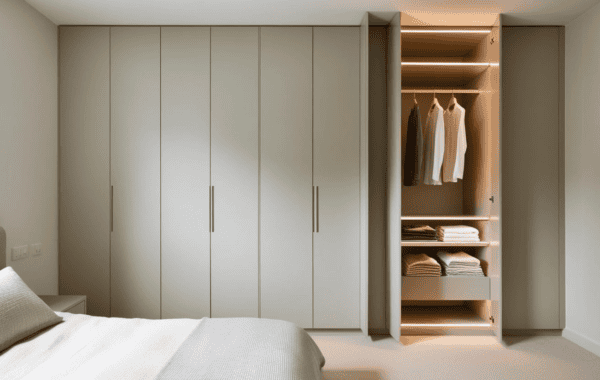
The workhorse. A reach-in sits in an existing recess or runs along a wall, with doors across the front, and you reach in rather than walk in. For most Auckland bedrooms, a well-designed built-in reach-in between $2,000 and $6,500 does everything you need.
Picture a 2.4-metre reach-in along the wall of a Mt Eden bungalow bedroom: full-height units to use the high ceiling, double-hang on one side for shirts and folded-over trousers, long-hang on the other for dresses and coats, a bank of four soft-close drawers in the middle, and shelving up top for the stuff you only reach twice a year. That’s a mid-range fit-out, and it’ll hold far more than the single rail and shelf it replaced.
What a built-in wardrobe costs in NZ, at a glance
Because a built-in wardrobe is the option most Auckland homeowners actually search for, here’s the short version of where the money lands. A basic built-in wardrobe in NZ, meaning standard height, melamine board, a rail or two and fixed shelves, starts around $1,800 and runs to about $4,500. A mid-range fit-out with full-height units and soft-close drawers sits at $4,500 to $9,000. The single biggest lever is whether you run it full-height: taking a built-in to the ceiling costs a little more board and picks up an extra shelf run across the full width, from the same footprint.
Walk-in Wardrobes
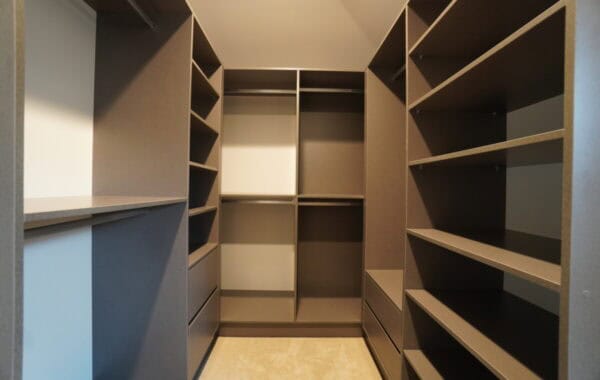
The master-bedroom upgrade. A walk-in needs floor space you actually walk into, which is why it sits at the top of the price range — you’re fitting out three walls instead of one. A functional walk-in starts around a moderate 2.4m x 2m footprint; below that, a generous reach-in usually makes better sense.
Say you’re carving a walk-in out of a spare room in a new Hobsonville build. You’ve got the floor area, so the questions become: how many bays, how much drawer storage, do you want a dressing bench or island, and how’s it lit and ventilated? Lighting matters more than people expect — you need to actually see colours and match items, so layered LED strips under shelves beat a single ceiling downlight. And keep the layout out of the path to an ensuite if you can; steam and clothes don’t mix.
Freestanding / Standalone Wardrobes
Custom freestanding units suit rooms where you can’t or don’t want to build into the structure — a rental you’re improving, an awkward older room in a Ponsonby villa, or a space you might reconfigure later. They cost a little less than equivalent built-ins because there’s less fitting and scribing to the walls, and they can move with you. The trade-off is they don’t use every last millimetre the way a built-in does. If a movable unit is the better fit for your situation, our guide to freestanding wardrobes in NZ weighs up the options in more detail.
Sliding vs Hinged vs Mirrored Doors
Doors are a real chunk of the budget and the first thing you see. Hinged doors are the most economical and give you full access to the opening; sliding doors save the floor space the door would otherwise swing into, which is gold in a tight Takapuna apartment bedroom. Mirrored sliders do double duty as a full-length mirror but add cost and weight. There’s no wrong answer — it’s about the room. A bedroom where the bed sits close to the wardrobe almost always wants sliders.
Doors are a big enough decision to have earned their own guide: our breakdown of sliding, hinged and mirrored wardrobe doors covers panel access, track types and what each choice does to a quote. Whatever the type, the design comes first. We measure, design it in 3D, and you see exactly what you are getting, and what it costs, before a single panel is cut.
Built-in, Fitted, Bespoke, Made-to-Measure: What the Words Mean and What Each Costs
Wardrobe pricing is confusing partly because the industry uses five words for roughly three products, and uses them inconsistently. Before you compare quotes, it helps to know which thing you are actually being quoted for, because the same room can attract very different numbers depending on which of these a supplier is selling.
| What it is usually called | What you actually get | Typical Auckland range |
|---|---|---|
| Built-in (also inbuilt, fitted) | Cabinetry fixed to the wall or set into an existing recess, scribed to the room. The umbrella term, and the one most Aucklanders mean. | $1,800 – $9,000 |
| Made-to-measure (also made-to-order) | Standard modules cut to your dimensions. The layout comes from a catalogue, the sizes come from your wall. Cheaper than full custom, tighter than flat-pack. | $1,800 – $5,500 |
| Custom (also bespoke) | Designed from your space and your brief rather than adapted from a module. Every internal dimension, bay count and finish is a decision rather than a default. | $4,500 – $20,000+ |
| Modular / flat-pack | Fixed-width boxes you assemble or have assembled. Filler panels cover whatever does not line up with the wall. | Below $1,800 |
The practical difference between made-to-measure and custom is where the design starts. Made-to-measure starts with a module and stretches it to fit your wall. Custom starts with your wall. In a square 1990s bedroom in Botany that distinction is worth very little, and made-to-measure is the sensible buy. In a villa with a chimney breast, a sloping ceiling or a 40mm difference between the two ends of the same wall, it is worth a great deal, because a module that cannot flex ends up hidden behind a filler panel and you have paid for storage you do not get.
“Bespoke” and “custom” mean the same thing in this trade, whatever the price difference implied by the word. If a quote uses one and charges a premium for it, ask what specifically is being designed from scratch.
Cheap Custom Wardrobes: What You Can and Cannot Get Under $3,000
People search for cheap custom wardrobes constantly and get very little honest information back, so here is the straight version. Under $3,000 in Auckland, a fitted, installed wardrobe is realistic if you keep it simple: a reach-in of roughly 1.8 to 2.4 metres, standard height rather than full-height, a melamine carcass in a standard decor, hinged or basic sliding doors, one or two rails, fixed shelves, and no drawer bank.
What does not fit under $3,000: drawers on quality runners, full-height units, mirrored sliders, integrated lighting, shoe or accessory pull-outs, and anything that needs joinery around an obstacle. Those are the items that move a wardrobe from the bottom band into the $4,500 to $9,000 range, and each of them is a real cost rather than a margin grab.
If your budget genuinely stops at $3,000 and the room needs more than a rail and a shelf, the more useful move is usually to reduce scope rather than reduce quality. A well-built half-width unit with proper runners beats a full-width one with rattly ones, and you can add the second half later. That sequencing is one of the more common things we end up recommending.
Do You Pay a Separate Design Fee?
Most Auckland wardrobe companies, ourselves included, roll the design into the project rather than charging a standalone designer fee, and the first in-home consultation and preliminary 3D design come free. Some interior designers and independent joinery designers do charge separately, either hourly or as a percentage of the build, in which case you are buying design and then buying the wardrobe from someone else.
Neither model is wrong, but they are not comparable line for line, so ask the question directly before you compare two quotes: is the design cost inside this number, and do I own the drawings if I take them somewhere else? A supplier who cannot answer that quickly is telling you something.
Custom vs Flat-pack: Where Your Money Goes
We’ll be straight with you, because pretending otherwise helps no one: a custom wardrobe is not the cheapest way to get clothes off the floor. So it’s fair to ask where the extra money goes, and whether it’s worth it for you.
The Honest Case for Flat-pack and Modular
Flat-pack and modular systems from the big retailers are cheaper up front and quick to get. If you’re handy with a drill, the space is a simple rectangle, and you’re after tidy, functional storage in a rental or a low-use room, they can be the sensible choice. There’s no shame in it — the right answer depends on the job.
Where they fall down is fit and finish. Off-the-shelf comes in fixed widths, so you end up with filler panels and dead gaps where the modules don’t quite reach the wall. The board is often thinner, the edges are basic, and the hardware is whatever came in the box. In a damp or older Auckland home, that combination ages fast.
Where Custom Earns Its Price
Custom isn’t about luxury for its own sake. It’s about three things flat-pack can’t do: fit your exact space with nothing wasted, use materials and hardware that last, and put a real warranty behind the whole thing.
Because we design and manufacture in our own Auckland factory rather than assembling someone else’s modules, we control the lot: board grade, the German laser edge-banding, the BLUM hardware, and the way it scribes to a slightly out-of-square 1970s wall. That’s the difference between a wardrobe that fits the showroom and one that fits your home. It’s also why we can back our cabinetry the way we do — see our workmanship and product guarantee for what that covers.
“The mistake I see most is people spending up on the doors and the colour, then cheaping out on the runners and the board behind them. It’s backwards. Spend where your hands go every day and where the moisture gets in. The finish you’ll admire for a week; the drawers you’ll open for twenty years.”
— the Little Giant Interiors design team
How to Budget Without Overspending
Custom doesn’t have to mean blowing the budget. A few honest moves keep the number sensible:
- Go full-height before you go fancy. Using the space up to the ceiling buys you more storage per dollar than almost any accessory.
- Put your money in hardware and board, not decor. A standard colour with great runners beats a designer finish on rattly drawers.
- Be honest about hanging vs shelving. Most people need less long-hang than they think and more drawers and shelves. Right-sizing this saves real money.
- Do the bedroom now, the rest later. Plenty of our clients do their wardrobe first, then come back for the laundry or a second wardrobe once they’ve lived with the quality.
If cashflow is the sticking point rather than the design, it is worth knowing we offer interest-free finance options so you can spread the cost. If you are still working out the layout rather than the budget, our guide to wardrobe layouts and walk-in dimensions covers the shapes that work and the room widths each one needs, and our notes on custom storage for small bedrooms have more ideas worth stealing. For awkward leftover spaces, under-stair storage is often the cheapest square metre in the house.
Does a Custom Wardrobe Add Value When You Sell?
It’s a fair question, and we’d rather give you a straight answer than a made-up statistic. Storage is consistently one of the things Auckland buyers notice and comment on — a home that feels organised and has somewhere to put everything shows better than one with clothes piled on a chair. Good fitted storage reads as “this home is sorted,” and that impression matters at an open home.
What we won’t do is promise you a specific percentage. Anyone quoting you an exact return on a wardrobe is guessing, because resale value depends on the suburb, the buyer, the rest of the house and the market on the day. What we can say honestly is that a well-built wardrobe is one of the lower-cost interior upgrades that a buyer can see and use immediately, unlike work that’s hidden in the walls.
The better reason to build it, though, is you. A wardrobe you use every morning for the next decade earns its keep long before you ever think about selling. Build it for how you actually live rather than for a hypothetical buyer, and the resale upside comes along for free.
Getting an Accurate Price for Your Wardrobe
Ranges are useful for planning. They’re no substitute for a real number on your real wall. The only way to know what your wardrobe costs is to measure the space, settle the layout, and price the actual board, hardware and doors you’ve chosen.
That’s what our free in-home consultation is for. One of our designers comes to you, measures up and works through the layout. You then get a free preliminary 3D design and a written estimate with the specifications broken down, so you can see where every dollar goes. No obligation, and no surprises on installation day. Most custom wardrobes take a few weeks from sign-off to install, because they are made to measure rather than pulled off a shelf, and that is rather the point.
➡ Book your free in-home design consultation with Little Giant Interiors
➡ See our 6-step design and build process
➡ Learn more about our custom wardrobes in Auckland
Frequently Asked Questions
How much does a custom wardrobe cost in Auckland in 2026?
A custom wardrobe in Auckland runs from about $1,800 to $20,000+ in 2026. A reach-in or standard built-in sits at $1,800–$4,500, a mid-range built-in at $4,500–$9,000, and a walk-in or dressing room at $9,000–$20,000+. The job we quote most often lands between $5,000 and $11,000. These match the bands published on our wardrobe cost calculator. Your exact number comes from a measure and a design.
How much does a built-in wardrobe cost in NZ?
A basic built-in in Auckland, meaning standard height, melamine carcass, a rail or two and fixed shelves, starts at about $1,800 and runs to roughly $4,500. A mid-range built-in with full-height units, soft-close drawers and a proper internal layout sits at $4,500 to $9,000. The biggest single lever is whether you run it to the ceiling, which picks up an extra shelf run across the full width from the same floor footprint.
What is the difference in cost between a built-in and a walk-in wardrobe?
A built-in fits one wall or an existing recess and typically costs $1,800 to $9,000 in Auckland. A walk-in fits out two or three walls of a room you step into, so it sits at $9,000 to $20,000+. The jump is mostly material and labour, because a walk-in carries far more carcass, shelving, drawers and often integrated lighting. A walk-in also needs a floor footprint of roughly 2.4m x 2m before it works comfortably.
What is the difference between made-to-measure and custom wardrobes?
Made-to-measure starts with a standard module and cuts it to your dimensions. Custom starts with your space and designs from there. In a square, regular bedroom the difference is small and made-to-measure is often the sensible buy at $1,800 to $5,500. In a villa with a chimney breast, a sloping ceiling or walls that are out of square, custom earns its $4,500-plus price because a module that cannot flex ends up behind a filler panel. Bespoke and custom mean the same thing.
Why do cheap wardrobe shelves sag?
Because the shelf spans further than the board is rated to carry. Laminex publishes maximum spans for Melteca, and an 18mm shelf carrying 50 kg per square metre is rated to about 830mm unsupported, or about 940mm with a support in the middle rather than only at the ends. A single 1.2 metre shelf with nothing under the centre is well past that, which is why it looks fine on installation day and has a curve in it by the second winter. The fix is more bays, not thicker board.
Is moisture-resistant board worth it for an Auckland wardrobe?
Usually yes, especially in older villas, rooms with poor airflow, or a wardrobe backing onto a bathroom or laundry. Laminex offers Melteca on Superfine MR particleboard and Lakepine MRZero substrates alongside the standard ones. Two limits matter though: Laminex specifies Melteca for interior use only and states it must not be used in high-humidity or wet areas such as saunas or showers, and that any exposed substrate must be sealed before service. Moisture-resistant is tolerance, not waterproofing, and the edge sealing does as much work as the substrate.
What actually drives the price of a custom wardrobe?
Five things move the number most: the carcass board and substrate, how the edges are sealed, the hardware, the number of bays and whether the unit runs full-height, and the doors and internals. Bay count is the one people underestimate, because it is a structural decision about shelf span rather than a styling one. Size and finish matter, but those five are the levers that decide whether the wardrobe is still square in a decade.
How much does a walk-in wardrobe cost in Auckland?
A walk-in or dressing room in Auckland typically costs $9,000 to $20,000+ in 2026. Price climbs with the number of bays, the amount of drawer storage, premium hardware, integrated lighting and any dressing bench or island. Aim for a floor space of at least 2.4m x 2m before a walk-in functions comfortably. Below that, a full-height reach-in usually gives you more usable storage for the money.
Can I get a cheap custom wardrobe under $3,000?
Yes, if you keep the scope simple. Under $3,000 in Auckland buys a fitted, installed reach-in of roughly 1.8 to 2.4 metres, standard height, melamine carcass in a standard decor, hinged or basic sliding doors, one or two rails and fixed shelves. What does not fit is a drawer bank on quality runners, full-height units, mirrored sliders, lighting or accessory pull-outs. If the room needs more than a rail and a shelf, reducing the width usually beats reducing the quality, and you can add the second half later.
Do soft-close drawers add much to the cost?
They add a real premium over basic runners, and they are the last place we would suggest saving money. Blum publishes its MOVENTO full-extension runners in 40kg to 70kg load-bearing classes, which is why they hold a wide, deep drawer full of clothes without dropping at the front. Full extension also means the whole drawer pulls out so you can reach the back. If the budget is tight, keep the hardware and choose a simpler door finish instead.
Do I pay a separate design fee for a wardrobe?
Most Auckland wardrobe companies, ourselves included, roll design into the project rather than charging a standalone fee, and the first in-home consultation and preliminary 3D design are free. Independent designers sometimes charge separately, hourly or as a percentage, in which case you buy design and then buy the wardrobe elsewhere. Neither model is wrong, but they are not comparable line for line, so ask whether design sits inside the quote and whether you own the drawings.
How long does a custom wardrobe take to make and install in Auckland?
Most custom wardrobes take a few weeks from design sign-off to installation, because they are manufactured to measure rather than pulled off a shelf. The timeline covers the in-home measure, the 3D design and estimate, your approval, manufacturing in our Auckland factory, and installation. The install itself is usually quick, often a day for a reach-in. The manufacturing lead time is where the weeks go, and we confirm dates at the estimate stage.
Does a custom wardrobe add value when I sell my home?
Good fitted storage is one of the things Auckland buyers consistently notice, and a home with somewhere to put everything shows better than one without. We will not promise a specific percentage return, because that depends on the suburb, the buyer and the market on the day, and anyone quoting you an exact figure is guessing. The stronger reason to build one is daily use over the years you live there.
Have you been putting off your wardrobe project?
We offer flexible finance options to help you get your dream wardrobe sooner. Learn more about our interest-free finance options.
References
- Little Giant Interiors — Wardrobe Cost Calculator NZ (2026 Auckland price bands)
- Laminex New Zealand — Melteca Technical Data Sheet (issued November 2022): substrates, finishes, interior-use limits, edgetape and shelf loading span tables
- Laminex New Zealand — Melteca 10 year warranty (issued October 2020)
- Blum New Zealand — MOVENTO full-extension runners, 40kg to 70kg load-bearing classes
- Blum New Zealand — Box (drawer) systems and BLUMOTION soft-close