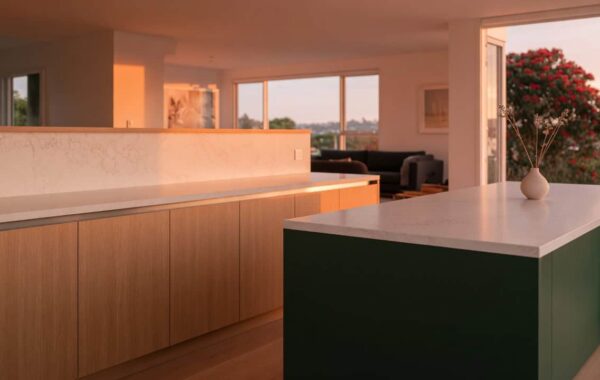

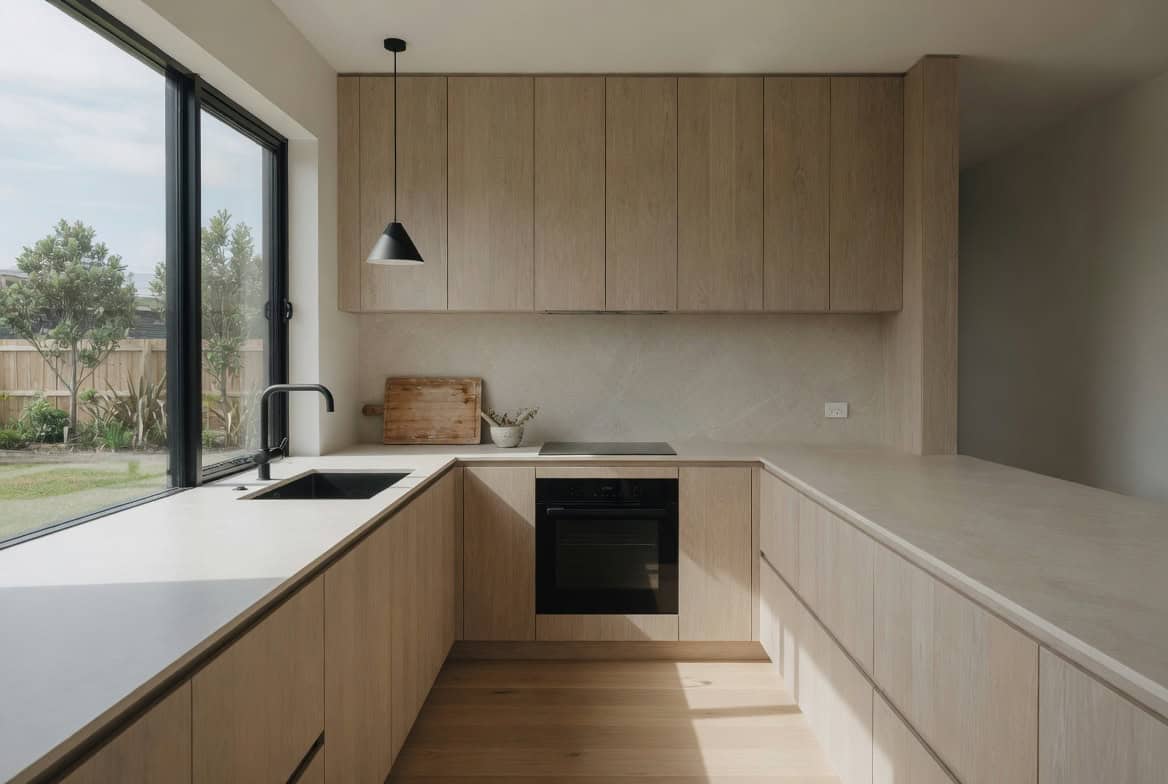

Scandinavian Kitchen Design NZ — A Practical Guide for Auckland Homes
Quick answer: Authentic Scandinavian kitchen design in NZ takes more than a white palette and pale timber — it’s a manufacturing problem, a light problem, and a material-sourcing problem before it’s a style choice.
Walk through Ponsonby on a Sunday morning and you’ll see plenty of kitchens that look Scandinavian-ish. White cabinetry. A bit of pale oak. Black tapware for contrast. In the right photo, with the right light, it lands.
Five years on, the story changes. Door edges catch the light unevenly. Edge banding lifts above the dishwasher. The “warm white” yellows under Auckland sun. The whole kitchen quietly tells you what it was — a pastiche of a style that takes real manufacturing discipline to do properly.
Authentic Scandinavian kitchens are different. They’re stripped back because the materials and the build are right — not because someone copied a colour palette. The minimalism is engineered. And in Auckland, getting that right means solving three problems most articles ignore: a manufacturing problem (the slab door that reads as one piece), a light problem (Auckland sun is sharper than Stockholm winter — that changes the palette), and a sourcing problem (which NZ suppliers actually deliver what authentic Scandi needs).
We’re going to walk through all three. With real materials, real Auckland projects, and the honest manufacturing reality behind the look — not a mood board.
This is what it actually takes to execute scandinavian kitchen design nz in real Auckland homes — whether you’re renovating a Mt Eden bungalow, building new in Long Bay, or fitting out an apartment off Britomart.
A quick orientation before we get into it:
- The technology behind authentic Scandi is German laser edge-banding — the reason the slab door reads as one continuous piece, not five
- The palette that works in Auckland is not the same palette that works in Copenhagen
- Four NZ suppliers — Laminex, Melteca, Dezignatek and Bestwood — make this style work when you know which products to pick
- And the detail most articles skip: the hardware. Handleless Scandi lives or dies on the mechanism behind the door

What Authentic Scandinavian Kitchen Design Actually Means
Most NZ definitions of Scandinavian kitchen design stop at three words: white, timber, minimal. That’s not wrong. It’s just incomplete enough to produce kitchens that look the part for a year and lose it after that.
The deeper version is older. It comes from a design philosophy that took shape across Sweden, Denmark, Norway and Finland in the early 20th century — function before decoration, restraint as a virtue, natural materials over synthetic, craft over volume. Scandi kitchen design isn’t a colour palette. It’s a hierarchy of decisions about what a kitchen is for.
The Five Principles We Work To
When we design a Scandi kitchen for an Auckland home, we work to five principles:
- Function before decoration. Every cabinet, every drawer, every metre of bench has to earn its place. Decorative-only elements are out. The spareness is functional, not aesthetic.
- Light is treated as a material. Light bounces off matte warm-white surfaces, off pale timber, off light grout. The kitchen is designed to spread daylight, not absorb it.
- Restraint over feature. No island with three different bench heights. No statement splashback that competes with the cabinetry. One voice, not a chorus.
- Natural materials lead. Timber, stone, ceramic, wool. Composites and laminates only where they out-perform the real thing — which, with German-edge-banded melamine, they often do for cabinet doors.
- Craft has to show. Edge bandings, drawer joinery, hinge alignment, finish consistency — the details have to be tight enough that a designer can’t pick where the manufacturer cut corners. Because in true Scandi, they didn’t.
Scandi Isn’t Quite Minimalism — Here’s the Difference
People use the two words interchangeably. They overlap, but they’re not the same.
Minimalist kitchens reduce. The goal is less of everything. The aesthetic is often cool — cold whites, hard lines, hidden everything.
Scandi kitchens edit. The goal is the right amount of warmth, the right amount of detail. Pale timber. A wool runner on the floor. A small ceramic vase on the bench. A black hardware accent. Visible craft. Scandi is minimalism with a heartbeat.
The practical implication for an Auckland kitchen: pure minimalism reads cold under Auckland’s white-grey winter light. Scandi was built to feel warm in winter. That’s why it ports better to NZ homes than strict minimalism does.
The Pinterest Pastiche Test — Five Tells
You can usually tell within five seconds whether a Scandi kitchen is the real thing or the imitation. Five tells:
- Door edges that catch light unevenly. Cheap edge banding leaves a darker line at every corner. German laser edge banding doesn’t.
- Handles forced onto cabinetry that wants to be handleless. Real Scandi commits — either no handles, or one consistent black or brass detail. Mixing creates noise.
- Timber that looks printed instead of grown. Cheap melamine timber finishes have a repeating grain pattern. Quality finishes (Bestwood, real veneer) don’t.
- Whites that are too white. Pure white reads clinical under Auckland sun. Authentic Scandi uses warm whites — Resene Black White, Sea Fog, Quarter Tea — not paper white.
- Mismatched bench thicknesses. A 20mm engineered stone bench on cabinetry built for 40mm reads wrong immediately. The proportions are the giveaway.
Sound familiar? If you’ve been pinning images and they’re not quite landing in real life, this is usually why.
💡 Design tip: Before you commit to a Scandi kitchen, do the corner test on three sample doors. Hold each one at eye level under raked side-light. If you can see a glue line at the corner, the kitchen won’t age well — full stop.
Once you understand what authentic Scandi actually is, the question becomes whether it works in Auckland — because the original Nordic palette was designed for a problem Auckland doesn’t have. That’s where we go next.
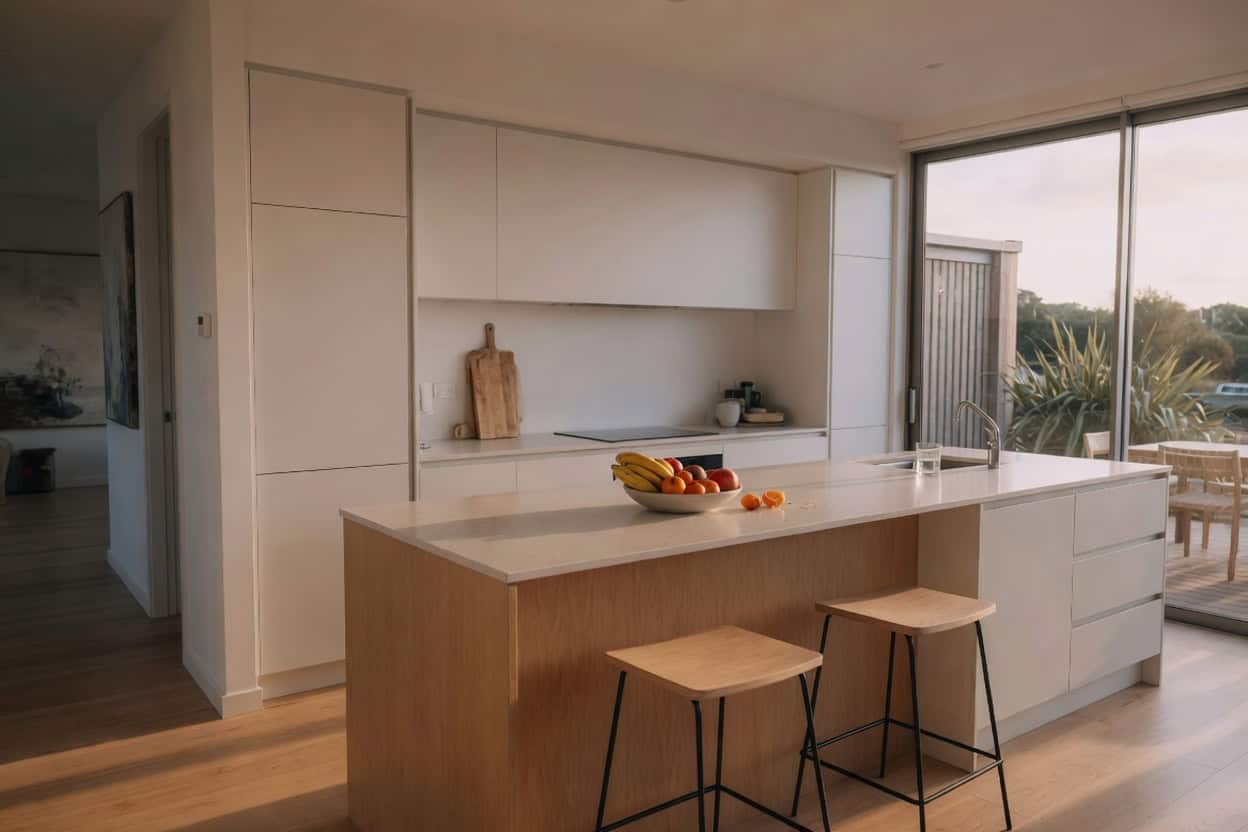
Why NZ Light and Auckland Homes Change the Scandinavian Playbook
Scandinavian design was built for a problem that doesn’t really exist in Auckland — long, dark, low-light winters. In Stockholm, the December sun rises after 8.30am and sets before 3pm. Indoor surfaces have to do most of the work brightening the room.
Auckland’s winter is different. Even in July we get strong, low-angle UV through the day. Summer sun is sharper still — Auckland sits closer to the equator than London, and our UV index regularly hits 12 on a clear day. A palette designed for Nordic dimness will read washed-out under Auckland sun.
This is the single biggest reason imported Scandi furniture and IKEA kitchens underdeliver here. The colours were calibrated for a different sky.
“Auckland light is the part of a Scandi kitchen that catches people out. The palette they fell in love with online was photographed in Northern Hemisphere winter. Drop it into a north-facing Auckland kitchen at midday and it reads cold and washed-out. The work is in the warm-tone adjustment.”
— Little Giant Interiors Design Team
The Auckland Light Adjustment
When we design a Scandi kitchen for an Auckland home, we adjust three things from the textbook Nordic palette:
- Warm the whites. Pure paper-white reads cold and clinical under Auckland sun. We push toward warmer whites — Resene Black White, Sea Fog, Quarter Tea — which read clean but not surgical.
- Tone down the pale timber. Bleached oak that looks soft and warm in Copenhagen looks bone-white in a north-facing Auckland kitchen at midday. We typically go a half-shade darker — a warmer honey-toned oak rather than a Nordic blonde.
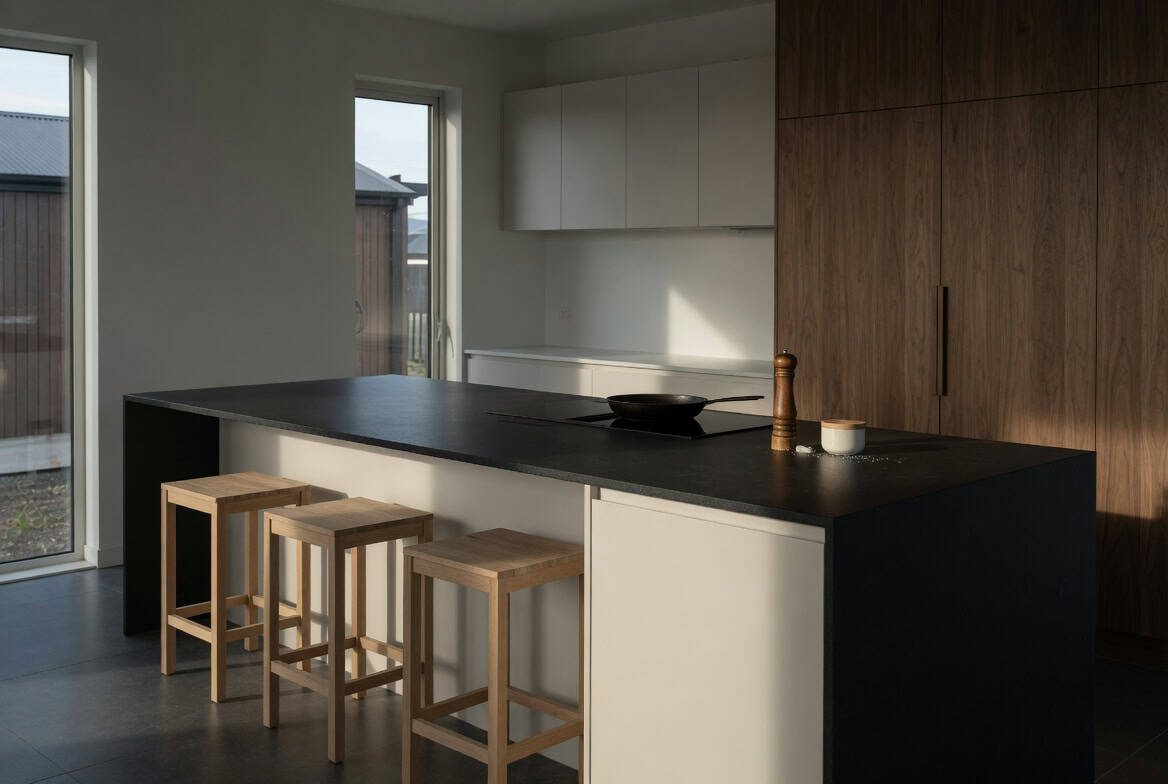
- Introduce a deeper anchor. A black bench, a charcoal pantry door, a deep timber island — something that gives the eye somewhere to rest. Auckland light doesn’t need help being bright; it needs a contrast point.
Scandi in a Ponsonby Villa, Mt Eden Bungalow, Hobsonville New-Build
Where the kitchen sits inside the house matters as much as how it’s designed.
In a Ponsonby villa or Grey Lynn townhouse, the character architecture — cornices, panelled doors, kauri floors — is doing decorative work already. Scandi reads beautifully against it precisely because the contrast is honest. The minimalist kitchen reads modern; the heritage shell reads warm. The tension makes both better. The risk is over-styling — adding handles, decorative panels, ornate hardware that fights the architecture instead of complementing it.
In a Mt Eden or Sandringham bungalow, lower ceilings mean light is more precious. We design with the light in mind — handleless slab doors to reflect maximum daylight, full-height pantry walls in matte warm white, pale-timber benches that pick up the kauri or rimu detail elsewhere in the home. The Scandi palette unlocks more light in a smaller room than almost any other style.
In a modern Hobsonville Point, Long Bay or Millwater new-build, full Scandi works straight from the textbook — open floor plans, large windows, the architecture already supports the style. Here the work is mostly material and finish discipline rather than adaptation.
In an apartment kitchen — Britomart, Wynyard Quarter, Newmarket — Scandi is often the smartest option. Apartment kitchens are small, light-poor, and bench-poor. Authentic Scandi maximises light, reduces visual clutter, and makes a small kitchen feel intentional rather than just compact. (Worth reading our piece on small kitchen renovation Auckland if that’s your situation.)
Resene Palette Anchors That Work Here
If you’re picking colours, these are the ones we use most for authentic Scandi in Auckland:
- Resene Black White — warm white at 18% tint, the body palette for most rooms
- Resene Sea Fog — warmer off-white that works against heritage architecture
- Resene Quarter Tea — soft warm neutral, joinery accent against white walls
- Resene Half Ironsand — the deep warm-grey anchor for islands or pantry walls
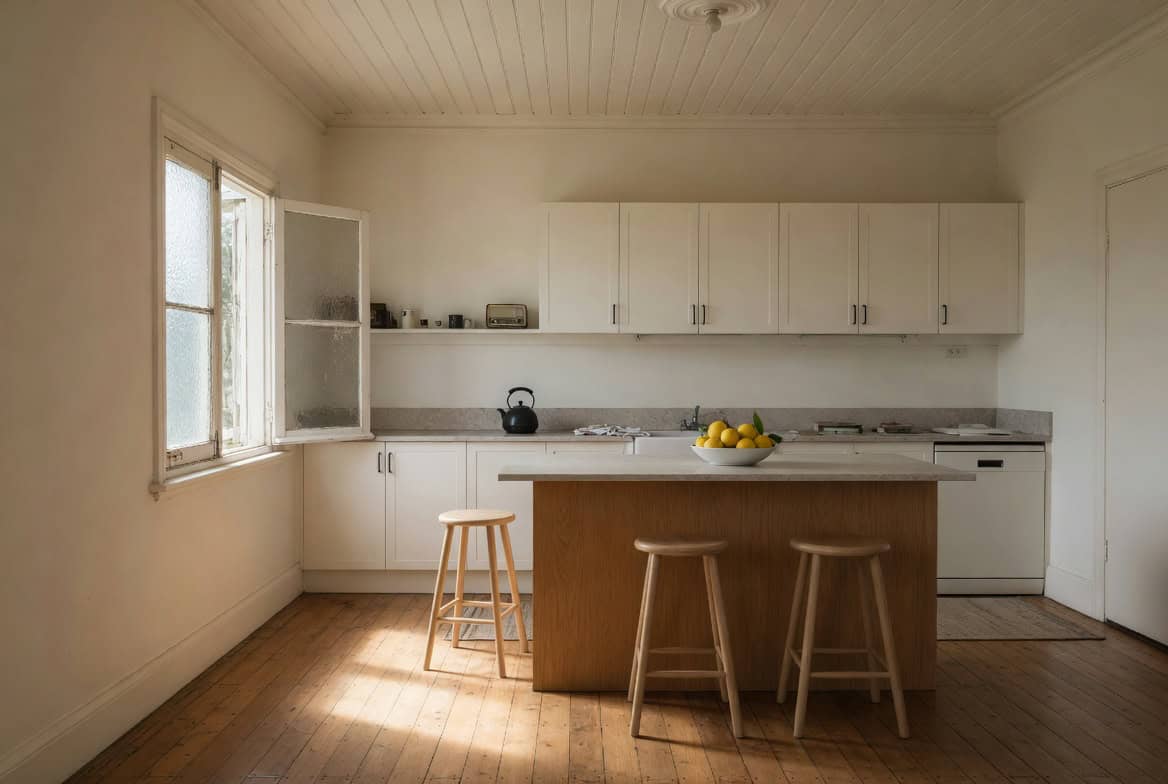
💡 Design tip: Get Resene paint sample pots in three warm-white options and stick A4 sheets in your kitchen for a full week. Look at them at 7am, midday, and 6pm. The right white is the one that still reads warm at all three times of day under your home’s specific light.
Now we get to the part most articles skip — which NZ supplier products actually deliver authentic Scandi, and why the door tells the truth about the whole kitchen.
The Materials That Actually Deliver Authentic Scandi in NZ
This is the section every other Scandinavian kitchen article skips. They tell you the palette. They don’t tell you which NZ products actually deliver it, or why the technology behind the door matters more than the colour on it.
Here’s the manufacturing reality.
The Edge-Banding Question — Why the Door Tells the Truth
The single biggest difference between an authentic Scandi kitchen and a pastiche is the door. Specifically, the edges of the door.
A Scandi slab door is meant to read as one piece — uninterrupted face, invisible edges. In real life, every door is built from a core (usually MDF or particleboard) with a face finish bonded to it. The edge has to be sealed and finished to match the face. That join is where 90% of pastiche kitchens fail.
There are three ways to do it:
- Manual edge banding with PVC or ABS strip glued under heat. Cheap, fast, common. Within 3-5 years the glue line shows. Edges lift around steam zones (over the dishwasher, behind the kettle). Doors swell, then warp.
- PUR (polyurethane) hot-melt edge banding. Better. Stronger glue, longer life. Still leaves a faintly visible line at the corner under raked light.
- Laser edge banding. The edge band is co-extruded with a thermoplastic layer that melts under laser heat and bonds molecularly to the door substrate. No glue line. No corner shadow. The edge reads as continuous with the face.
Our 700m² Auckland factory runs a German laser edge-bander on every door we make. That’s why our slab doors don’t have the corner-tell that cheaper kitchens do. This is the technology behind the slab door reading as one piece — and Scandi minimalism doesn’t survive without it.
“After fifteen years in cabinetry, I can tell within five seconds of touching a slab door whether it’s been laser-edged or strip-glued. It’s the single biggest predictor of how a Scandi kitchen will look ten years in — and it’s the part of the manufacturing process most homeowners never see.”
— Eunice, Lead Designer, Little Giant Interiors
Laminex and Melteca — Which Products Actually Work
For cabinet bodies and door faces, our default Scandi pairing is:
- Laminex Chalk or Laminex Snowdrift for matte warm white doors
- Melteca Natural Oak or Melteca Limed Oak for pale timber-look cabinetry
- Melteca Notaio Walnut as the dark anchor — pantry doors, island fronts — when the room needs contrast
These specific products are chosen because they hold up under Auckland UV without yellowing, they take laser edge-banding cleanly, and they carry a 15-year residential warranty. Most pastiche kitchens fail on one of those three counts.
Dezignatek for Thermoformed Scandi Profiles
If the design calls for a soft-edge slab door — a slight rounded edge, often used in Scandi to soften the room visually — the answer is a Dezignatek thermoformed door rather than a flat-pressed laminate. Dezignatek’s Series 3 thermoform profiles wrap a single PVC face around the entire door with no edge join at all — face and edge are one continuous piece. For handleless Scandi with a softened edge, this is the most authentic option in NZ.
Bestwood for Timber-Look Warmth
When the design calls for real or near-real timber warmth — usually for an island front, an open-shelf section, or a feature pantry — we specify Bestwood. Bestwood’s woodgrain melamine boards carry a genuine wood feel under the hand (textured surface that matches the visible grain) which the cheaper printed melamines don’t. Specifying Bestwood for the timber elements and Laminex or Melteca for the white elements is one of the cleanest authentic-Scandi pairings available in NZ.
BLUM for Handleless — The Mechanism Behind the Door
Handleless Scandi requires a mechanism. Without one, the doors are decorative — they don’t open easily. We specify BLUM TIP-ON BLUMOTION for handleless drawers and BLUM SERVO-DRIVE for taller pantry or appliance openings. These mechanisms carry BLUM’s lifetime domestic warranty. The mechanism is the part you can’t see in a Pinterest photo — and the part that determines whether the kitchen still feels right in year ten.
The full list of suppliers we work with is on our partners page — these are the brands we’ve vetted over years of building cabinetry, and they’re the ones we’d trust in our own homes.
💡 Design tip: When you’re getting quotes for a Scandi kitchen, ask each manufacturer directly: “What edge-banding technology do you use?” If the answer isn’t laser or at minimum PUR hot-melt, the slab doors will visibly age within five years. The price difference is real, but so is the longevity gap.
How to Execute Scandinavian Kitchen Design in Auckland — and the Mistakes to Avoid
The Five Mistakes We See Most Often
After years of building custom kitchens across Auckland, the same five mistakes turn up in homes where the owners had Scandi intent but ended up with something else:
- Pure white walls + pure white cabinets. Reads clinical, not Scandi. Always introduce at least one warm timber element and one dark anchor.
- Wrong handle decision. Mixing handle styles, or adding handles to a kitchen that was designed handleless. Pick the lane and commit.
- Cheap edge banding on slab doors. The single biggest predictor of how long the kitchen stays looking Scandi vs how fast it dates.
- Over-styling the splashback. Patterned tile, statement stone, anything decorative competes with the cabinetry. For real Scandi, the splashback is quiet — matte ceramic, sealed porcelain, or the same engineered stone as the bench.
- Skipping the lighting plan. Scandi depends on light. Recessed task lighting under wall cabinets, warm 3000K LED, dimmable feature pendant over the island. A Scandi kitchen without proper lighting reverts to a “white kitchen” the moment the sun drops.
A Real Project — Mt Eden
One we finished recently was a 1920s bungalow in Mt Eden. The owners had renovated the bathrooms a few years earlier in a heritage style, but they wanted the kitchen to be the modern counterpoint — Scandi in feel, sympathetic to the kauri floors and panelled walls.
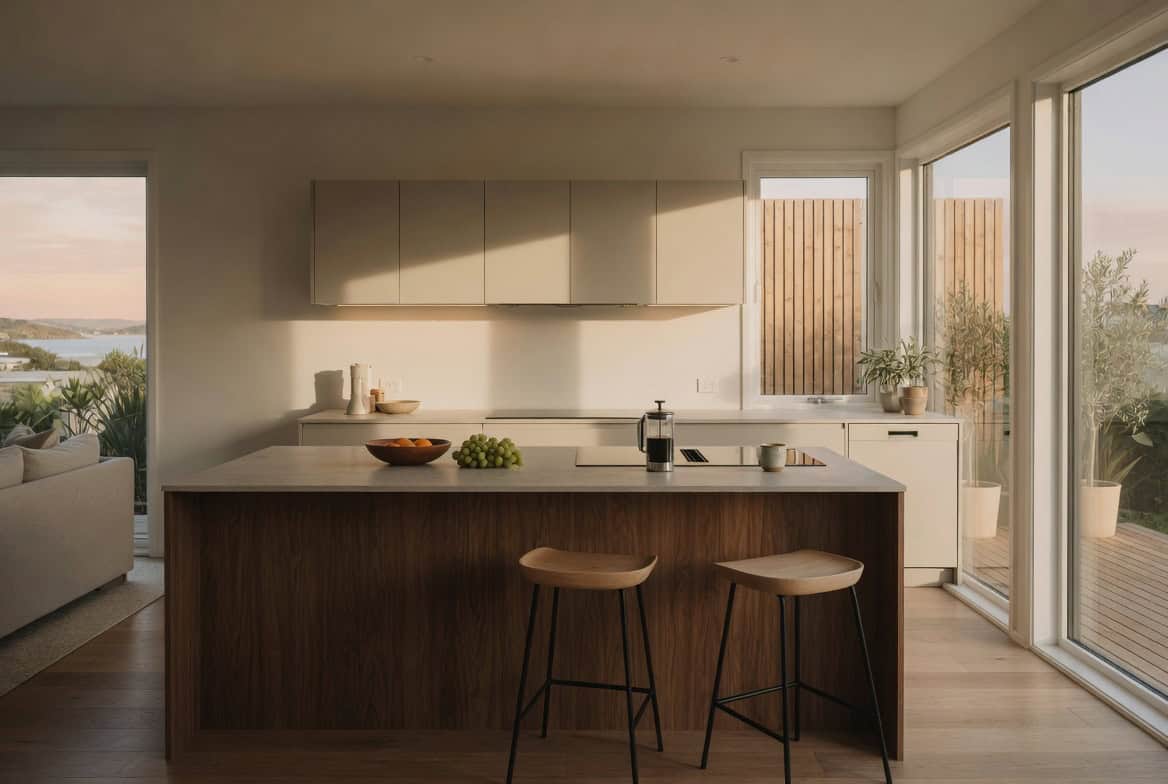
Eunice — our lead designer on the project — specified Laminex Chalk for the perimeter cabinetry, a 3.2m island in Bestwood Natural Oak for the timber anchor, Caesarstone Cloudburst Concrete benchtops, and a full-height Melteca Limed Oak pantry wall. Handleless throughout, with BLUM TIP-ON BLUMOTION on the drawers and SERVO-DRIVE on the pantry. The whole kitchen took eight weeks from design lock to handover.
The result reads quietly modern next to the kauri. It works in the bungalow’s lower ceiling height because the handleless slab doors bounce light back into the room rather than breaking it up.
How the Process Works When You Brief Us
We work to a 6-step design and build process — consultation, estimate, custom design with a free 3D render, materials and manufacturing, installation, handover. The first step is a free in-home consultation with one of our designers — in your kitchen, not in a showroom — because what works depends on your home’s light, layout, and architecture.
For a Scandi kitchen specifically, bring three things to that consultation:
- The Pinterest or Instagram references you’ve saved — but bring them knowing we’ll talk through which ones are realistic to execute and which ones are pastiche
- Honest budget range — Scandi done properly sits mid-to-upper end of custom. Flat-pack won’t get there, and we’ll be straight with you about it
- A sense of which elements matter most to you — the door material, the bench, the light, the storage logic. Scandi is a hierarchy of choices, and the priority order shapes the design
💡 Design tip: Don’t book a Scandi kitchen consultation until you’ve walked through three real Scandi kitchens in person. Open showrooms, friends’ kitchens, even a few well-shot examples on an Auckland design tour day. Photos lie about scale and finish. Real life doesn’t.
Getting Authentic Scandi in Your Auckland Home — What Happens Next
Authentic Scandi in an Auckland kitchen takes more than a colour swatch and a Pinterest board. It takes laser-edge-banded slab doors, warm-toned whites calibrated for Auckland light, specific NZ supplier products that actually hold up, and a designer who’ll be straight with you about what works in your home.
That’s what we do. Design + Manufacture + Install, all under one roof. From a 700m² factory in Auckland, with 15-year warranties on the cabinetry and a free in-home design consultation to start.
➡ Book your free in-home design consultation with Little Giant Interiors
➡ See our 6-step design and build process
➡ Learn more about our custom kitchen design in Auckland
What is Scandinavian kitchen design?
Scandinavian kitchen design is a hierarchy of decisions — function before decoration, restraint over feature, natural materials, visible craft, and light treated as a material rather than a finish. It's not a colour palette. The white-timber-minimal description most articles use is incomplete. Authentic Scandi reads quiet and warm, with engineered minimalism in the cabinetry build itself — particularly the seamless slab door produced through laser edge-banding rather than glued strip banding.
Does Scandinavian kitchen design work in NZ light?
Yes, but the palette has to be adjusted. The original Nordic palette was designed for low-light Northern Hemisphere winters. Auckland's UV is sharper and our summer sun harsher — pure paper-white reads cold and washed-out, and bleached pale oak can read bone-white. The fix is warmer whites (Resene Black White, Sea Fog, Quarter Tea), half-shade-darker timbers (honey oak rather than blonde), and introducing one deeper anchor element such as a charcoal pantry or dark island.
How is Scandinavian kitchen design different from minimalist?
Minimalist kitchens reduce everything — cold whites, hard lines, hidden everything. Scandi kitchens edit. The goal is the right amount of warmth and detail rather than the absence of it. Pale timber, a wool runner, ceramic accents, a black hardware detail, visible craft. Scandi is minimalism with a heartbeat — and it ports better to Auckland homes than strict minimalism because it was built to feel warm in winter, not cold.
What materials are used in authentic Scandinavian kitchens in NZ?
Our default Scandi material set for NZ kitchens is Laminex Chalk or Snowdrift for matte warm white doors, Melteca Natural Oak or Limed Oak for pale timber-look cabinetry, Melteca Notaio Walnut as a dark anchor, Bestwood for timber-look warmth on islands and feature panels, and Dezignatek Series 3 thermoformed doors when a soft-edge profile is needed. Hardware is BLUM throughout — TIP-ON BLUMOTION for handleless drawers, SERVO-DRIVE for pantry and appliance openings.
How much does a Scandinavian kitchen cost in Auckland?
A custom Scandi kitchen in Auckland typically sits in the mid-to-upper range of custom cabinetry pricing — usually $35,000 to $75,000+ depending on size, material spec, and layout complexity. The cost reflects the manufacturing reality — laser edge-banded slab doors, specified BLUM hardware, and proper material selection sit above flat-pack and standard custom but below high-end imported European cabinetry. Flat-pack won't deliver authentic Scandi at any price — the edge-banding alone is the giveaway.
Can Scandinavian kitchen design work in a villa or bungalow?
Yes — character homes are often where Scandi works best in Auckland. In a Ponsonby villa, Grey Lynn townhouse or Mt Eden bungalow, the heritage architecture is already doing the decorative work. A minimalist Scandi kitchen reads modern against the kauri floors and panelled walls, and the tension between the two makes both better. The risk is over-styling — adding handles or ornate hardware that fights the architecture rather than complementing it.
Will a Scandinavian kitchen date quickly?
A properly executed Scandi kitchen ages better than almost any other contemporary style. The palette is restrained, the materials are timeless (warm whites, natural timber, engineered stone), and there's no statement feature to date. The kitchens that date quickly are the pastiche versions — cheap edge banding that lifts within 5 years, printed timber finishes that look obviously fake within a decade, and trend-driven hardware. Authentic Scandi built with quality materials and laser-edge-banded doors holds up for 15+ years.
What's the difference between Scandi-style and an IKEA kitchen?
IKEA kitchens reference Scandi visually but underdeliver on the manufacturing reality. The cabinet body is fine for the price, but the door substrates and edge banding aren't built for long-term NZ conditions — Auckland UV yellows the white finishes and the edges lift around steam zones within a few years. The hardware is functional but not BLUM-grade. For genuine handleless Scandi with 15+ year longevity, custom-manufactured cabinetry with laser edge-banding and BLUM mechanisms is the only path.
Should a Scandinavian kitchen be handleless?
Most authentic Scandi kitchens are handleless, but it isn't compulsory. Handleless reinforces the minimalism and lets the slab door read as one continuous piece — the soul of the style. If you go handleless, the mechanism matters — we specify BLUM TIP-ON BLUMOTION for drawers and SERVO-DRIVE for taller pantry doors. Alternatively, one consistent black or brushed brass detail (long edge-pull or finger-pull) works in a more relaxed Scandi look. Avoid mixing handle styles.
What colours work best for Scandinavian kitchens in NZ?
Our most-used palette anchors for Scandi kitchens in Auckland are Resene Black White (warm white body), Resene Sea Fog (warmer off-white for heritage homes), Resene Quarter Tea (soft warm neutral as a joinery accent) and Resene Half Ironsand (deep warm grey for islands or pantry walls). The trick is warmth — pure paper-white reads clinical under Auckland sun. Always sample three white options in your actual kitchen across morning, midday and evening light before committing.
Have you been putting off your kitchen renovation?
We offer flexible finance options to help you get your dream kitchen sooner. Learn more about our interest-free finance options.