

Last updated:
A butler’s pantry is a second, hidden workspace off your main kitchen — storage, prep bench, and often a sink, that keeps the mess out of sight while you cook or entertain. For Auckland homeowners, from compact CBD apartments to villas in Remuera, it’s become one of the most requested features in a kitchen renovation. This guide walks through what a butler’s pantry actually is, whether you need one, how to size and lay it out, the design ideas worth stealing, and the mistakes that catch people out, all tailored to Auckland homes, our humid climate, and the way we cook here.
“A butler’s pantry isn’t just storage. It’s a lifestyle upgrade that brings order to the busiest room in the house,” says the design team at Little Giant Interiors.
2026 Auckland Update: Moisture, Salt Air, and Material Choice
The single biggest change in how we design butler’s pantries for Auckland homes is moisture control. Enclosed pantries trap humidity, and in genuinely coastal suburbs such as Devonport, Takapuna, St Heliers and Bucklands Beach, salt-laden air accelerates corrosion on hinges and runners. We’ve seen unsealed grout in coastal installs start showing mould inside the first year.
Two practical takeaways for 2026:
- Coastal and harbourside suburbs (Devonport, Takapuna, St Heliers, Blockhouse Bay): sealed, impervious surfaces such as a porcelain splashback, plus an extractor fan if the space is enclosed, and marine-grade or powder-coated hardware rather than plain steel.
- Inland family homes (Hillsborough, Mt Roskill, Manukau): salt is not the issue, cooking and laundry moisture is. An L-shaped layout with pull-out shelving handles bulk storage without eating walkway space, and a louvered or slatted door keeps air moving through an enclosed space.
💡 Design tip: If your pantry is fully enclosed, treat ventilation as non-negotiable. A small extractor or louvered door does more for the life of your cabinetry than any finish you choose.
What Is a Butler’s Pantry, Exactly?
The term goes back to 19th-century English and American estates, where butlers managed a dedicated room for prepping meals, polishing silver, and storing fine china — out of sight of guests. The room existed partly to secure valuables, which is where the name comes from.
You can still see traces of that in Auckland’s older homes around Remuera and Parnell. But the modern butler’s pantry has nothing to do with servants — it’s a practical extension of the kitchen, built for families who entertain, cook a lot, or just hate clutter.
How It Differs from a Walk-In Pantry
People use the two terms interchangeably, but they’re not the same thing. A walk-in pantry is storage — shelves for food and kitchenware. A butler’s pantry does more: it adds a working bench, and usually a sink or a second appliance, so you can prep and clean up away from the main kitchen.
A modern butler’s pantry typically includes:
- Bench space for prep or running small appliances.
- Storage — shelves, cabinets, or pull-out systems for food, cookware, and gear.
- A secondary sink, dishwasher, or microwave to take load off the main kitchen.
- A finish that matches the main kitchen, so it reads as one connected space.
In Auckland, where open-plan living is the norm, that hidden workspace is the whole point — it keeps the main bench guest-ready while the real work happens behind it. It’s especially popular in Ponsonby and Grey Lynn, where people entertain often and want the cooking and the socialising to flow together.
Why Aucklanders Want Them
In an open-plan Auckland house the kitchen is not just where food gets made. It is where people work, eat, do homework and end up standing when guests arrive. A butler’s pantry suits that pattern by giving you:
- Clutter control — dirty dishes, appliances, and prep mess stay out of sight.
- Bulk storage — handy if you shop at Costco or load up at the Avondale Sunday Market.
- Easier entertaining — prep and pour out of view, so the host isn’t stuck behind a chaotic bench.
- Flexibility — coffee station, baking hub, drinks zone, whatever suits your household.
💡 Design tip: If you entertain a lot, prioritise bench space and a second sink. Cleanup is where a butler’s pantry earns its keep on a busy night.
Key Features at a Glance
A well-designed butler’s pantry balances function and looks. Here is what we specify on almost every one we build:
| Feature | Purpose | Benefit |
|---|---|---|
| Bench space | Surface for prep, appliances, or unpacking groceries | Keeps the main kitchen clear for presentation |
| Shelving | Organises food, cookware, and appliances | Adjustable or open shelving maximises storage |
| Secondary sink | Handles dishwashing or soaking big pots | Frees up the main sink when entertaining |
| Power points | Runs microwaves, blenders, coffee machines | Adds function without cluttering the main bench |
| Lighting | Lights the workspace properly | Better visibility, plus warmth and appeal |
Four Kinds of Pantry, and Which One You Are Actually Asking For
Most of the confusion in a pantry brief comes from four different things sharing one word. Getting the label right early saves a lot of redrawing, because the four have genuinely different footprints, costs and services.
The built-in pantry (a cupboard, not a room)
A tall cabinet inside the kitchen run, usually 450 to 600mm wide, fitted out with adjustable shelves or a pull-out larder unit. It takes no floor area beyond the cabinetry line and needs no services. For a couple, a small family, or an apartment, this is very often the right answer and the whole butler’s pantry conversation is unnecessary. The single upgrade worth paying for here is pull-outs rather than fixed shelves, because a 600mm deep fixed shelf hides its own back third.
The walk-in pantry (a room for storage only)
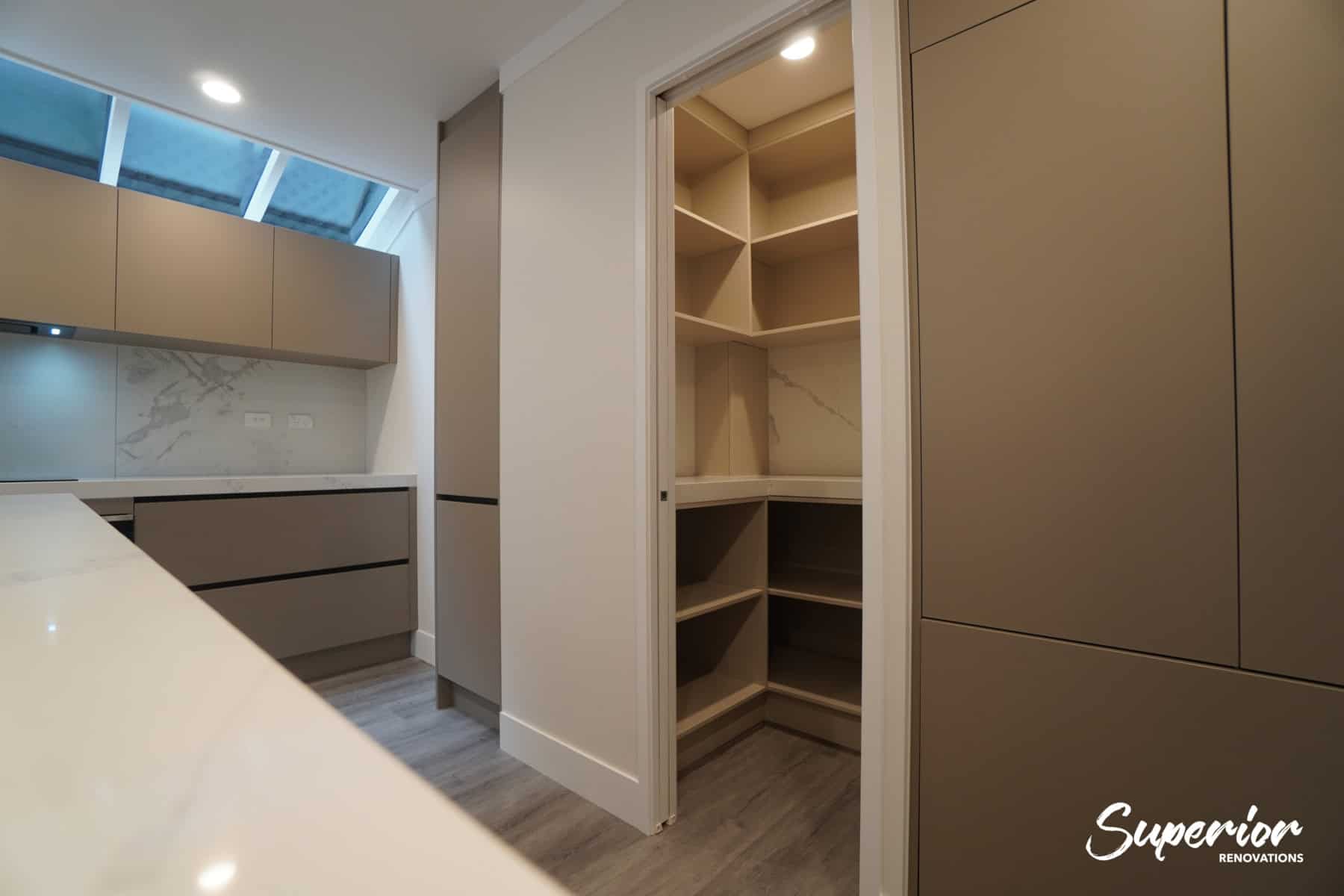
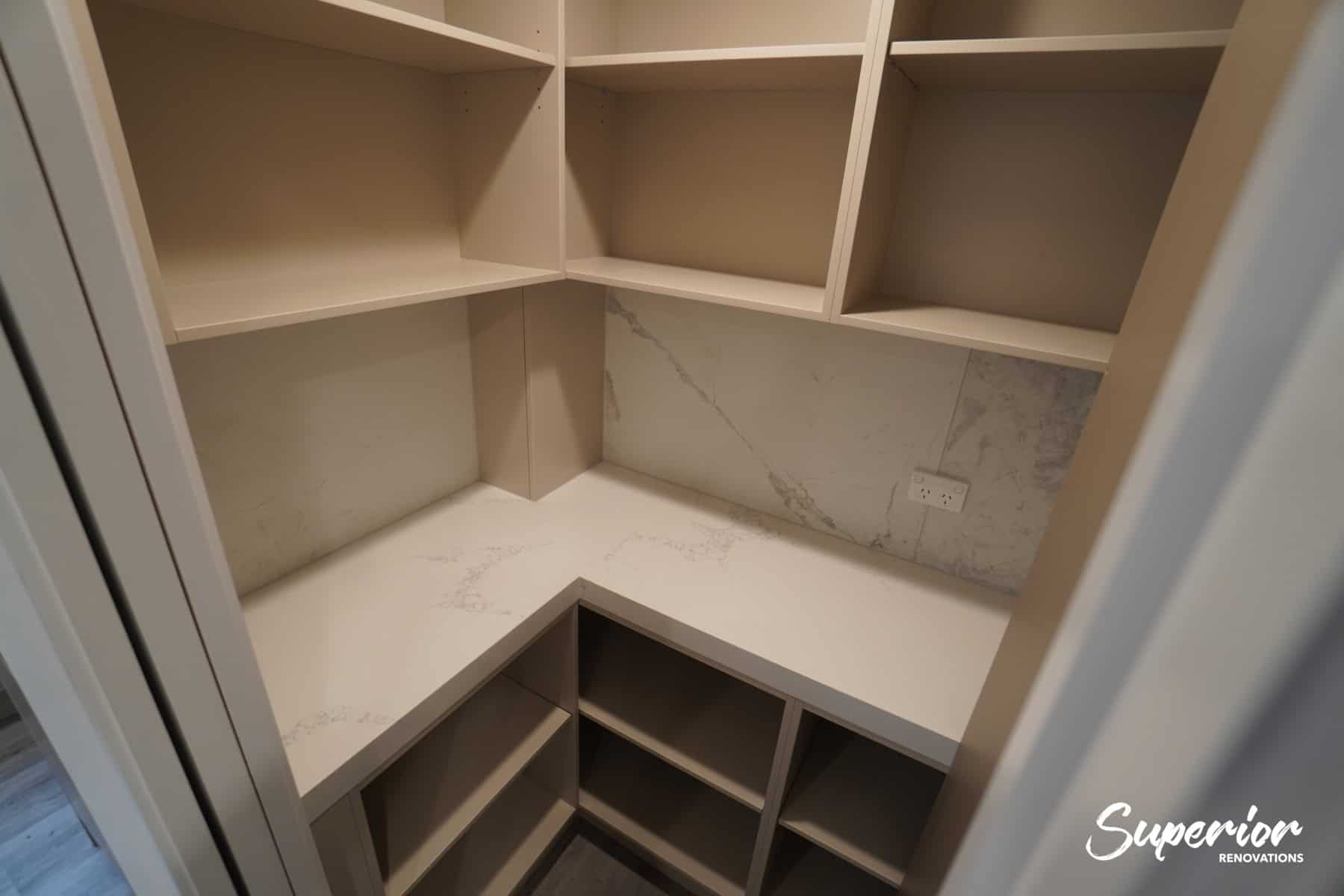
A small room you step into, shelved on one, two or three walls, with no bench and no services. This is the type most people picture and the one most Auckland briefs should probably land on. It holds far more than a cupboard, costs a fraction of a butler’s pantry because there is no plumbing or electrical work, and it fits where a butler’s pantry will not.
What makes a walk-in work or fail is depth. Shelves deeper than about 400mm turn into a place where food goes to expire, because you cannot see the back row. We build walk-ins with shallow shelving on the side walls and the deeper shelving reserved for the end wall where you can face it squarely. If the room is narrow, shelve one long wall properly rather than both walls badly.
Three walk-in pantry design decisions that matter more than the finishes:
- Door type. A swinging door needs a metre of clear floor to open into, which in a small pantry is the exact metre you wanted for standing in. A cavity slider or a simple open archway usually wins.
- Light on entry. If the switch is outside the room, nobody uses it. Put the light on a door sensor or inside the opening.
- Floor to ceiling, with a step. Take the shelving to the ceiling and accept that the top shelf needs a stool. That is far better than losing 400mm of height to a bulkhead you did not need.
The butler’s pantry (a room that works)
Storage plus a bench, and usually a sink, sometimes a second dishwasher or a microwave. The bench is the whole distinction: it is the difference between somewhere things live and somewhere work happens. It is also what brings plumbing, waste, power and ventilation into scope, and that is where the cost separates from a walk-in.
The scullery (a butler’s pantry that took over)
In New Zealand practice, scullery and butler’s pantry are used almost interchangeably, but when people mean scullery they usually mean the version where the real work has moved in permanently: the main sink, the dishwasher, sometimes the cooktop, with the visible kitchen reduced to a serving and socialising bench. In an open-plan house where the kitchen is on show from the dining table, this is a genuinely good idea rather than an indulgence, and it is the layout we get asked for most often on new builds.
If your brief is really a scullery, say so at the design stage, because it changes where the plumbing and extraction go and it changes which room the consent question attaches to.
Do You Actually Need One? Assessing Your Storage Needs
A butler’s pantry should solve a problem you already have — not create a new one. Not every Auckland home needs one. The decision comes down to how you use your kitchen and how much space you’ve got. Auckland housing runs from CBD apartments to Epsom villas, so the honest answer is genuinely different house to house.
Take Stock of What You Store
Start with an honest inventory of what is actually in your kitchen right now:
- Food supplies — do you stockpile rice, pasta, tinned goods? Deep shelves or pull-out drawers handle bulk well.
- Appliances — blenders, toasters, coffee machines clutter benches. A pantry gives them a home that’s still within reach.
- Cookware and serveware — frequent entertainers tend to have platters, extra dinnerware, and specialty gear like woks.
- Specialty items — spices for curries, large containers for big family cooks. These need organised, accessible storage.
💡 Design tip: List your kitchen items and sort them by how often you use them. Daily items go at arm height; seasonal gear goes up high or deep.
Match It to How You Live
Your habits decide this more than your house size does. A few questions worth answering honestly before anyone draws anything:
| Question | Why it matters | What a pantry does |
|---|---|---|
| Do you entertain often? | Hosting needs extra prep and cleanup room | Hides the mess so you can focus on guests |
| Is your kitchen cluttered? | Open-plan kitchens have to stay tidy | Keeps benches clear and the space calm |
| Do you cook complex meals? | Elaborate cooking needs space and tools | Extra bench supports involved prep |
| Is your kitchen small? | Compact kitchens lack storage and workspace | A small pantry adds both without a full reno |
If you answered yes to any of those, a butler’s pantry will likely earn its place.
Space and Budget Reality
Space is the hard constraint in Auckland. As a working minimum, allow 1000mm for a walkway and 600mm for benchtops — anything tighter and the space fights you. Larger footprints give you room for a second sink or appliances. For smaller homes in Grey Lynn or Newmarket, a compact pantry or a hybrid walk-in design often makes more sense.
On budget: custom cabinetry, secondary appliances, and high-end finishes push the cost up fast. Modular and flat-pack systems keep it sensible without gutting the function.
💡 Design tip: If budget’s tight, spend on shelving and bench first. The luxury extras — wine fridge, stone benchtop, can wait or get skipped entirely.
Or Maybe You Don’t, Comparing the Alternatives
Sometimes a good walk-in pantry or smarter cabinetry does the job for a lot less:
| Option | Pros | Cons |
|---|---|---|
| Butler’s pantry | Storage, prep, and cleanup in one; great for entertaining; hides mess | Needs more space and budget; overkill for small households |
| Walk-in pantry | Lots of storage; cost-effective; fits smaller spaces | Limited workspace; no prep or appliance zone |
| Enhanced cabinetry | Uses existing space; budget-friendly | Won’t hide mess or add real prep room |
Planning the Layout and Size
The layout decides whether your pantry works hard or just looks good empty. Get the flow wrong and you’ll feel it every time you carry a tray through a too-narrow gap. Get it right and it feels like a natural part of the kitchen.
What to Plan Around
- Workflow — keep the sink near the dishwasher, shelving near the bench. The fewer steps, the better.
- Accessibility — daily items between 900mm and 1200mm off the floor; rare items higher.
- Ventilation — our humid climate needs airflow. A small exhaust fan or louvered door earns its place.
- Integration — same materials and colours as the main kitchen, so it reads as one space.
Common Layouts
| Layout | Description | Dimensions | Best for |
|---|---|---|---|
| Linear (single wall) | Bench and storage along one wall | Min. 1.2m x 2m | CBD or Grey Lynn apartments; small spaces |
| L-shaped | Bench and storage on two walls | Min. 1.5m x 2m | Mt Eden or Newmarket homes |
| U-shaped | Storage on three walls, maximum capacity | Min. 2m x 2m | Remuera or Parnell; keen entertainers |
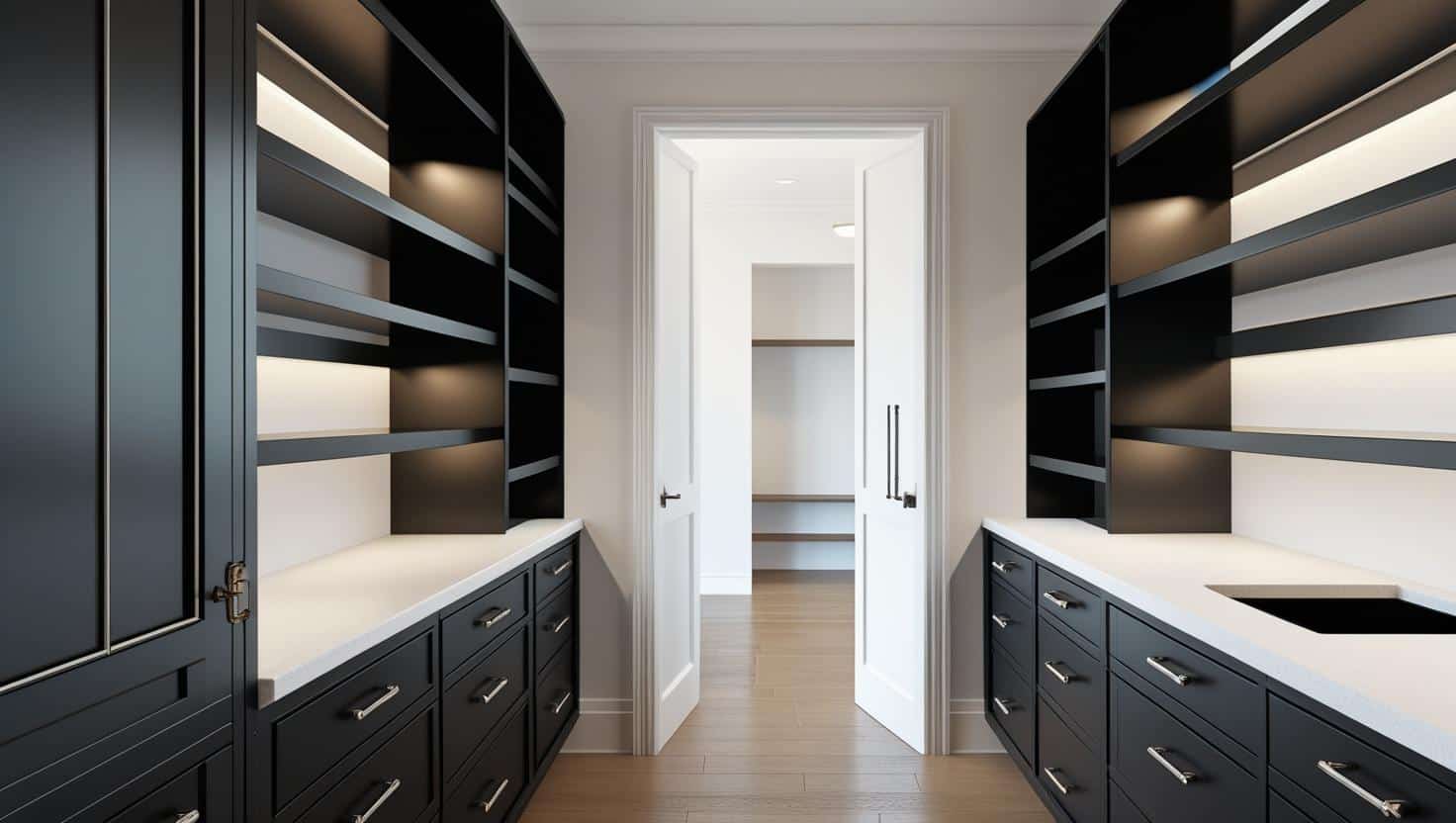
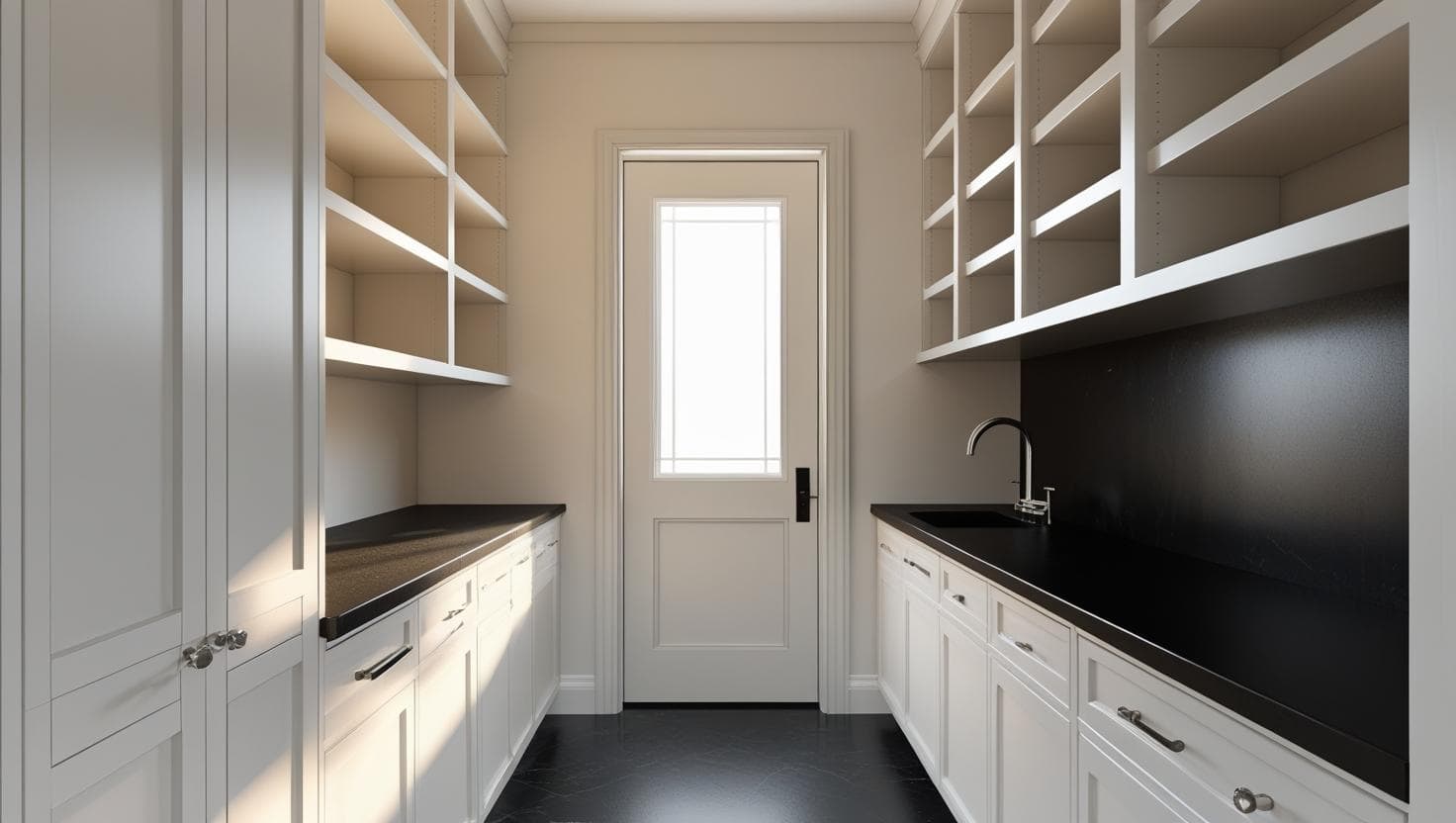
| Galley | Two parallel benches, corridor-style | Min. 1.5m x 3m | Epsom villas; bulk storage |
Linear and L-shaped are the workhorses for most Auckland homes. U-shaped and galley suit larger suburban builds with room to spare.
Sizing It Right
- Small (1–2m²) — apartments and townhouses in Ponsonby or Herne Bay. Go vertical with tall cabinets and open shelves.
- Medium (2–4m²) — homes in Mt Eden or St Heliers. Room for a sink, bench, shelving, and a microwave.
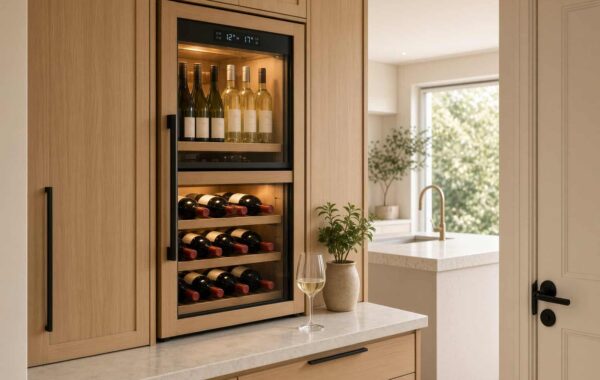
- Large (4m²+) — Remuera or Parnell. Fits multiple appliances, a second dishwasher, even a wine fridge.
💡 Design tip: In smaller homes, a hybrid pantry — mostly storage with a narrow prep bench, gets you most of the benefit without the footprint.
The Two Dimensions That Decide Everything
Of all the numbers in a pantry drawing, two do the real work.
Clear floor width between opposing runs. This is the walkway, and it is the dimension that decides whether the room is usable rather than merely legal. Allow a metre and you can open a drawer and still walk past it. Drop to 800mm and you cannot open a lower drawer while someone is standing at the bench. In a galley pantry with benches or shelves on both sides, this number is the design.
Bench depth. Six hundred millimetres is the working minimum for prep, matching standard kitchen bench depth, and it is what a sink and a benchtop appliance need. Going to 800mm in a larger pantry is comfort rather than necessity. Going below 600mm turns the bench into a shelf you cannot chop on.
Everything else, the shelf heights, the door type, the number of power points, follows from those two once they are settled.
One caution worth stating plainly: adding a sink, a second dishwasher, extraction or new circuits to a pantry is plumbing and electrical work, and in some cases it is work that needs consent or a Licensed Building Practitioner. Whether your particular job does depends on what is being altered and where. Ask Auckland Council or your LBP before the cabinetry is drawn, not after it is made. We will tell you where we think the line sits, but we are cabinetmakers and that call is not ours to make.
Practical Layout Tips
- Bench depth — 600mm minimum for prep; 800mm in larger pantries for comfort.
- Adjustable shelving — flexes from tall cereal boxes to small spice jars.
- Power points — at least two double points for appliances. We’re a coffee city; plan for the machine.
- Lighting — task lighting under cabinets, especially in deep or narrow pantries.
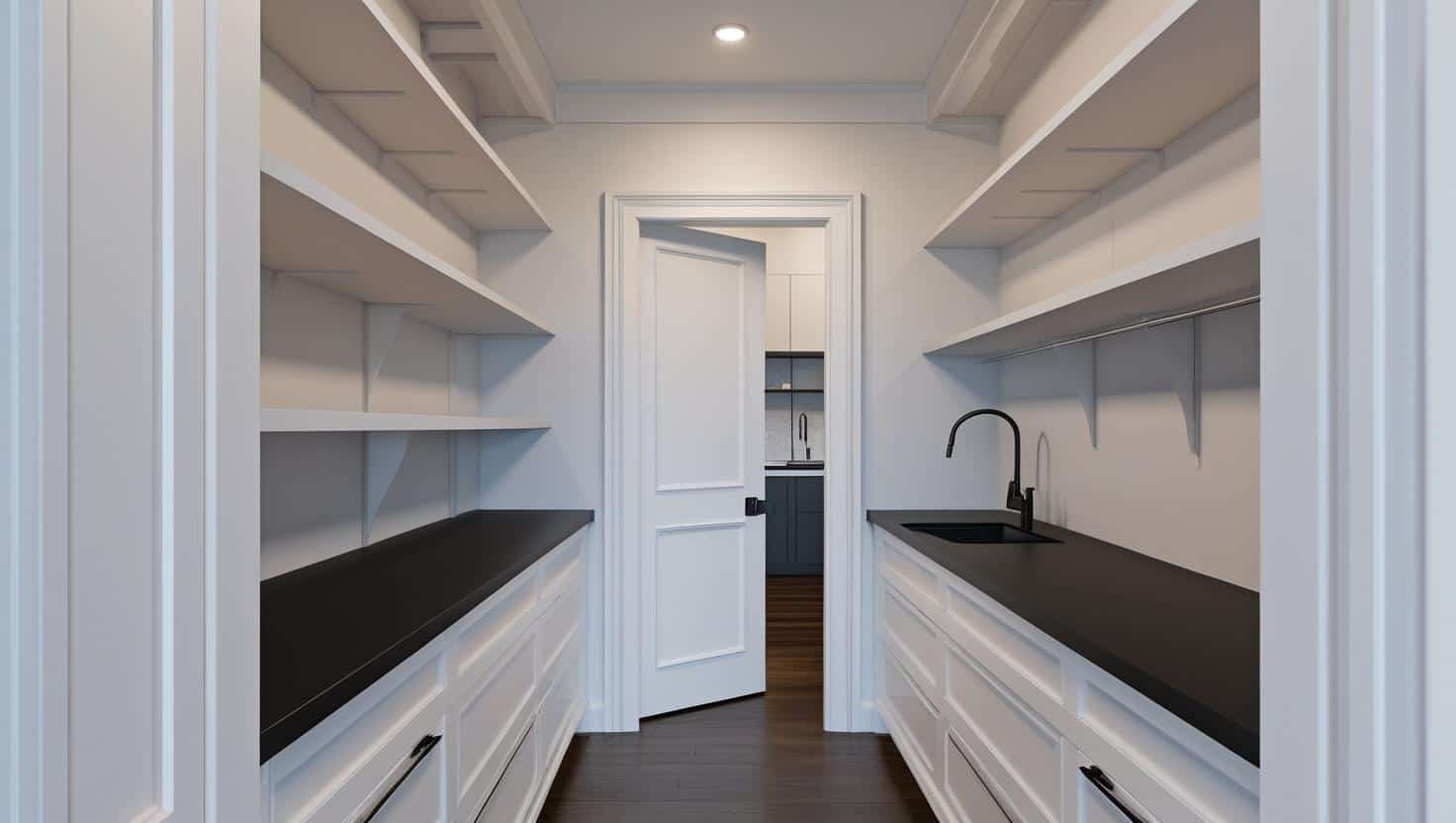
- Access — a sliding door or open entry beats a swinging door in a tight space.
Design Ideas Worth Stealing
Open Shelving
Open shelves keep everything visible and easy to grab, and they suit the clean, Scandi-leaning look a lot of Auckland kitchens go for. They also double as display if your jars and serveware are worth looking at, which is a genuine reason to choose them and a genuine reason not to. To make them work:
- Durable materials — treated timber or powder-coated steel handles the humidity without warping.
- Smart placement — daily items at eye level, decorative pieces up top.
- Matching containers — glass jars or bamboo canisters for a tidy, cohesive look.
- Mix with closed storage — cabinets below hide the bulky, less photogenic stuff.
Pantry Shelving: Depths, Spacings and What Goes Where
Shelving is where a pantry is won or lost, and it is almost always specified last and worst. The failure is nearly never load. It is depth and spacing.
- Depth beats quantity. A 300 to 350mm shelf holds one row of everything and you can see all of it. A 600mm shelf holds two rows and you use one. If you have the wall length, shallow and long always beats deep and short.
- Vary the spacing deliberately. Tinned goods and jars want roughly 200 to 250mm of clear height; cereal boxes and bottles want closer to 350mm; a stand mixer or a slow cooker wants 450mm or more. A pantry shelved at one uniform spacing wastes air above every short item.
- Make them adjustable and mean it. Adjustable shelving is only useful if the pin holes actually run the full height of the cabinet. Half a dozen positions in the middle is not adjustable.
- Bench height is the working zone. Everyday items belong between roughly 900mm and 1200mm off the floor, which is the band you can reach without bending or stretching. Bulk and seasonal gear goes above and below that.
- Open or closed is a cleaning decision. Open shelving in a pantry that shares air with a cooktop collects a fine grease film that you will be wiping off jars. If the pantry is enclosed and ventilated, open shelves stay clean. If it is open to the kitchen, put doors on it.
- Weight is a fixing question, not a shelf question. A pantry shelf full of preserves is heavy, and what carries it is what the brackets or pins are fixed into. If shelving is going onto a wall rather than into a cabinet, that fixing needs to hit framing.
We build pantry shelving as cabinetry rather than as brackets on a wall, because a cabinet carries its own load into the floor and does not depend on what is behind the lining. Our guide to installing shelving in New Zealand homes covers the wall-fixed alternative and its published load limits.
Task Lighting
Lighting is the most under-planned part of a pantry. A pantry with one ceiling light casts your own shadow straight onto the bench you are working at, which is why it goes unused after dark:
- Under-cabinet LED strips — light the bench for prep and reading labels.
- Overhead lighting — recessed or pendant for general light in bigger pantries.
- Motion-sensor lights — handy for small enclosed pantries; saves fumbling for a switch.
- Accent lighting — warm LED spots to lift open shelves.
💡 Design tip: Go LED throughout. Lower running cost, and it pairs with the warm downlights most Auckland kitchens already use.
Function and Finish Together
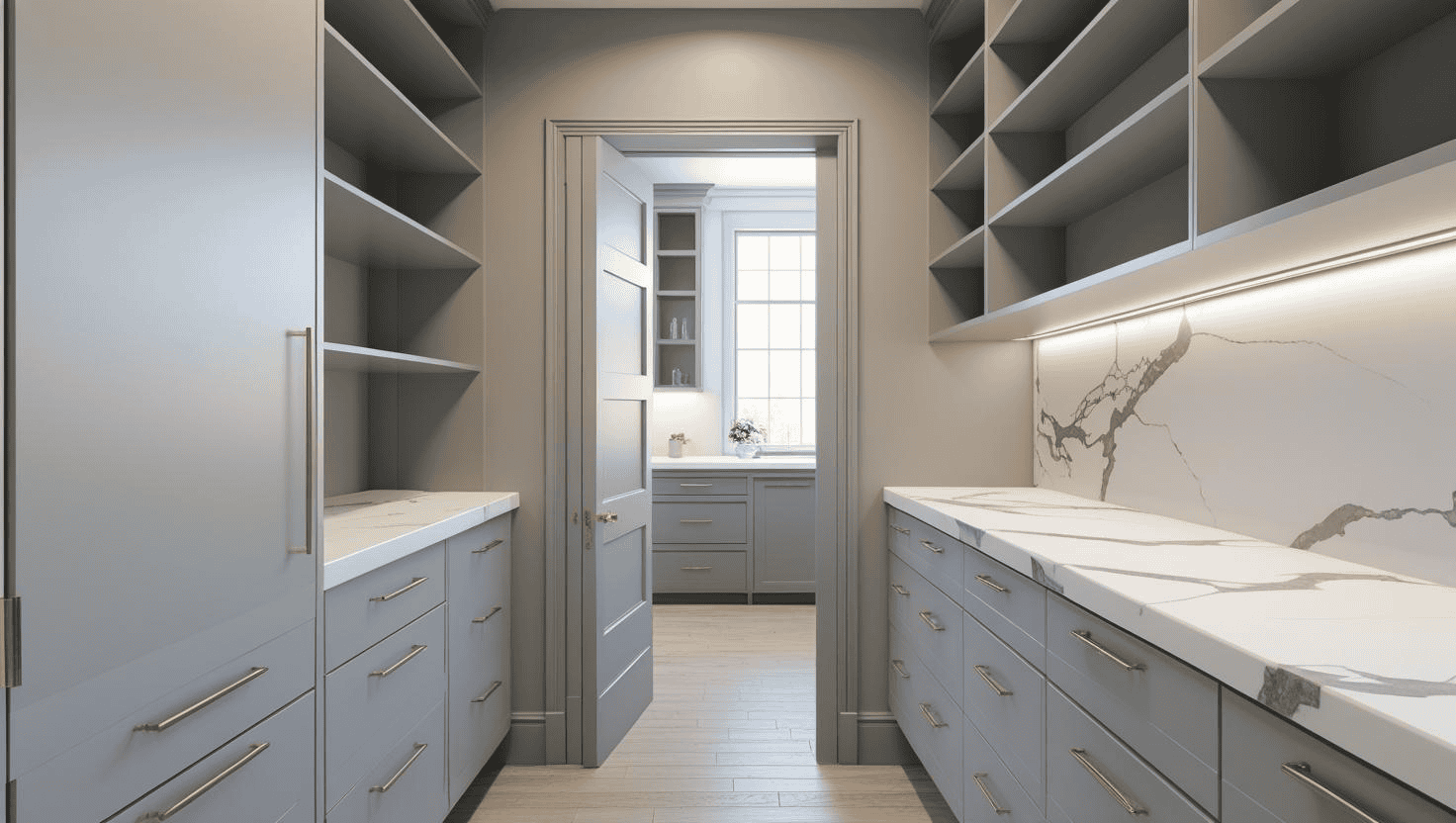
Every element should pull its weight and still look like part of the kitchen:
| Feature | Function | Finish |
|---|---|---|
| Secondary sink | Dishwashing and soaking, away from the main bench | Stainless or ceramic for a clean, modern look |
| Pull-out drawers | Full access to deep storage | Soft-close runners and matte fronts |
| Built-in appliances | Second dishwasher or microwave | Integrated for a streamlined face |
| Custom shelving | Fits everything from spices to platters | Timber or glass for warmth |
Keeping Flow with the Main Kitchen
A pantry that clashes with the kitchen looks like an afterthought. In an open-plan Auckland home the pantry doorway is usually visible from the dining table, so the two spaces have to read as one. To tie them together:
- Consistent materials — carry the kitchen’s cabinetry finish into the pantry. Matte black in the kitchen, matte black in the pantry.
- Matching palette — whites and natural timbers read as one space.
- Thoughtful access — a sliding door or open entry keeps the transition smooth.
- Cohesive lighting — same warmth and style across both.
💡 Design tip: In Parnell’s heritage homes, shaker-style cabinet fronts in the pantry echo the villa character without forcing a period look.
Small Butler’s Pantry Ideas for Compact Auckland Kitchens
You don’t need a big footprint to get a working butler’s pantry — you need to use every millimetre of the one you have. Making a tight room work is the same discipline as fitting a full kitchen into a room that was never meant to hold one. Plenty of the pantries we build for Ponsonby terraces, Grey Lynn townhouses and CBD apartments come in under 2m², and the small ones often work harder than the big ones because nothing gets wasted.
If you’re squeezing a pantry into a tight space, these are the moves that count:
- Go full height. Take cabinetry to the ceiling and put seasonal or rarely-used gear up top. A small pantry gains most of its capacity vertically.
- Lose the swing door. A cavity slider or a simple open entry saves close to a square metre of floor that a hinged door would block, which in a 2m² pantry is the difference between usable and not.
- One bench, storage under, open shelves above. A single 600mm prep bench with drawers below and adjustable shelves above covers prep and storage without a second run of cabinetry.
- Pull-out shelving on deep cupboards. Anything deeper than about 300mm needs a pull-out, or the back becomes a black hole. BLUM runners keep them running smoothly for the life of the pantry.
- Skip the second sink. In a compact pantry, plumbing eats space and budget for little gain. Keep it prep-and-storage and leave the sink in the main kitchen.
- Light the bench, not just the room. One double power point and an under-shelf LED strip make a narrow pantry genuinely usable after dark.
💡 Design tip: In a small pantry, matte or open shelving to the ceiling reads as more space, not less. Closed cabinetry all the way up can make a narrow room feel like a cupboard you’ve stepped inside.
Material Durability in the Auckland Climate
Our humidity and coastal salt air are hard on pantry materials, so the finish you pick matters as much as the layout. Typical service-life ranges for common pantry materials:
- Porcelain tiles (floors/splashbacks): 25+ years. Impervious and non-slip; seal grout annually to keep mould out in humid kitchens.
- Moisture-resistant melamine (cabinets): 15–25 years. Factory-sealed edges resist humidity; wipe-clean finish.
- Polyurethane (painted surfaces): 18–30 years. Gloss or matte sealed; stands up to coastal salt air.
- Solid timber (benches/shelves): 20–35 years with upkeep. Seal every 12–18 months to stop expansion.
- High-pressure laminate (bench): 12–22 years. Good scratch and heat resistance; sealed edges essential near splash zones.
💡 Design tip: Within a few hundred metres of the water, in Devonport, Milford, Mission Bay or Bucklands Beach, salt air will find cheap hinges fast. Specify stainless or powder-coated hardware from the start; it is a small line item that saves a callback.
Whichever surfaces you land on, the pantry is the part of the kitchen most likely to be cleaned with whatever is under the sink. Our kitchen cabinet care guide sets out what is safe on each finish, and our comparison of acrylic against laminate cabinet fronts covers why we normally specify laminate in a pantry even when the main kitchen is acrylic.
Mistakes to Avoid
A few errors come up again and again. Here’s what catches people out.
1. Underestimating the Space
Cramming a pantry into too little room is the most common one. Below 1000mm of walkway and 600mm of bench, the space stops working — narrow walkways, not enough storage, and a cluttered feel that defeats the whole purpose.
2. Ignoring Ventilation
Sealed pantries trap moisture, and in our climate that means mould — especially in coastal suburbs like Mission Bay. Solid shelves with no gaps make it worse by blocking airflow. A small extractor fan or louvered door fixes it.
3. Skimping on Lighting
One overhead bulb casts shadows across a deep pantry. Without task lighting on the bench, you’re prepping in the dark. Combine overhead and under-cabinet LEDs.
4. Overloading It
A second dishwasher, a fridge, a microwave, and a wine fridge in a small pantry just clutters it and blows the budget. Pick the features you’ll actually use. A busy Mt Eden family wants deep shelving; the wine fridge suits the St Heliers entertainer, not them.
5. Poor Workflow
Sink far from the dishwasher, shelving far from the bench, a door that swings into the room — each adds steps and friction. Plan the sink-bench-storage triangle the way you would in the main kitchen.
6. Not Matching the Kitchen
Different cabinetry, a clashing benchtop, mismatched lighting — and the pantry reads as a bolt-on. Carry the kitchen’s finishes through.
7. Forgetting Maintenance
Untreated timber and porous stone stain and warp in our humidity. Fixed shelves and tight corners trap dust and crumbs. Engineered stone or laminate with adjustable shelving keeps upkeep low.
| Aspect | What to do |
|---|---|
| Space | At least 1m walkway and 600mm bench depth |
| Ventilation | Extractor fan or ventilated shelving |
| Lighting | Task plus overhead LED |
| Features | Essentials first; luxury extras only if used |
| Workflow | Sink, bench, and storage in a logical triangle |
| Integration | Consistent materials and lighting with the kitchen |
| Budget | Modular cabinetry to manage cost |
Designing Your Butler’s Pantry with Little Giant Interiors
Whether you’re storing bulk buys, cooking for a big family in Howick, or hosting in Parnell, a well-planned butler’s pantry keeps your kitchen working and clutter-free. We’ve covered what it is, whether you need one, how to size and lay it out, the design ideas worth using, and the mistakes to dodge. The rest is matching it to how you actually live.
When you’re ready to plan one, our team designs, manufactures and installs it alongside the main kitchen so the two read as one space. See the custom kitchen cabinetry we build in Auckland, and for the finishing calls our guides to kitchen benchtop costs and handleless kitchen design are worth a read.
Keen to get started? Get in touch with Little Giant Interiors to talk through your kitchen storage options and design a pantry that fits your home.
A walk-in pantry is storage only: a small room you step into, shelved on one or more walls, with no bench and no plumbing. A butler pantry adds a working bench, and usually a sink and sometimes a second dishwasher or a microwave, so prep and cleanup can happen out of sight of the main kitchen. That bench is the whole distinction, and it is also what brings plumbing, power and ventilation into the job, which is why a butler pantry costs considerably more than a walk-in of the same size. Only if it solves a problem you already have. If you entertain often, cook involved meals, buy in bulk, or your kitchen is visible from the dining table and you want it to stay presentable, it earns its place. For a couple or a small household in an apartment or a townhouse, a well-fitted tall pantry cabinet with pull-outs, or a walk-in pantry with no services at all, usually delivers most of the benefit for a fraction of the cost. We would rather talk you out of one than build one you do not use. Work from two dimensions rather than a floor area. Allow around 1000mm of clear floor between opposing runs so a drawer can open while someone is standing at the bench, and 600mm of bench depth, which matches standard kitchen bench depth and is what a sink or a benchtop appliance needs. Below about 2 square metres you are realistically designing a single-wall pantry rather than a room with a walkway, and that is a perfectly good outcome if the wall is long enough. Shallower than most people expect. Around 300 to 350mm holds one row of everything and lets you see all of it. A 600mm shelf holds two rows and you will use the front one, which is how food ends up expiring at the back. If you have the wall length available, shallow and long always beats deep and short. Vary the shelf spacing as well: roughly 200 to 250mm of clear height for tins and jars, around 350mm for cereal boxes and bottles, and 450mm or more for a stand mixer. Three decisions carry most of the outcome. Get the door right, because a swinging door needs a metre of clear floor to open into and that is usually the metre you wanted to stand in, so a cavity slider or an open archway is often better. Put the light inside the room or on a door sensor, because a switch on the outside wall does not get used. And take the shelving to the ceiling, accepting that the top shelf needs a stool, rather than losing height to a bulkhead. After that it is depth and spacing, and both should be shallower and more varied than a standard shelving kit gives you. In New Zealand practice the two terms are used almost interchangeably, but when people say scullery they usually mean the version where the real work has moved in for good: the main sink, the dishwasher, sometimes the cooktop, with the visible kitchen reduced to a serving and socialising bench. It is the layout we are asked for most often on new builds, and it is worth naming at design stage because it changes where the plumbing and the extraction go. It depends almost entirely on whether it has services. Shelving in a small room is cabinetry and nothing else. Add a sink and you have added plumbing, waste, a benchtop, a tap and usually extraction, and the cost steps up rather than creeping. The most useful thing you can do before talking to anyone is put your kitchen and pantry through our kitchen cost calculator to get a baseline, then get the pantry quoted both with and without a sink so you can see what that one decision is worth. Sometimes, and it depends on what is being altered rather than on the cabinetry. Fitting out an existing room with shelving is generally straightforward. Adding a sink, a second dishwasher, new circuits or mechanical extraction is plumbing and electrical work and may bring consent obligations or require a Licensed Building Practitioner, particularly if walls are being altered. Ask Auckland Council or your LBP before the cabinetry is drawn. We will flag where we think the line sits, but the call is not ours to make. Treat ventilation as part of the design rather than an afterthought. An enclosed pantry with no airflow holds cooking and dishwasher moisture, and BRANZ research on New Zealand housing found that on average around a third of the modern homes it measured were underventilated. A small extractor, or a louvered or slatted door, does more for the life of the cabinetry than any finish you choose. Clause G4 of the New Zealand Building Code covers ventilation and clause E3 covers internal moisture, and both exist for this reason. Within a few hundred metres of the water, in Devonport, Milford, Mission Bay or Bucklands Beach, specify hardware for the environment rather than for the price. Stainless or powder-coated hinges and runners rather than plain steel, sealed and impervious surfaces such as a porcelain splashback rather than unsealed grout, and an extractor if the space is enclosed. Inland the enemy is not salt, it is cooking and laundry moisture, and the answer there is airflow rather than different hardware. Often yes, and the small ones frequently work harder because nothing is wasted. Plenty of what we build for terraces, townhouses and apartments comes in under 2 square metres. The moves that count are taking cabinetry to the ceiling, using a single-wall layout instead of trying to get two runs into a room that will not take them, choosing a slider or an open entry over a swinging door, and putting a narrow prep bench in place of a full one rather than skipping the bench altogether. In an open-plan house, yes, because the pantry doorway is usually visible from the dining table. Carry the same cabinetry finish, the same palette and the same lighting warmth through, and the two spaces read as one. Where you can sensibly diverge is inside: cabinet interiors, and the surfaces nobody sees behind a closed door, do not need the premium finish, and specifying those in a standard laminate is the easiest saving available without changing how the room looks. Underestimating the walkway width, ignoring ventilation, lighting it with a single ceiling fitting that puts your own shadow on the bench, shelving it too deep so the back row is invisible, hanging a swinging door into the only clear floor space, overloading it with appliances until there is nowhere left to work, and finishing it so differently from the kitchen that it reads as an afterthought. Almost all of those are decided before anyone chooses a colour. What is a butler’s pantry, and how is it different from a walk-in pantry?
Do I need a butler’s pantry in my Auckland home?
What is the minimum size for a butler’s pantry?
What is the ideal depth for pantry shelving?
How do I design a walk-in pantry?
Is a scullery the same as a butler’s pantry?
How much does a butler’s pantry cost in Auckland?
Do I need consent for a butler’s pantry?
How do you stop a butler’s pantry getting damp or musty?
What should I use for pantry surfaces in a coastal Auckland home?
Can you fit a butler’s pantry into a small Auckland kitchen?
Should the pantry match the main kitchen?
What are the most common butler’s pantry design mistakes?
Have you been putting off your kitchen renovation?
We offer flexible finance options to help you get your dream kitchen sooner. Learn more about our interest-free finance options.
References
- Ministry of Business, Innovation & Employment — Building Code Clause G4 Ventilation
- Ministry of Business, Innovation & Employment — Building Code Clause E3 Internal Moisture
- BRANZ Study Report SR341 — The role of ventilation in managing moisture inside New Zealand homes
- Auckland Council — Building and consents
- Little Giant Interiors — Warranties and Guarantees schedule