


Last updated:
Quick answer: Acrylic kitchen cabinet fronts give the deepest matte or gloss face but chip permanently; laminate handles daily knocks better and an edge can sometimes be patched. In an Auckland kitchen, the substrate and the edge sealing decide more than either finish.

Most homeowners meet this decision the same way. Two quotes, one specifying acrylic fronts and one specifying laminate, with a price gap nobody has explained. The products are rarely the problem. What is usually missing is any account of what each finish does at year five, year eight and year ten, and which of the two failure modes you would rather live with.
Here’s what we’ve learned after years of building custom kitchens across Auckland — from villas in Ponsonby to new builds in Hobsonville to 1970s brick-and-tile in Howick. The “acrylic = premium, laminate = budget” story you’ll often hear is too simple. Both finishes have a place. Both have failure modes. And the cost of getting it wrong shows up years later, long after the spec sheet has been filed away.
What You’re Actually Choosing Between (in NZ, Not India)
Most of the guides that rank for “acrylic vs laminate kitchen cabinets” are written for Indian modular kitchens. Those products aren’t what you’ll see in an Auckland joiner’s sample book. Before we get into warranties and ageing, let’s be clear about what’s actually available in New Zealand — because the choice isn’t really two options. It’s closer to five.
Laminate in NZ: HPL and LPL (Melamine)
Laminate is the umbrella term. Under it, you’ve got two very different products.
High-pressure laminate (HPL) is layers of decorative paper and kraft paper saturated with resin and pressed under heat into its own sheet, which is then bonded to a substrate, usually moisture-resistant MDF or particleboard. It’s hard-wearing and comes in a wide range of colours and textures. The HPL you’ll see on a New Zealand quote is usually Laminex or Formica, both covered by Laminex New Zealand’s laminate warranty, and Laminex’s guide to cabinetry sets out its range.
Low-pressure laminate (LPL), also called melamine, is a thinner decorative layer bonded directly onto the board during manufacture. Melteca, from Laminex New Zealand, is the LPL brand on our own warranty schedule. Melteca Hi-Gloss is LPL with a high-shine finish, often specified as a cost-effective alternative to acrylic for clients who want the look without the premium price tag.
Laminex also carries woodgrain HPL decors in oak and walnut looks, convincing enough that many people only spot the difference from timber veneer when they touch them.
Acrylic in New Zealand: Laminex Acrylic Panels and Ultraglaze
Acrylic is a different construction altogether. A thin decorative acrylic layer is applied over a board substrate and shipped under a protective film that stays on until installation. The colour is either printed on the back of the acrylic sheet (shows through with depth) or applied as a backing layer. The result is a mirror-gloss or ultra-matte finish that laminate genuinely cannot replicate.
In NZ, the two acrylic options you’ll see specified are:
Laminex Acrylic Panels, a matte range that includes decors such as Haze Matte. On Laminex’s product page the panels are listed as UV stable for indoor use, moisture, scratch, scuff, stain and fingerprint resistant and easy to clean, with a Group 4 fire rating and a 10-year warranty.
Ultraglaze, which is made in New Zealand by New Zealand Panels Group and warranted for 10 years to the original purchaser. Note that the Ultraglaze name also exists in Australia as a Polytec product on different warranty terms, so the brand alone does not tell you what you are buying.
What a Laminex Acrylic Panel Actually Is
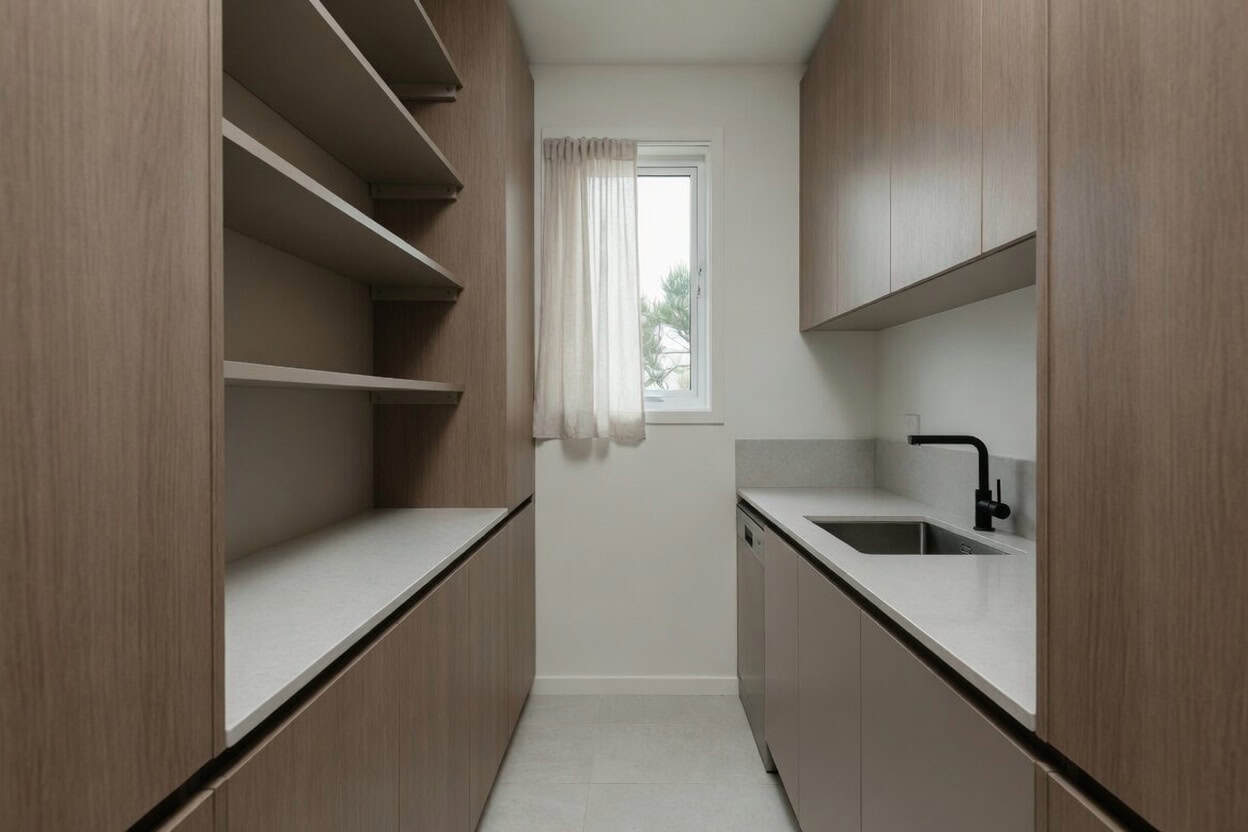
An acrylic cabinet front is not a sheet of perspex screwed to a door. Laminex Acrylic Panels are supplied as a finished panel: an acrylic decorative layer on a board substrate, sold for interior cabinetry and wall lining, and listed by Laminex with the properties above. The case for matte is tactile rather than visual: a super-matte acrylic does not hold a fingerprint the way a gloss panel does, which matters more on a fridge-side panel than any brochure photograph suggests.
Two things follow that people are rarely told. The panel arrives with a protective film that stays on until the kitchen is installed, so what you approve in a showroom sample is not what your joiner is handling on site. And because the decorative layer is comparatively thin and very hard, it does not scuff progressively the way laminate does. It looks perfect, then it has a chip. There is no middle state.
The Substrate Matters More Than Most People Realise
Here’s something you almost never see discussed in a materials guide: both laminate and acrylic are only as good as what’s underneath them. A budget particleboard carcass with premium acrylic doors will still fail at the edges in a humid scullery. A moisture-resistant MDF carcass with standard laminate doors will outlast a cheap acrylic kitchen.
Our cabinetry is made on German laser machinery in our Rosedale factory, and the questions worth asking any joiner are which substrate sits in the wet zones and how every cut edge is sealed. Laminex’s own Melteca technical data sheet says any exposed substrate must be sealed before service and that the substrate must not come in contact with any liquid. We’ll come back to why that matters so much in Auckland’s climate in the ageing section.
💡 Design tip: When you’re comparing quotes from two joiners, ask what grade of substrate they’re using and how the edges are bonded. A meaningful gap between two quotes is often the substrate rather than the door finish, and substrate failure ends a kitchen long before the doors show wear.
Dezignatek: Thermoformed, a Third Category Worth Knowing
There’s a third finish type you’ll sometimes see quoted alongside acrylic and laminate: thermoformed doors. Dezignatek, made by New Zealand Panels Group in Auckland, is the thermoform brand on our warranty schedule. According to its technical data sheet, the doors are solid-coloured or printed décor vinyl applied by vacuum, heat and pressure over moisture-resistant high density fibreboard, which gives one continuous surface across the face and edges. That’s what makes shaker profiles, bevelled edges and finger-pull grooves possible in a single wrapped skin.
Thermoformed sits closer to laminate on price, but heat is its limit: Dezignatek’s data sheet says surface temperatures above 50 degrees Celsius may result in delamination that is not covered by warranty, warns against exposure above hobs and ovens, and notes darker colours absorb more heat. We use it where the design calls for shaped profiles that flat HPL and acrylic panels can’t deliver. If a shaped or profiled door is what you are after, our guide to thermoform kitchen cabinet doors in NZ covers that route in full. It’s a useful third option but not really part of the acrylic-vs-laminate decision for flat-panel modern kitchens.
For the rest of this guide the comparison is the one-against-one choice most Auckland clients are actually wrestling with: Laminex or Melteca laminate against Laminex Acrylic or Ultraglaze.
Melteca vs Melamine: the Same Board Under Two Names
People ask us to compare Melteca and melamine as though they were rival products. They are not. Melteca is a melamine panel. Laminex makes it, and the decorative paper is fused into the board surface under heat and pressure at the point of manufacture. That is what low-pressure laminate means.
When a quote says melamine and another says Melteca, you are usually looking at a generic description of the same category and a brand name within it, and the meaningful question is which brand and which substrate, not which of the two words the joiner typed.
High-pressure laminate is the genuinely different thing. HPL is manufactured as its own sheet, then bonded to a substrate as a separate step. That extra thickness is why HPL takes a knock better along a door edge, and it is also why an HPL door has a glue line that an LPL door does not.
Where Each Finish Is Actually Allowed to Go
This is the specification detail that causes the most trouble at quote stage, and it isn’t a matter of opinion. Laminex’s Melteca data sheet says not to use Melteca in constant wear situations such as sink bench tops, high use shop counters, bar tops or restaurant tables. If a quote puts Melteca on a working benchtop, that’s a specification error rather than a bold choice.
The same logic applies to acrylic. Laminex Acrylic Panels are an interior panel product for cabinetry and wall lining, listed for indoor use, and outdoor application is excluded by name in the Laminex Acrylic, Laminex Laminate and Melteca warranties. Acrylic or laminate fronts on an outdoor kitchen or a covered deck servery sit outside all three.
Timber Veneer: the Third Option People Forget to Price
When homeowners search acrylic against laminate they are often really choosing between three things, because timber veneer sits in the same part of a quote. Veneer is thin sheets of real timber pressed onto a board, so it’s the one option here with real grain rather than a printed or coloured face. If warmth is what you are after and you had assumed a timber-look laminate was the only affordable route, ask for veneer to be priced alongside, and ask how it’s finished and what can be done about a scratch. Our guide to choosing kitchen cabinet materials covers the wider set.
The Warranty Data Behind Each Finish
This is the part of a kitchen quote that almost nobody reads and everybody relies on. If a supplier can’t or won’t tell you their warranty in writing, that’s a red flag. Every product we use is backed by documented warranties, most of which are publicly available as PDFs on the manufacturer’s website. Here’s what you’re actually getting when you sign off on acrylic or laminate in Auckland.
Laminex Acrylic: 10-Year Warranty
Laminex’s Laminex Acrylic Panels warranty is a 10-year limited warranty. It covers:
- Defects that result directly from Laminex’s manufacture or supply of the panel, during the first ten years after purchase
- Panels bought from Laminex New Zealand after 01 September 2018 for interior residential or interior commercial use in New Zealand
- Defects notified to Laminex within seven days of being noticed
It does not cover scratches, scuffs, normal wear and tear, general fading and discolouration from light, or outdoor application. That’s the acrylic catch, and we’ll deal with it honestly in the ageing section.
Ultraglaze: 10 Years, and in New Zealand It Is Not a Polytec Product
This one is worth getting right, because the specification sheets on either side of the Tasman say different things. Polytec is an Australian manufacturer, and its own warranty terms and conditions list Ultraglaze and Ultramatt at seven (7) years. The acrylic panel specified as Ultraglaze in New Zealand kitchens is a different supply: it is made here by New Zealand Panels Group, and the Ultraglaze product warranty (December 2022) warrants the panels and edging “for a period of 10 years from the date of purchase” against defects in manufacture.
Two conditions in that document matter at quote stage. The warranty runs to the original purchaser only and is not transferable, which is the opposite of how our own workmanship guarantee behaves. And it requires the panels to be installed using the components specified in the current Ultraglaze technical literature, which is one practical reason we do not mix a supplier’s panel with someone else’s edging system.
If a quote says “Ultraglaze”, ask which one. An Australian-supplied Polytec panel and a New Zealand Panels Group panel carry three years of difference in cover.
Laminex High-Pressure Laminate: 7 Years
The Laminex Laminate warranty covers Laminex high-pressure laminate, Formica high-pressure laminate, Laminex Metallics and Laminex Magnetics, and runs “during the first 7 years after initial purchase” for interior residential or commercial use. Read the conditions rather than the headline: cover applies only where the product has stayed installed at the location it was first fitted, where it was installed and maintained as Laminex specifies, and where the defect is notified within seven days of it becoming apparent. Outdoor application is excluded outright, which is the clause that catches an outdoor kitchen or a covered deck servery.
Melteca Hi-Gloss: 10 Years
Laminex’s own Melteca warranty (issued October 2020) is headed “10 year warranty” and covers Melteca Standard, Melteca Hi-Gloss and Melteca Jumbo quality laminated panels “during the first ten years after the initial purchase”. Our own guarantee schedule lists Melteca Laminates at 10 years, matching the manufacturer.
The mechanism is worth understanding either way. Melteca is a low-pressure melamine panel, so the decorative layer is fused during board manufacture rather than bonded on afterwards. Our guide to Laminex and Melteca cabinetry in New Zealand goes through the individual decors and finishes. There is no separate face to delaminate. Where a Melteca panel does fail, look first at the substrate at a cut edge near a sink or a dishwasher, which is exactly where the data sheet insists on sealing.
What Our Own Guarantee Actually Covers
Our published guarantee schedule separates the two things homeowners tend to blur together. Installation carries a 5-year warranty, and general workmanship and installation sit under a full-satisfaction guarantee. Blum and Hettich hardware carries a lifetime warranty, and so do Blanco sinks. Surfaces sit under their own supplier terms on that same schedule: Laminex, Melteca, PrimePanels and Bestwood laminates at 10 years, Caesarstone at 10, Dezignatek doors at 10, and electrical workmanship at 12 months. The guarantee transfers to the new owners if you sell the house, which matters if a kitchen is going in ahead of a sale.
Two things follow from reading that schedule honestly. No cabinet finish sold in New Zealand is warranted indefinitely, so a finish decision is a decision about roughly a decade, not a lifetime. And the hardware outlasts everything else in the room, which is why drawer runners are the last place we would let anyone save money.
“Choosing a finish is not choosing what looks good forever. It is choosing which failure you would rather have in eight years: a laminate edge that can sometimes be patched, or an acrylic chip that cannot.”
— Little Giant Interiors Design Team
NZ Kitchen Finish Warranty Comparison Table
| Finish | NZ Warranty | Covers | Doesn’t Cover |
|---|---|---|---|
| Laminex Acrylic | 10 years | Manufacturing and supply defects, interior use | Scratches, scuffs, wear and tear, fading from light, outdoor application |
| Ultraglaze acrylic (New Zealand Panels Group) | 10 years, original purchaser only, not transferable | Defects in manufacture, panels and edging | General fading and discolouration from UV exposure |
| Laminex and Formica HPL | 7 years | Manufacturing defects, interior use | Normal wear and tear, improper maintenance, outdoor application |
| Melteca Standard / Hi-Gloss / Jumbo (LPL) | 10 years (Laminex and our own schedule) | Manufacturing defects, interior use | Scratches, scuffs, burns, wear and tear, outdoor application |
| Little Giant Interiors installation and workmanship | Installation 5 years, guarantee transferable; Blum and Hettich hardware lifetime | Installation workmanship, joinery, hardware fitting | Finish (covered by finish manufacturer warranty) |
💡 Design tip: Before you sign a kitchen contract, ask your cabinetmaker to provide the written warranty for both the cabinet body and the finish, separately. These are two different documents. If they can’t produce both, that’s your cue to keep looking.
What the Warranty Doesn’t Tell You
Warranty is the floor, not the ceiling. A 10-year Laminex Acrylic warranty means the sheet won’t delaminate under normal use — it doesn’t mean your doors will look unchanged at year 10. A Melteca warranty covers manufacturing defects; it doesn’t predict how the edges will handle a teenager slamming the pantry door.
The warranty tells you the product’s promise. Real-world ageing tells you everything else. That’s where Auckland’s climate enters the picture.
Auckland Humidity: How Each Finish Actually Ages Here
Our factory is in Rosedale, and the cabinetry we quote is the cabinetry we cut, edge and install ourselves. The callbacks come back to us, so we see how a finish has actually behaved in an Auckland kitchen years after handover rather than reading it off a brochure. Most of the acrylic-versus-laminate material that surfaces in a search is written for Indian or Australian conditions, against products and warranty terms that are not the ones sold here.
Why Auckland Is Harder on Cabinetry Than the Brochure Assumes
We are not going to put a number on the humidity inside your kitchen. Nobody publishes a dependable one for Auckland homes, and the figures that circulate online do not survive being checked against their supposed source. What is documented is the mechanism. BRANZ study report SR341 measured in-service ventilation rates across a range of modern New Zealand housing and found that, on average, around a third of those homes were underventilated. The Building Code requires an adequate combination of thermal resistance, ventilation and space temperature in spaces where moisture may be generated (clause E3.3.1), and a means of removing cooking fumes and the moisture from utensil washing from the spaces where they’re generated (clause G4.3.3).
In a kitchen that moisture is cooking steam, a dishwasher venting at the end of its cycle, a sink in constant use, and very often a scullery or laundry sharing the same air. Add an indoor drying rack through an Auckland winter and the room spends months cycling between wet and dry. Cabinetry does not fail because the air was humid on one bad day. It fails because that cycle repeats a few thousand times.
Humidity doesn’t kill a cabinet finish. It kills the edge of the cabinet finish, via the substrate behind it. That’s the failure worth designing out.
How Laminate Ages in Auckland
Year 1–3: No visible change. HPL and Melteca both look exactly as they did on install day. The only failure we see in this window is if a previous trade (not us) has used non-moisture-resistant MDF in a laundry — that’ll swell at the sink-side drawer fronts early.
Year 4–7: Edge wear starts. The vulnerability of laminate is the edge — where the decorative surface meets the cut line of the board. On cheaper cabinets with PVC edge-banding applied with hot-melt glue, you’ll see micro-gaps start to open up after a few years of humidity cycles. Steam gets in, the glue line absorbs moisture, the edge lifts. That’s why Laminex’s Melteca data sheet says any exposed substrate must be sealed before service, and why the edge treatment is worth asking about on every quote.
Year 8–15: Depends entirely on the edge treatment. A laminate kitchen whose edges never opened up can look close to new well into its second decade. One whose edges failed can need new doors around the rangehood far sooner. The finish didn’t fail. The edge did.
How Acrylic Ages in Auckland
Year 1–3: Looks exactly like the showroom, with one gloss caveat. New acrylic looks exactly like the sample. A matte face such as Laminex’s Haze is the more forgiving one, and Laminex lists its acrylic panels as fingerprint resistant. Gloss acrylic in a dark colour looks sharp in a show home and hard work in a family one, because every fingerprint shows.
Year 4–7: Chip patterns emerge. This is where the honest conversation has to happen. The acrylic decorative layer is thin and hard. Anything harder than the layer itself will chip it, and the chip is permanent. The places acrylic takes chips are predictable:
- Drawer fronts at hip height — watches, belt buckles, keys in pockets
- Corner edges of island end panels where people brush past
- The base edge of lower doors — mop buckets, toddler trikes, vacuum cleaners
- The front edge of soft-close drawers where rings clip as hands go in
Unlike laminate, acrylic cannot be repaired. There’s no filler, no polish, no touch-up kit. A chipped acrylic door gets replaced. Laminex’s acrylic warranty itself plans for discontinued colours: where a colour is no longer in its standard range, the replacement offered is as close a type or colour match as possible from the range at the time.
Year 8–15: Ageing depends on light and cleaning. The Laminex Acrylic and Ultraglaze warranties both exclude general fading and discolouration from light or UV exposure, so keep acrylic fronts out of sustained direct sun. Cleaning is where most of the remaining risk sits: use only what the panel maker says is safe, and our kitchen cabinet care guide sets out what that means for each finish.
The Scullery / Laundry Specific Truth
Where most kitchens live and die, finish-wise, is the scullery. High humidity, poor ventilation, concentrated cooking spillover, dishwasher steam. A scullery is walk-in pantry and prep space combined, and for one we recommend laminate or Melteca over acrylic, for three reasons:
- Edge durability matters more than finish depth in a utility space
- The constant steam from the dishwasher and boiling pots is the exact condition where poorly sealed edges fail first
- The aesthetic difference matters less behind a door that’s usually closed
Same logic applies to laundries and sometimes butler’s pantries. Save the acrylic for the visible main kitchen, save the laminate for the workhorse spaces. This is the specification split we suggest wherever there is a scullery, and it is not a budget decision. It is a decision about matching each finish to the conditions it will actually face, which is a different question from which finish you like most.
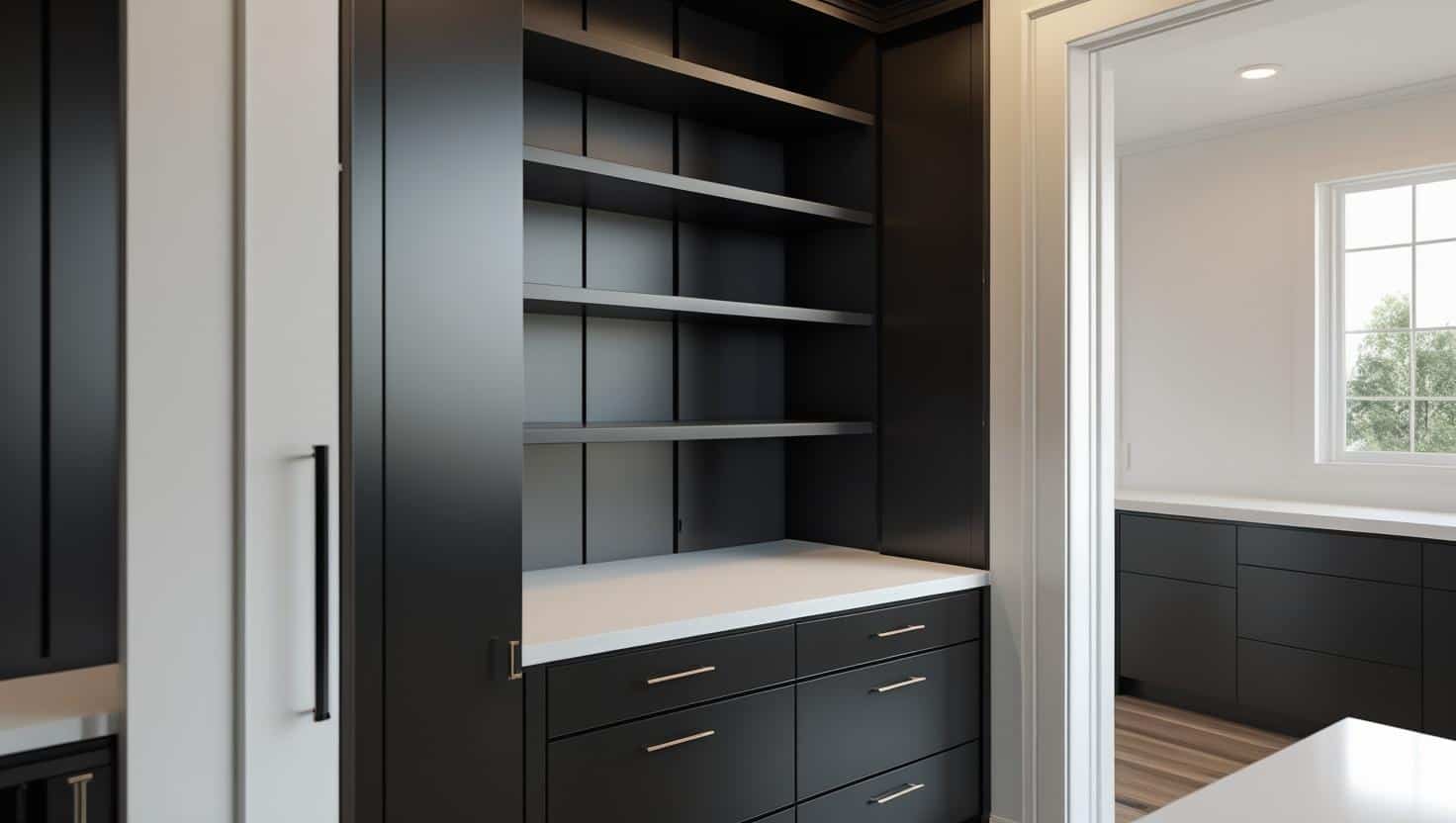
💡 Design tip: If your plan includes a scullery, butler’s pantry, or combined laundry-pantry, ask your designer to spec the utility space separately. You don’t need to match the main kitchen finish — and specifying laminate in the high-humidity zones will often save the whole kitchen from looking dated in 10 years.
The Real Ten-Year Cost: Upfront, Replacement, and Total
This is where most comparison guides go vague — “acrylic is more expensive” without numbers. Here’s what the cost actually looks like for a typical Auckland custom kitchen in 2026, broken down properly. We do not publish a price per finish; the ordering below comes from our own quoting across the Laminex, Melteca and Ultraglaze ranges. Actual quotes vary by size, layout, hardware and substrate specification.
Where Each Finish Sits, Cheapest to Dearest
Ordering we can stand behind, from our own quoting. Percentages we cannot, so there are none here: a finish uplift is a share of a cabinetry cost that swings with door count, run length, hardware and substrate, and a tidy percentage would only look precise.
| Finish | Where it sits | What you are paying for |
|---|---|---|
| Melteca standard (LPL) | Baseline | NZ-made, widest availability, the reference point every other finish is priced against |
| Melteca Hi-Gloss (LPL) | A step up from baseline | A gloss face without an acrylic budget. Vertical applications only, not benchtops |
| Laminex high-pressure laminate | Mid-range, rising with the decor | A thicker separate sheet bonded on, which takes a knock along an edge better than LPL. Premium woodgrains sit at the top of this band |
| Dezignatek (thermoformed) | Upper mid-range | Shaker and profiled doors in one continuous wrapped surface, which flat panels cannot do |
| Ultraglaze acrylic (New Zealand Panels Group) | Premium | Gloss or matte acrylic depth, made here, warranted 10 years to the original purchaser only |
| Laminex Acrylic Panels | Premium, top of the group | A super-matte acrylic face, listed by Laminex as fingerprint resistant, warranted 10 years |
What Actually Moves the Number on Your Quote
We are not going to publish a price band per finish, because we would be inventing precision we do not have. A finish uplift is a percentage of a cabinetry cost that itself swings with the number of doors and drawer fronts, the run length, the hardware, the substrate and how much of the kitchen is actually visible. Two kitchens of the same length can be priced far apart before anyone has chosen a colour.
What we can tell you is what drives the gap, in the order it drives it:
- How many fronts, not how many metres. Finish cost lands on doors, drawer fronts and exposed end panels. A drawer-heavy kitchen has far more finished surface than a door-heavy one of the same length, so the acrylic premium on it is larger.
- Which surfaces are actually seen. Cabinet interiors, the inside of a scullery and the back of an island do not need the premium finish. Specifying those in standard Melteca is where the money actually comes off, and it changes nothing about how the room looks.
- The edge treatment. Laser-bonded edging costs more than hot-melt PVC and is the line item most worth defending. It is also the line item most often quietly downgraded to win a quote.
- The substrate. Moisture-resistant board through the wet zones is not a finish decision at all, and it will outrank the finish in deciding how the kitchen looks in ten years.
The reliable way to get a real number is to price the same layout twice. Put your layout through our kitchen cost calculator for a baseline, then ask whoever is quoting you to hold the layout, hardware and substrate constant and change only the finish. Anything else is comparing two different kitchens. Our guide to comparing kitchen quotes in NZ covers the rest of what to hold constant.
The Costs That Arrive After Year Five
Upfront price is the part everyone compares. The part nobody prices is what happens when something gets damaged, and here the two finishes behave completely differently.
- Acrylic damage is a door replacement. A chip cannot be filled or polished out, so the remedy is a new front, colour-matched from the same decor if it is still in the range. That last condition matters: the Laminex acrylic warranty allows for the closest available match if a colour has been discontinued, which tells you what the manufacturer itself expects over a decade.
- Laminate damage is sometimes a repair. An edge chip on high-pressure laminate can often be filled or patched. It will not be invisible up close, but it is measured in a service call rather than a replacement panel.
- Substrate damage is neither. If moisture has got into the board at a cut edge, replacing the front does not fix it, and that is the failure that actually ends a kitchen early.
That asymmetry is the whole argument for the combination specification below. It puts the finish that cannot be repaired where nothing hits it, and the finish that can be repaired where everything does.
💡 Design tip: Ask your designer to price the same layout with three different finish specs at quote stage, with the same hardware and the same substrate. It’s the only way to see what the finish alone is costing you.
When to Combine Acrylic and Laminate: The Smart-Money Play
Our default recommendation for most Auckland family homes isn’t pure acrylic or pure laminate. It’s the combination. Acrylic on the uppers, where the visual impact lives and the light catches, and laminate or Melteca on the lowers, the island end panels, and anywhere that takes daily abuse. Here’s why it works, and the situations where each extreme still makes sense.
Why Acrylic Uppers + Laminate Lowers Works
Most of the visual weight of a kitchen sits at eye level and above. When you walk into a kitchen, the uppers (wall cabinets, rangehood surround, open shelving) are at your focal plane. The lowers are below sight line in casual viewing. So the depth of an acrylic finish on the uppers is doing most of the aesthetic work. The lowers need to look coordinated, not identical.
At the same time, the lowers take most of the physical abuse. Kids opening drawers with wet hands, dogs brushing against end panels, the mop, the vacuum, the rubbish bin, toddlers using the pantry handle as a climbing aid. Acrylic on a lower cabinet in a family home is asking to chip. Laminate copes with that better, and an edge knock on laminate can sometimes be patched where an acrylic chip cannot.
The coordination comes from choosing the two finishes together. Pick the laminate decor against the acrylic sample in your own kitchen’s light, not from a swatch book on its own. Done well, it reads as a deliberate design decision rather than a budget compromise.
When All-Acrylic Actually Makes Sense
Pure acrylic kitchens work in three specific situations:
- Show kitchens or apartments you don’t cook in heavily. Central city apartments, holiday homes, or kitchens that are primarily design features rather than working rooms can absolutely justify full acrylic. The wear doesn’t happen if the use doesn’t happen.
- Minimalist handleless designs where every detail matters. Full-acrylic with integrated finger-pulls, no visible hardware, clean panel lines — this specific design language benefits from the uninterrupted surface acrylic delivers that HPL can’t quite match.
- Couples or single-occupant households with no kids, pets, or heavy daily cooking. The abuse profile is lower, so the chip risk is lower. A household that entertains a couple of times a month and eats out the rest of the week will see very different year-ten acrylic performance from a family of five cooking every night.
When All-Laminate Is the Right Answer
Equally, there are kitchens where acrylic isn’t worth specifying anywhere:
- Rental properties, or homes being prepared for sale within 5 years. You won’t recoup the acrylic premium and the risk of visible wear before sale is high.
- Sculleries, butler’s pantries, and walk-in pantries. Already covered above — the humidity and abuse profile makes acrylic a bad spec behind a door that’s usually closed.
- Family homes with young kids where budget needs to go to layout, hardware, or appliances first. A beautifully laid-out Laminex HPL kitchen with good hardware will outperform a poorly laid-out acrylic kitchen every day of the week.
- Timber-look designs. If the aesthetic you want is oak, walnut, or smoked ash, Laminex HPL woodgrain decors are closer to real timber visually than any acrylic woodgrain on the market.
The decision isn’t acrylic versus laminate. It’s which one belongs where in your specific kitchen, for your specific life, over the next decade or more.
That’s the conversation we have at consultation.
Making the Call: What We’d Actually Recommend
If you’ve read this far, you’re not looking for a quick answer. You’re looking for the right decision for a kitchen you’ll live with for a long time. Here’s how we’d frame the call at consultation stage.
Start with the space, not the finish. How do you cook? How many people live in the home? Do you have a scullery? A laundry combined with pantry? Pets? Kids under 10? That profile tells us more about the right finish than any colour palette or design inspiration picture ever will.
Understand both warranties and both failure modes. Acrylic’s weak point is a permanent chip; laminate’s is the edge, where moisture gets into the board. Neither is invincible. The one with the failure mode that’s least visible and least common in your specific home is the right one for you.
Get the substrate and edge treatment into the conversation. If a competing quote is $5,000 cheaper, ask what they’re using for substrate and how they’re bonding the edges. Moisture-resistant MDF and laser-bonded edges are the two things that separate a cabinet that still looks good at year 10 from one that needs replacing early.
Consider the combination first, extremes second. The acrylic-upper / laminate-lower spec gives most Auckland family homes the look they want, the durability they need, and a better total cost over a decade than either extreme.
Finally, see it in your home. A sample square of Laminex Acrylic Haze in a showroom under LED lighting is different to the same sample in your kitchen under your lighting, next to your tapware and your floor tile. The same is true for laminate. A free in-home consultation is where we bring the samples, show you real colours in real light, and help you build the combination that works for your space.
Ready to Choose Your Kitchen Finish the Right Way?
Every kitchen we build starts with a free design consultation at your place or in our showroom, where we talk through the finishes in this guide with samples and the trade-offs for your home. You get a free preliminary 3D design and estimate, then a detailed fixed quote once you’ve chosen your materials. No pressure, no obligation, just an honest conversation about what will still look right in ten years.
➡ Book your free in-home design consultation with Little Giant Interiors
➡ See how our design and build process works
➡ See how we specify and build a kitchen from the substrate up
Frequently Asked Questions: Acrylic vs Laminate Kitchen Cabinets NZ
Which lasts longer, acrylic or laminate kitchen cabinets in NZ?
Neither finish is warranted forever, so the honest comparison is a decade. On the manufacturers own documents, Laminex Acrylic Panels carry 10 years, Ultraglaze acrylic from New Zealand Panels Group carries 10 years to the original purchaser only, Laminex high-pressure laminate carries 7 years, and Laminex publishes 10 years on Melteca Standard, Hi-Gloss and Jumbo panels. In an Auckland kitchen, laminate usually shows edge wear before acrylic shows surface wear, but a laminate edge can sometimes be patched and an acrylic chip cannot. Our own installation and workmanship guarantee runs to 5 years and transfers if you sell the house, with Blum and Hettich hardware covered for life.
Do acrylic kitchen cabinets scratch easily?
Laminex lists its acrylic panels as scratch resistant, but resistant is not proof, and unlike laminate a chip on acrylic cannot be filled or repaired. The usual chip points are drawer fronts at hip height, exposed end panels where people brush past, and the base edges of lower doors where a mop bucket or a vacuum lives. For family homes with young children or pets we usually recommend keeping acrylic to the upper cabinets and laminate on the lowers, so the damage that will happen does not happen where you can see it.
How much more expensive is acrylic compared to laminate for a kitchen in NZ?
Acrylic is the most expensive of the mainstream cabinet fronts and Melteca is the least, with high-pressure laminate and gloss laminate in between. We are not going to publish a dollar figure for the gap, because it moves with the size of the kitchen, the number of doors and drawer fronts, the substrate and the hardware, and a number that ignores all of that is worse than no number. Run your own layout through our kitchen cost calculator, then ask any joiner quoting you to price the same layout twice, once in acrylic and once in laminate, with everything else held identical. That is the only comparison that means anything.
Is acrylic a good choice for Auckland humidity?
The acrylic face is not the part at risk. Laminex lists its acrylic panels as moisture resistant and UV stable for indoor use; the weak points are the substrate and the edge. Laminex's Melteca data sheet says the substrate must not come in contact with any liquid and that any exposed substrate must be sealed before service. A moisture-resistant substrate in the wet zones with every cut edge sealed handles a kitchen or a scullery. A cheap carcass with poorly sealed edges fails here whether the door is acrylic or laminate.
Can you combine acrylic and laminate in the same kitchen?
Yes, and for most Auckland family homes it is the specification we would actually recommend. Acrylic on the uppers, where the visual impact sits and contact wear is minimal, with high-pressure laminate or gloss laminate on the lowers, island end panels and any utility space. Choose the laminate decor against the acrylic sample in your own kitchen light so the two read as one design decision rather than a budget compromise. It also puts the finish that cannot be repaired where nothing hits it.
What is the warranty on Laminex Acrylic panels in NZ?
Laminex publishes a 10-year limited warranty on Laminex Acrylic Panels bought from Laminex New Zealand after 01 September 2018 for interior residential or commercial use. It covers defects that result directly from manufacture or supply during the first ten years, and the defect must be notified within seven days of being noticed. It excludes scratches, scuffs, normal wear and tear, general fading and discolouration from light, and outdoor application. Ask your cabinetmaker for a copy before you sign off the specification, not after.
What is the warranty on Ultraglaze in New Zealand?
Ten years, and the supplier is not who most people assume. Ultraglaze in New Zealand is made by New Zealand Panels Group, and its product warranty dated December 2022 covers the panels and edging for a period of 10 years from the date of purchase against defects in manufacture. Two conditions matter: the warranty is to the original purchaser only and is expressly not transferable, and it requires installation using the components specified in the current Ultraglaze technical literature. Polytec in Australia lists its own Ultraglaze and Ultramatt at seven years, which is where the confusion comes from. If a quote says Ultraglaze, ask which supply it is.
Does acrylic yellow over time?
Both the Laminex Acrylic and Ultraglaze warranties exclude general fading and discolouration from light or UV exposure, so neither manufacturer promises against it. Keep acrylic fronts out of sustained direct sun, especially on a west-facing run, and clean them only with what the panel maker says is safe. Haze and swirl marks on a gloss face usually come from the wrong cleaner or an abrasive pad, so check the care advice for your exact panel before you reach for a spray. Our kitchen cabinet care guide covers each finish.
What is Melteca Hi-Gloss and how does it compare to acrylic?
Melteca Hi-Gloss is a low-pressure melamine panel with a high-gloss decorative surface, made in New Zealand by Laminex, and it is the usual answer for a gloss kitchen without an acrylic budget. Laminex warrants Melteca Hi-Gloss for 10 years and designs it for vertical applications such as cabinetry, doors and feature panels, so it belongs on doors and panels rather than on a benchtop. Visually it is reflective but it does not have the mirror depth of true acrylic, and the gap is most obvious in dark colours under a downlight. A well-specified Hi-Gloss kitchen will comfortably outlast a badly specified acrylic one.
Is Melteca the same thing as melamine?
Yes. Melteca is a brand of melamine panel made by Laminex, and melamine is the generic description of the category. The decorative layer is fused into the board during manufacture rather than bonded on afterwards, which is why it is called low-pressure laminate. If one quote says melamine and another says Melteca, that is not a difference in product type. Ask instead which brand, which substrate and how the edges are finished, because those are the three answers that change how the kitchen ages.
Should I use acrylic in my scullery or laundry?
Usually not. Sculleries, butler pantries and laundries carry the highest moisture load in the house and the lowest visibility, since the doors are generally shut. The aesthetic value of acrylic is largely wasted there, and the money is better spent on the main kitchen. We usually recommend high-pressure laminate or gloss laminate in utility spaces even when the main kitchen is acrylic, because an edge knock can sometimes be patched and replacing one door later costs less.
Are acrylic kitchen cabinets worth the extra cost?
For the right kitchen and the right household, yes. For the wrong one, no. Acrylic gives a depth of matte or gloss that laminate cannot match, and on a handleless design or an apartment kitchen where the cabinetry is the room, the premium earns its place. In a family home with young children, pets and heavy daily cooking, the fact that a chip is permanent usually makes laminate or a combination specification the better call. The upgrade that pays off most reliably in either case is not the finish at all. It is a moisture-resistant substrate and properly bonded edges.
Related guides
- What thermoformed doors can do that flat panels cannot
- Planning a handleless kitchen around the finish you choose
- Cabinetry cost tiers and what each one includes
Have you been putting off your kitchen renovation?
We offer flexible finance options to help you get your dream kitchen sooner. Learn more about our interest-free finance options.
References
- Laminex New Zealand — Laminex Acrylic Panels product specification and 10-year warranty
- Laminex New Zealand, Laminex Acrylic Panels 10 Year Limited Warranty
- Laminex New Zealand, Laminex Laminate warranty (7 years)
- Laminex New Zealand, Melteca 10 year warranty
- Laminex New Zealand, Melteca Technical Data Sheet
- Dezignatek, Technical Data Sheet, November 2024
- Ultraglaze (New Zealand Panels Group) — Ultraglaze Product Warranty, December 2022
- polytec — Limited Warranty Terms and Conditions (Ultraglaze and Ultramatt, seven years, Australia)
- Laminex New Zealand — Guide to Cabinetry, November 2025
- BRANZ Study Report SR341 — The role of ventilation in managing moisture inside New Zealand homes
- Building Regulations 1992, Schedule 1 (the New Zealand Building Code), clauses E3 and G4