

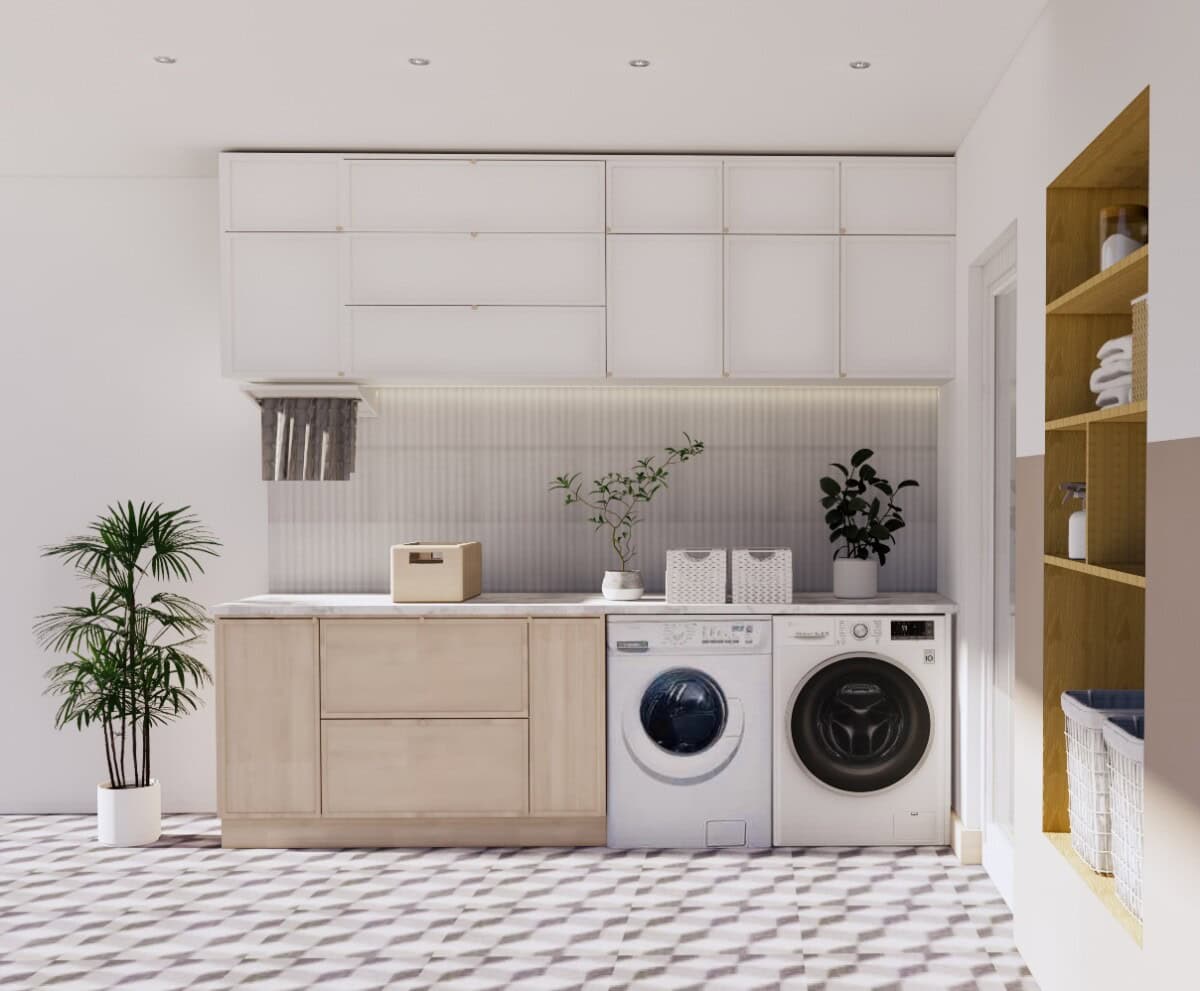

Laundry Cabinetry Cost in Auckland: What You’ll Really Pay in 2026
Quick answer: Laundry cabinetry in Auckland typically costs $2,000–$4,500 for flatpack melamine, $5,000–$9,000 for semi-custom with soft-close hardware, and $9,000–$15,000+ for full custom floor-to-ceiling joinery — usually the single biggest line item in any laundry renovation.
The laundry is the room nobody photographs and everybody uses. It’s also the room where people most often underestimate the cabinetry budget — usually because they’ve been pricing the whole renovation as one lump and have no idea how much of that number is the joinery itself.
So let’s pull the cabinetry out and look at it on its own. Across a typical Auckland laundry, the cabinetry alone accounts for somewhere between a third and half of the total renovation spend. Get that number right and the rest of your budget — flooring, tapware, the tradies — starts to make sense. Get it wrong and you’re back to square one a week before the install.
This guide gives you the real ranges we see across Auckland in 2026, what pushes the price up or down, and where you can trim without ending up with cabinetry that swells the first humid summer.
Want a price for your own laundry?
Get a rough estimate in about two minutes with our free laundry cabinetry cost calculator.
On this page: What laundry cabinetry costs in Auckland · What drives the price up or down · How to keep the cost down · FAQs
What Laundry Cabinetry Actually Costs in Auckland
Here’s the honest spread. These are installed ranges for the cabinetry portion of a laundry — not the whole room, and not including plumbing, tiling, or appliances.
| Tier | What you get | Typical installed cost (Auckland, 2026) |
|---|---|---|
| Flatpack / modular melamine | Pre-made carcasses, standard fronts, basic hinges | $2,000–$4,500 |
| Semi-custom, moisture-resistant board | Made to your measurements, soft-close hardware, better fronts | $5,000–$9,000 |
| Full custom | Designed to the room, moisture-resistant or polyurethane finish, BLUM hardware, floor-to-ceiling | $9,000–$15,000+ |
| Door & front replacement only | Reface sound existing carcasses | $1,000–$3,000 |
Why the gap between flatpack and custom is so wide
Flatpack is cheap because it’s built to a fixed size in a factory you’ll never see, then assembled on site. It works in a square, standard laundry. The trouble is that most Auckland laundries aren’t square or standard — they’re a nook off the kitchen in a 1970s brick-and-tile in Pakuranga, a lean-to off the back of a Grey Lynn villa, or a slim cupboard run in a Takapuna apartment. The moment your space has an odd wall, a window in the wrong place, or a sloping floor, flatpack starts wasting room.
Custom cabinetry costs more because it’s measured, drawn, and cut for your exact space — which is where the value sits in a small room. When every millimetre counts, a few hundred millimetres of dead space you can’t use is the difference between fitting a full-height broom cupboard or not.
The good news for anyone pricing a laundry right now: the wild material inflation of a few years back has well and truly cooled. New Zealand residential construction costs rose just 2.3% in the year to December 2025, according to the Cordell Construction Cost Index — a long way from the 10%-plus spike of late 2022. QV CostBuilder put the year-on-year rise for a standard new home at around 1.1% to November 2025, against a 38% jump across 2020–2024. Translation: 2026 is a settled year to be quoting cabinetry.
💡 Design tip: Before you compare quotes, ask each supplier what’s actually included — carcass material, hinge brand, soft-close, and whether installation is in the price. Two quotes can look $3,000 apart and turn out identical once you line up the spec.
If you want the cabinetry figure for your own laundry rather than a range, the cost calculator is the fastest way in. For the full-room picture — plumbing, tiling, the lot — our sister company covers full laundry renovation costs in detail.
What Pushes a Laundry Cabinetry Quote Up or Down
Five things move the number more than anything else. Knowing them lets you spend where it matters and pull back where it doesn’t.
| Cost driver | Effect on price | Why it matters in a laundry |
|---|---|---|
| Material | The single biggest lever | Standard melamine is cheapest; moisture-resistant board and polyurethane cost more but hold up far better near water |
| Soft-close hardware | Moderate add | Quieter and longer-lasting; worth it in open-plan homes where the laundry sits off the living area |
| Full-height vs standard | Adds cost, adds storage | More material and labour, but it’s the highest-value upgrade in a small laundry |
| Internal organisers | Adds cost | Pull-out hampers, drawer stacks, and tip-out bins are where a laundry stops being a dumping ground |
| Size & layout | Scales the whole quote | A run of base units costs less than a full perimeter with overheads and a tall bank |
Material is where Auckland’s climate earns its keep
This is the one we’d push back on if you tried to cut it. A laundry is a wet, warm room — steam off the dryer, splashes at the tub, damp washing sitting around. Standard particleboard with a thin melamine skin handles that for a while, then the bottom of the tub cabinet starts to swell where water has wicked into an exposed edge.
Moisture-resistant board costs a little more per sheet, and in a laundry it’s the difference between cabinetry that lasts five years and cabinetry that lasts twenty. We build laundry carcasses from moisture-resistant substrate as standard, finished in Melteca or a painted polyurethane front depending on the look you’re after. Auckland’s humidity isn’t a reason to spend more everywhere — it’s a reason to spend it here.
“People want to save on the laundry because it’s ‘just the laundry’. The one place we’d talk them out of cutting is the carcass material. It’s hidden, it’s boring, and it’s the bit that fails first if you get it wrong near water.”
— Little Giant Interiors Design Team
Hardware: where soft-close stops being a luxury
The hinges and runners are the parts you touch every day, so they’re worth getting right. We fit BLUM soft-close hinges and runners across our laundry joinery, with the option of LEGRABOX drawers where someone wants a deeper, cleaner drawer stack for detergents and folded washing. Häfele covers the specialised bits — pull-out hampers, tip-out trays at the tub, internal bins.
Soft-close adds a moderate amount to the quote. In a standalone laundry off the garage, it’s a nice-to-have. In a Hobsonville new-build where the laundry opens straight into the kitchen, it’s the reason nobody hears the cupboards slam at 6am.
💡 Design tip: In a small laundry, spend on one tall full-height cabinet before you spend on a run of fancy drawers. Vertical storage in a narrow room beats clever drawers nearly every time.
How to Keep Laundry Cabinetry Costs Down
Custom isn’t the cheapest option and we won’t pretend it is. But there’s a real gap between cutting cost and cutting corners, and most of the savings live in the first category.
Replace the doors, keep the carcasses
If your existing cabinetry is structurally sound and just looks tired, you don’t need to rip it out. Most laundry cabinetry runs on standardised carcasses — the boxes behind the doors. Swapping the doors, drawer fronts, and kickboards updates the whole room for a fraction of a full rebuild.
Door and front replacement typically runs $1,000–$3,000 depending on the size of the room and the finish you choose, plus around $300+GST in fitting if you bring in a local installer. New doors themselves sit somewhere between $60 and $200 each. It’s quick, it’s tidy, and you’re not living without a laundry for a fortnight. The catch: it only works if the carcasses are in good nick. If the bottom of the tub cabinet has already swollen, refacing it is throwing good money after bad — that’s the point where a rebuild in moisture-resistant board pays off.
Mix your materials instead of going premium everywhere
You don’t need polyurethane on every surface. A common move in our Auckland projects: moisture-resistant board throughout the carcasses, a hardwearing laminate on the doors people see, and the splurge saved for one feature — a benchtop, or a single run of full-height cabinetry. That’s how you land a custom result on a mid-range budget without it looking like a compromise.
A real-world example
A family in Mt Albert came to us with a narrow villa laundry — a 1.4m run between the back door and the bathroom wall, the classic afterthought space. They didn’t want a renovation, they wanted the room to work. We took it floor to ceiling on the single long wall: moisture-resistant carcasses, a stacked washer-dryer enclosed in a tall cabinet, a pull-out hamper, BLUM soft-close throughout, and a laminate benchtop over the front-loader for folding. The cabinetry came in around $8,500. It didn’t make the laundry bigger. It made every centimetre of it count.
That’s the thing about getting the cabinetry right in a small room — it does more for daily life than almost any other spend in the house. If you want more ways to claw back space, our guide to laundry cabinet NZ ideas is worth a read. And when you’re ready to put real numbers to your own space, every project starts with a free in-home consultation and a 3D design — you can see exactly what you’re buying before you commit. Here’s how our 6-step design and build process works.
💡 Design tip: If budget’s tight, phase it. Get the cabinetry and storage right now — the part that’s hard to change later — and leave the benchtop upgrade or new tapware for a second round. Cabinetry done well is the bit you won’t want to touch again.
Is Custom Laundry Cabinetry Worth It?
For a square laundry where flatpack fits cleanly, off-the-shelf is a fair call and we’ll tell you so. For everything else — the odd-shaped nook, the villa lean-to, the apartment cupboard, the small room you need to work twice as hard — custom is where the money goes furthest, because it’s measured for your space and built in our own 700m² Auckland factory rather than ordered to a fixed size.
Want a price for your own laundry?
Get a rough estimate in about two minutes with our free laundry cabinetry cost calculator.
That’s also why we can back it with up to a 15-year warranty — when you cut and edge every panel in-house on German laser machinery, you’re not hoping a flatpack box holds up. You can see what our guarantee covers for yourself.
➡ Book your free in-home design consultation with Little Giant Interiors
➡ See our 6-step design and build process
➡ Learn more about our custom laundry cabinetry in Auckland
Laundry Cabinetry Cost: Frequently Asked Questions
How much does laundry cabinetry cost in Auckland in 2026?
Installed laundry cabinetry in Auckland typically runs $2,000–$4,500 for flatpack melamine, $5,000–$9,000 for semi-custom with soft-close hardware, and $9,000–$15,000+ for full custom floor-to-ceiling joinery. Cabinetry is usually the largest single line item in a laundry renovation, accounting for roughly a third to half of the total spend. The final figure depends on material, size, hardware, and how much of the room you cabinet.
What does it cost to replace just the laundry cabinet doors in NZ?
Replacing only the doors, drawer fronts, and kickboards typically costs $1,000–$3,000 depending on room size and finish, plus around $300+GST in fitting if you use a local installer. Individual doors run roughly $60–$200 each. It only makes sense if your existing carcasses are still sound — if the boxes have swollen near the tub, a rebuild in moisture-resistant board is the better spend.
Is custom laundry cabinetry worth it over flatpack?
For a square, standard laundry, flatpack can be a sensible choice. For odd-shaped or small rooms — villa lean-tos, apartment cupboards, narrow nooks — custom is where the value sits, because it's measured and built for your exact space and wastes no room. Custom also lets you specify moisture-resistant materials and quality hardware that hold up far better in Auckland's humid climate.
What's the most durable material for laundry cabinetry in Auckland's climate?
Moisture-resistant board for the carcasses is the key choice in a wet, warm room. Standard particleboard with a thin melamine skin can swell where water reaches an exposed edge, often within a few years. Moisture-resistant substrate finished in Melteca or polyurethane costs a little more upfront but lasts far longer near the tub and dryer. It's the one area we'd talk you out of cutting.
How much of a laundry renovation budget is cabinetry?
Cabinetry is typically the biggest single cost in a laundry renovation, accounting for roughly a third to half of the total. The rest covers plumbing, electrical, flooring, tiling, tapware, and painting. If you're budgeting a full renovation rather than just the joinery, our sister company Superior Renovations covers full laundry renovation costs in detail.
Do soft-close drawers and hinges cost much more?
Soft-close hardware adds a moderate amount to a laundry cabinetry quote rather than a large jump. In a standalone laundry it's a comfort upgrade; in an open-plan home where the laundry sits off the kitchen or living area, it's well worth it for the quieter operation and longer hardware life. We fit BLUM soft-close across our laundry joinery as standard.
How long does custom laundry cabinetry take to make and install?
Custom laundry cabinetry is measured to order, so it takes weeks rather than days — typically a few weeks from design sign-off to installation, depending on the workload and materials. The process runs through consultation, 3D design, manufacturing in our Auckland factory, then installation. The install itself is usually a day or two for a standard laundry.
Can I get full-height cabinetry in a small laundry?
Yes, and it's usually the highest-value upgrade in a small room. Taking cabinetry floor to ceiling on one wall turns unused vertical space into broom storage, a stacked washer-dryer enclosure, or a tall pantry-style cupboard for cleaning supplies. In a narrow laundry, vertical storage almost always beats adding more drawers.
What's the cheapest way to update laundry cabinetry?
If the carcasses are structurally sound, replacing the doors, fronts, and kickboards is the most cost-effective update at roughly $1,000–$3,000. Mixing materials also helps — moisture-resistant board on the carcasses, a hardwearing laminate on the doors, and the budget saved for one feature like a benchtop. Phasing the work over two stages spreads the cost too.
Does Little Giant Interiors warranty its laundry cabinetry?
Yes. Because we design, manufacture, and install our cabinetry in our own 700m² Auckland factory using German laser technology, we back it with up to a 15-year warranty on the cabinetry, alongside supplier warranties on specialised hardware. You can see exactly what's covered on our guarantee page.
Have you been putting off your laundry renovation?
We offer flexible finance options to help you get your dream laundry sooner. Learn more about our interest-free finance options.