


Small Laundry Ideas NZ — 14 Designer-Tested Solutions for Auckland Homes
Quick answer: A small laundry in Auckland works best when every element earns its place — stacked front-loaders to halve the footprint, full-height cabinetry to hide appliances, and ventilation that meets Clause E3 of the NZ Building Code. The 14 ideas below have all been tested in real Auckland villas, bungalows, and apartments.
If you’ve got a small laundry in Auckland, you already know the problem. Not enough floor area. Too much washing. Detergent bottles, pegs, and damp towels competing for the same square metre. We design custom laundries in compact homes across Auckland every week, from Ponsonby villas to North Shore townhouses, and the same constraints keep showing up — narrow nooks, awkward corners, layouts that weren’t built for modern appliances.
This guide pulls together 14 small laundry ideas we use most often. They’re grouped roughly by what they solve: saving floor space, getting more out of walls, hiding what you don’t want on show, and dealing with Auckland’s humidity. Every idea comes with real NZ costs, suburb-specific notes, and the compliance points most laundry guides skip.
The Building Code matters more in laundries than people think. Clause E3 of the NZ Building Code (Internal Moisture) requires impervious surfaces around sinks and appliances, plus active ventilation — a fan, a window, or both. In Auckland’s humid summers, this isn’t optional paperwork. It’s the difference between a laundry that stays fresh and one that grows mould behind the dryer. We’ll flag the E3 implications throughout.
One quick reference before the ideas start.
洗衣房橱柜成本计算器
Custom laundry cabinetry pricing depends on size, materials, hardware, and how complex the design gets. Before booking a consultation, you can get a rough estimate in under a minute using our calculator. It accounts for Auckland-specific pricing and gives you a ballpark figure based on the cabinetry choices you’d actually make.
Try the laundry cabinetry cost calculator
1. Stack Your Washer and Dryer
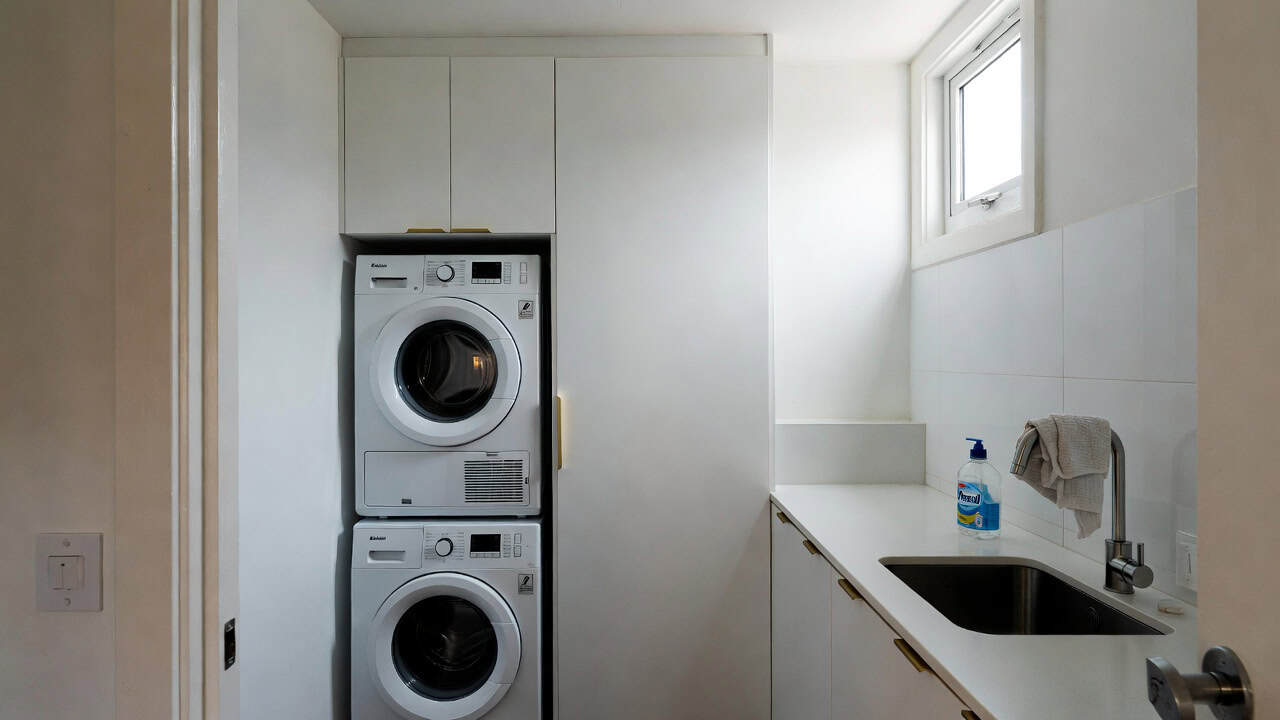
Stacking your appliances is usually the first move in any small laundry redesign. It halves the floor footprint and frees up space for things that actually need it — a folding bench, a sink, or just enough room to swing a basket of wet washing past the door.
Why it works in Auckland homes
A side-by-side washer and dryer takes around 1.2 to 1.4 metres of bench width. A stack drops that to 600mm. In a Mt Eden bungalow we worked on recently, stacking the appliances added enough room to fit a 1.2m folding bench and a slim broom cupboard against the opposite wall — the same space that previously held nothing but two appliances and a bin.
Stacking also works well in apartments. Most CBD and Takapuna apartments have a laundry-in-a-cupboard layout where a stacked column is the only option that fits behind bi-fold doors.
Choosing the right machines
You need front-loaders. Top-loaders can’t be stacked. Most major brands sell a stacking kit as an accessory — Fisher & Paykel, Bosch, LG, Haier all offer them. The kit bolts the dryer to the top of the washer and is essential for safety. Check the kit is rated for your specific model pair before you buy.
For families, a 7-9kg washer and dryer combo handles weekly loads comfortably. For singles or couples, 5-7kg is plenty. A heat-pump dryer pairs well with a stacked layout because it doesn’t need an external vent, which matters if you’re stacking against an internal wall. EECA estimates heat-pump dryers use 40-60% less energy than conventional vented dryers.
Installation in older Auckland homes
Older villas and bungalows weren’t designed around appliance stacks. Check the floor is level — uneven kauri floorboards in pre-1940s homes can throw a stack off plumb, and vibration over time can damage both machines. Pack the feet, or have a builder check the floor before installation.
Plumbing access is the other catch. If your existing taps are positioned for a side-by-side layout, you may need a plumber to relocate them. Allow $400–$800 for plumbing adjustments in older homes.
💡 Design tip: Leave a 50mm gap between the stack and the surrounding cabinetry. Front-loaders vibrate hard during the spin cycle and need clearance to move. Pack the feet with anti-vibration pads to reduce noise transfer through the floor.
What it costs in Auckland
Quality stackable washer-dryer pairs run $2,000–$4,500 depending on brand, capacity, and dryer type (vented, condenser, or heat pump). Stacking kits add $150–$300. Custom cabinetry to enclose the stack starts at around $1,500 for a basic surround and goes up depending on materials and finishes.
2. Use Your Walls for Storage
The wall above your washer is usually empty. That’s wasted storage in a room where you need every square centimetre to pull its weight. Wall storage works because it pushes everything off the floor — detergent, baskets, ironing supplies, cleaning gear — and keeps the floor clear for movement.
Open shelves vs. closed cabinets
Open shelves are cheaper and look lighter in a small room. Floating timber shelves at 250–300mm deep hold detergent bottles, fabric softeners, and folded towels without crowding the space. Painted MDF or solid pine both work in Auckland’s humidity provided they’re sealed properly.
Closed cabinets hide clutter and protect contents from dust, which matters more than people expect. Cabinets with ventilated doors (slotted or perforated panels) prevent moisture buildup in damp Auckland conditions — a closed box with no airflow above an active dryer is a mould risk.
If you go closed, run cabinets to the ceiling rather than stopping short. The 300mm gap above standard wall cabinets just collects dust. Full-height storage costs more but uses the volume properly.
Fold-down drying racks
Auckland weather doesn’t always cooperate with outdoor drying. A wall-mounted, fold-down drying rack solves indoor drying without taking permanent floor space. Mounted above the washer or on a clear wall, it drops down when needed and folds flat when not. Accordion-style racks extend 500–600mm and hold a couple of loads of delicates or towels.
💡 Design tip: Mount drying racks near a window or extractor fan. Air-drying in a sealed room raises humidity and slows the drying. EECA recommends air-drying where possible because it cuts dryer energy use significantly — but only if the moisture can escape.
Installation notes for older homes
Plasterboard alone won’t hold a loaded wall cabinet. Find studs (usually 450mm or 600mm centres in modern homes, more variable in pre-1940s villas) or use proper toggle anchors rated for the load. Concrete walls in apartments need masonry bolts and a hammer drill. For anything heavy, fix into solid backing — not just GIB.
What it costs
Floating shelves start at $60–$120 each. Slim wall cabinets run $200–$500 depending on size and finish. A fold-down drying rack costs $100–$250. Custom wall storage from us starts at around $800 for a configured run — designed to fit the exact space rather than working around standard cabinet sizes.
3. Add a Pull-Out Folding Bench
A folding bench is one of those things you don’t realise you need until you don’t have one. Folding laundry on the kitchen table or the bed is a constant source of low-level annoyance, and a permanent fold-out surface in a small laundry usually isn’t possible. A pull-out bench solves both problems.
How a pull-out bench works
The bench slides out from inside a cabinet on heavy-duty runners — usually rated for 30–50kg. When not in use, it tucks back behind a cabinet door. Most pull-outs are 500–600mm wide and 400–500mm deep, which is enough surface for folding a towel or sorting a basket without needing a full benchtop.
In our builds, we usually integrate the bench into the cabinet directly under the washer or beside a stacked column. A client in Parnell wanted a pull-out beside her stack that doubled as a desk for paying bills — same mechanism, slightly deeper, paired with a power point above for a laptop.
Materials that handle humidity
The bench surface needs to handle damp clothes and the occasional spill. Laminated timber, melamine, and engineered stone all work. Solid timber is fine if it’s properly sealed but cheaper untreated pine will warp within a year in an Auckland laundry. We typically specify Laminex or Polytec laminate for pull-out benches — the surface is moisture-resistant, easy to wipe, and resists the wear of repeated folding.
Installation reality
The cabinet frame has to be solid. A pull-out under load — say, a fully-loaded laundry basket — puts real stress on the runners and the cabinet sides. Flat-pack cabinets often aren’t rated for this. Custom cabinetry is built around the load from the start.
💡 Design tip: Add a small lip (10–15mm) at the back edge of the bench. It stops items sliding off when the bench is extended, and it’s invisible when the bench is closed. Small detail, big difference in daily use.
What it costs
A basic pull-out bench retrofitted into existing cabinetry costs $300–$700. Custom pull-out benches built into new cabinetry from us start at around $900 including the surrounding cabinet — designed to integrate properly rather than bolted on as an afterthought.
4. Hide the Whole Laundry in a Cabinet
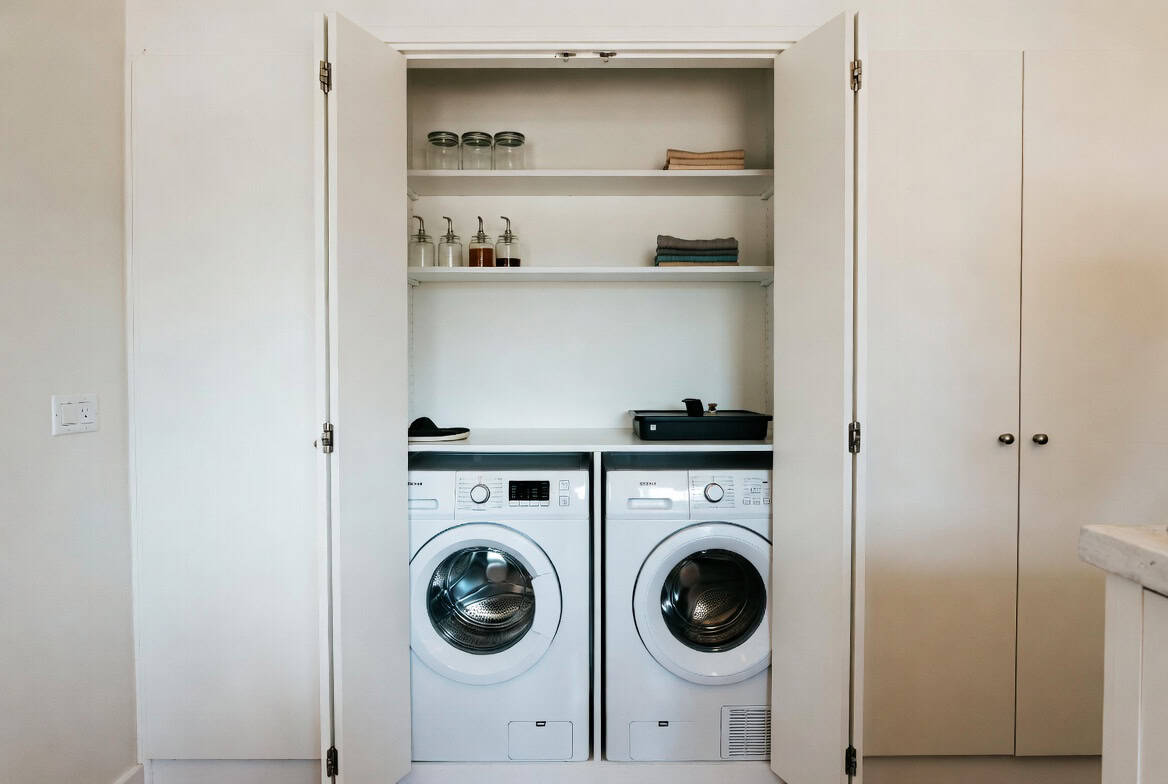
If your laundry shares space with the kitchen, hallway, or bathroom, hiding the appliances behind cabinet doors is the cleanest way to keep the room functional without it looking like a utility area. This is sometimes called a European laundry — a fully-enclosed laundry within another room — and it’s increasingly common in Auckland apartments and new builds.
Door options that work in tight spaces
Standard swing doors need clearance to open, which is usually exactly what you don’t have. Two better options:
Bi-fold doors open in half their swing radius. Two narrow panels fold against each other and slide along a top track. They’re good for openings up to 1.2m wide.
Cavity-sliding or pocket doors disappear into the wall when open. They take more planning (the wall needs a cavity built into it) but they’re the cleanest solution — no swing arc, no protrusion, completely hidden when not in use.
Hinged doors still work if you have the swing space. For very narrow openings, lift-up doors (like overhead kitchen cabinets) can work above a stack, though they’re less common in laundries.
Ventilation is mandatory
This is where most DIY hidden laundries get it wrong. An enclosed dryer pumps moisture into the cabinet, and without ventilation, that moisture has nowhere to go. Within months you get warped cabinet interiors, mould on the back panels, and a smell that doesn’t shift.
NZ Building Code Clause E3 requires laundries to be ventilated. In a closed-cabinet laundry, this usually means one of three approaches:
- A ducted extractor fan venting outside, switched with the dryer
- Slatted or perforated door panels allowing passive airflow
- A heat-pump or condenser dryer that captures moisture into a reservoir rather than venting it
For more detail on the moisture management requirements, see the Ministry of Business, Innovation & Employment building guidance on Clause E3.
Internal layout
Once you’ve enclosed the appliances, the internal space needs to actually function. We usually design these with the stacked appliances on one side, a slim shelf-and-bench unit on the other, and storage above. The total internal cabinet depth needs to be at least 650mm — most front-loaders are 600mm deep, and you need clearance behind for hoses and the power point.
💡 Design tip: Match the laundry cabinetry to the surrounding kitchen or hallway joinery. Same door profile, same handles, same colour. The point of a hidden laundry is that it disappears — distinctive doors give it away.
What it costs
A simple pre-made laundry cabinet with off-the-shelf doors runs $1,200–$2,500. Custom hidden laundry cabinetry from us starts at around $3,500 and goes up depending on size, door style, and internal fit-out. Add $400–$800 for an installed extractor fan, and $200–$500 for any electrical work required.
5. Build a Multi-Purpose Nook
When floor space is genuinely scarce, the laundry can’t afford to do just one job. The most space-efficient laundries we design tend to combine functions — laundry plus mudroom, laundry plus pet zone, laundry plus general storage. The footprint stays the same, but the room earns its keep across multiple daily routines.
Laundry-mudroom combination
Common in Auckland villas with side entries and back-door access from the garden. The setup: stacked appliances on one wall, a built-in bench seat with shoe storage underneath on the opposite wall, hooks above the bench, and a slim broom cupboard at the end. Family bags, school shoes, and muddy gumboots get dropped on the way in and stop dirt tracking through the house.
We did a build in Grey Lynn where the laundry-mudroom was less than 4 square metres total. Stacked washer-dryer, 1.2m of bench seating with shoe storage, six hooks at adult and child height, and a slim sink. Family of four, no problem.
Pet station integration
If you’ve got a dog, a laundry-pet-station combo can save a lot of household friction. Build a low cubby with a non-slip surface for food bowls, a wall-mounted tap above for water bottle refills, and a slim drawer for leads, brushes, and treats. The slim sink (covered in idea 9) doubles as a paw-washing bay after a wet walk.
Storage that doesn’t crowd
The risk with multi-purpose nooks is that they end up looking like a junk room. The fix is to make sure everything has a defined home and that visible surfaces stay mostly clear. Closed storage for anything that isn’t aesthetically neutral. Open shelves only for items you’d choose to display — woven baskets, folded towels, a single plant.
💡 Design tip: Choose a flooring material that handles wet feet, dropped baskets, and the occasional pet accident. Tiles, vinyl, or sealed concrete all work. Timber floors in a laundry-mudroom will mark within a year — even sealed timber struggles with the volume of moisture in this kind of space.
What it costs
A basic multi-purpose nook with bench seating, hooks, and shelving runs $1,800–$3,500 depending on cabinetry quality. Adding a slim sink with plumbing brings the total to $2,500–$4,800. Custom builds from us start at around $4,000 and scale with the complexity of the joinery.
“Small laundries in Auckland aren’t a limitation. They’re a design problem with a finite set of good answers. Stack the appliances, hide what doesn’t need to be seen, ventilate properly, and make every surface earn its place. The houses we work in were rarely built with modern laundry needs in mind, so it’s our job to retrofit something that actually functions.”
— Eunice, Head Designer, Little Giant Interiors
6. Use a Corner L-Shaped Layout
Corners are usually dead space. Most laundries leave them awkwardly empty — too small for full cabinetry, too irregular for standard appliances. An L-shaped corner layout pulls cabinetry around two walls and turns a wasted corner into the most efficient part of the room.
How the layout works
Stacked appliances go on one arm of the L. A bench with storage runs along the other arm. Wall storage sits above the bench. The corner itself becomes a 90-degree benchtop turn — useful for sorting, folding, or just somewhere to put the basket down.
This works best in rooms with at least 1.5m on each arm. Smaller than that and the corner becomes too cramped to use properly. For very small spaces, a straight-line layout (idea 1) usually beats an L because the corner geometry eats more space than it saves.
Where it works best
Bathroom-laundry combos in older Auckland villas often have a natural corner where the basin sits — replacing the basin with a stack and turning the basin onto the perpendicular wall opens up real space. Apartment kitchens with a laundry tucked into the corner behind bi-fold doors also suit the L-shape.
What it costs
An L-shaped layout with stacked appliances, basic cabinetry, and a benchtop runs $2,800–$5,500 depending on materials. Custom L-shaped builds from us start at around $4,500. Corner construction is slightly more complex than straight runs, which is why the floor price is higher than a basic layout — but the storage gain often justifies it.
7. Install a Sliding or Cavity Door
A standard hinged door eats around 0.8m² of floor space when it swings open. In a small laundry, that’s space you can’t afford to lose. Sliding doors, barn-style hardware, and cavity sliders all eliminate the swing arc and recover that floor area for actual use.
The three options compared
Cavity slider: The door disappears into a cavity built into the wall. Cleanest visual result. Requires the wall to be opened up during construction, so it’s most practical during a renovation rather than as a retrofit.
Surface-mounted slider (barn-door style): The door slides along an exposed track mounted on the wall above the opening. Easier to retrofit because no wall modifications are needed. The door stays visible when open, which can be a feature if it looks intentional or a problem if it doesn’t.
Bi-fold door: Two narrow panels folded together on a top track. Smaller swing arc than a hinged door but not zero. Good middle option for openings where a cavity slide isn’t possible.
Wall space and structural notes
Surface-mounted sliders need wall space beside the opening equal to the door width — so a 900mm door needs 900mm of clear wall to one side. Check for power points, switches, and pipework before committing to the layout.
The header above the opening needs to support the door’s weight, especially for solid timber doors. In older Auckland villas with non-standard wall construction, a structural check is worth doing before installation. The Building Code requires the structure to support the load without deflection.
💡 Design tip: Don’t pick a sliding door for its own sake. In tight spaces where a hinged door blocks half the room, a slider is a clear win. In rooms where a hinged door already opens cleanly, the slider adds cost without adding much function.
What it costs
A surface-mounted sliding door with hardware costs $600–$1,500 installed. Cavity sliders run $1,200–$2,800 depending on wall construction and door choice. Bi-fold doors are $400–$900. Heavy timber doors push the higher end of all three ranges.
8. Add a Fold-Down Ironing Board
A freestanding ironing board is a nightmare in a small home. It lives somewhere awkward — leaning behind a door, propped against a wall, slowly falling over. A wall-mounted or cabinet-integrated fold-down board solves the storage problem and means you actually use it.
The two main types
Wall-mounted, surface-fixed: The board flips down from a wall bracket. When folded up, the bracket sits 80–100mm proud of the wall. Cheapest and easiest to retrofit.
Cabinet-integrated: The board is built into a cabinet door or behind a flush panel. Pulls out, swings down, locks in position. More expensive but completely hidden when not in use. We integrate these into custom laundry cabinetry where the client uses the board regularly.
Position and clearance
Ironing boards are 1.2–1.4m long when open. You need that much clear floor space in front of the board, plus around 600mm of side clearance for your arms. Mount the board at standing-elbow height — usually 850–900mm from the floor.
Place it near a power point. Running an extension cord across a laundry floor is both annoying and a trip hazard.
What it costs
A basic wall-mounted fold-down board costs $150–$400. Cabinet-integrated boards built into custom cabinetry run $500–$1,000 depending on the cabinet construction. The integrated option only makes sense if you’re already doing custom cabinetry — retrofitting one into an existing cabinet usually isn’t worth the cost.
9. Fit a Slim Laundry Tub or Sink
A laundry without a sink is harder to live with than people expect. Pre-soaking stains, hand-washing delicates, rinsing kids’ sports gear, washing the dog’s bowls — all of it ends up in the kitchen sink if there’s no alternative. A slim laundry tub adds back that function without taking much space.
Tub vs. sink choice
A traditional laundry tub is deep — typically 250–300mm — and wide enough to soak a load of clothes. A laundry sink is shallower and similar in profile to a kitchen sink. For small Auckland laundries, the slim tub format (around 400mm wide and 250mm deep) is usually the right compromise — enough depth for soaking, narrow enough to fit alongside a stacked appliance column.
Stainless steel handles Auckland’s humidity better than other materials over time. Ceramic tubs look smarter but chip more easily and don’t tolerate dropped bottles.
Plumbing reality
Adding a sink to an existing laundry isn’t always straightforward. The water supply, hot and cold, needs to reach the sink position. Waste needs a fall to existing drainage. In a Ponsonby villa we worked on, the existing waste pipe was on the wrong wall — adding a sink meant cutting and running new pipe under the floor, which added $1,200 to the job.
Before committing to a sink location, get a plumber to confirm what’s possible without major work. Sometimes shifting the sink by 200mm avoids a major plumbing rework.
Reece stocks a good range of slim laundry tubs sized for compact NZ laundries — they’re worth a look as a reference for what’s available. Reece NZ have showrooms across Auckland where you can see tubs in person.
💡 Design tip: A pull-out tap with a flexible hose is worth the extra $80–$150 over a fixed spout. You can rinse the tub properly, fill a bucket on the floor, and wash awkward items that don’t fit under a fixed tap.
What it costs
A slim stainless steel laundry tub costs $250–$600 depending on brand and size. Tapware runs $150–$500. Plumbing installation in an existing laundry is $400–$1,200 depending on access. Total cost for a sink retrofit usually lands between $800 and $2,300.
10. Add Vertical Drying Solutions
Auckland’s weather defeats outdoor drying for half the year. Indoor drying eats floor space. Vertical drying — racks that use the air above your head rather than the floor below your feet — solves both at once. Several formats work in small laundries, depending on your ceiling height and load.
Ceiling-mounted pulley racks
A traditional clothes airer is a wooden or metal frame suspended from the ceiling on a pulley. You lower it, hang the washing, pull it back up to ceiling level. The clothes dry in the warmer air near the ceiling and stay out of the way. These work brilliantly in homes with ceilings over 2.7m and look surprisingly good in older villas where the heritage style suits.
Wall-mounted accordion or retractable racks
For homes with standard 2.4m ceilings, a wall-mounted accordion rack is a better fit. It pulls out from the wall when needed and folds flat when not. Retractable line systems work similarly — line pulls out from a wall-mounted spool and clips into a hook on the opposite wall.
Heated drying rails
A heated towel rail or dedicated heated drying rail uses around 30–80 watts and dries delicates in a few hours. Useful for items that can’t go in the dryer — wool jumpers, swimwear, school sports gear — and it pulls double duty as a towel warmer.
Airflow matters more than the rack
Indoor drying raises room humidity. Without ventilation, that moisture lands on your walls, ceiling, and inside your cabinetry. The Building Code requires laundry ventilation precisely because indoor drying without airflow causes mould. Pair any vertical drying solution with an extractor fan or open window.
EECA recommends air-drying where possible because it cuts dryer energy use significantly. Their guidance on energy-efficient laundries is worth reading if energy bills are a factor.
What it costs
Ceiling pulley racks run $200–$500. Wall-mounted accordion racks $100–$250. Retractable line systems $80–$200. Heated drying rails $400–$1,200 plus electrical installation. Custom drying solutions integrated into our cabinetry start at $400.
11. Use a Modular Pegboard or Grid System
Pegboards and grid systems give you wall storage that adapts as your needs change. Hooks, baskets, shelves, and clip-on accessories slot into the grid wherever you want them. Move things around as the household changes — a young family’s pegboard layout looks very different to a retired couple’s.
Pegboard vs. wire grid
Painted timber or MDF pegboards have a heritage look that suits villas and bungalows. Wire grid systems look more industrial — good for apartments and modern builds. Both function similarly: a fixed surface, multiple attachment points, swappable accessories.
For a laundry, the grid carries pegs, brushes, lint rollers, irons, peg bags, small tools, and microfibre cloths. The trick is to choose accessories that match the load you actually carry — a grid with mismatched random hooks looks chaotic; a grid with intentional storage looks designed.
安装
Both pegboards and grid systems are light enough that plasterboard anchors work for most setups. For heavier loads (a peg bag full of clothes pegs is heavier than people think), find studs and fix into solid backing.
What it costs
A basic pegboard with hooks costs $80–$200. Wire grid systems run $120–$350 depending on size and accessory range. Custom-built integrated grid systems within our cabinetry start at around $400 — usually only worth it if you’re already doing custom joinery.
12. Mount a Wall-Mounted Laundry Basket System
Floor baskets take up floor. Wall-mounted basket frames hold the same baskets at a useful height, freeing the floor and making sorting easier on your back. The frame holds removable baskets — typically two or three — for whites, colours, and delicates.
Why this works
Sorting becomes a habit rather than a chore. Dirty clothes go straight into the right basket as you walk in, instead of piling on the floor until laundry day. The system also keeps things off the laundry floor where moisture and dust accumulate.
Mount the baskets at around 1.0–1.2m from the floor — high enough that you don’t bend, low enough that you can drop clothes in without aiming.
What it costs
A pre-made wall-mounted basket frame with three fabric baskets runs $200–$500. Custom-integrated basket systems within our cabinetry start at around $600 — typically built into the same run as a pull-out bench or under-bench storage.
13. Build in a Glass Partition for Open-Plan Layouts
If your laundry sits within or beside a living space, a glass partition keeps it visually open while containing noise and moisture. Useful in open-plan apartments and modern builds where building a full wall would make the main living space feel smaller.
How it works
Tempered glass — usually 10–12mm thick — runs either floor to ceiling or as a half-height screen. A sliding glass door provides access. The laundry is visually present but acoustically separated and moisture-contained.
This works best when the laundry itself is well-designed. A glass partition over a messy laundry just puts mess on display. If you’re going glass, the laundry behind needs to be tidy by design — closed cabinets, integrated appliances, intentional surfaces.
Building Code and safety
Glass partitions in NZ must use tempered or laminated safety glass — this is non-negotiable and your installer will confirm the spec. For partitions taller than 1m, additional bracing or framing may be required. Get a professional installer for anything beyond a small fixed screen.
What it costs
A frameless glass partition installed by a glazier runs $1,500–$4,500 depending on size, glass thickness, and door hardware. This is the most expensive option in this guide and only makes sense for specific layouts — open-plan apartments and architecturally designed spaces. For most small Auckland laundries, a sliding cabinet door (idea 7) does the job for a fraction of the cost.
14. Plan a European Laundry Within Another Room
A European laundry is a fully-integrated laundry within another room — typically a kitchen, hallway, or bathroom — concealed behind cabinetry that matches the surrounding joinery. It’s the most common new-build apartment layout in Auckland and an increasingly popular renovation choice for compact homes.
Why it suits small Auckland homes
If you don’t have a dedicated laundry room, building one usually means stealing space from somewhere else. A European laundry stays inside an existing room, costing zero floor area. The appliances live behind doors that look like ordinary kitchen or hallway cabinetry. When closed, the laundry disappears.
We design European laundries into a lot of apartment kitchens — Takapuna, the CBD, Newmarket. The setup is typically a tall cabinet column at the end of a kitchen run, holding stacked appliances behind a door that matches the kitchen joinery. Above the appliances, a slim shelf. Beside them, a narrow pull-out bench.
The compliance points that matter
Three Building Code requirements apply specifically to European laundries:
- Ventilation (E3): The cabinet must vent moisture out of the surrounding room. This usually means a dedicated extractor fan ducted to outside, or a heat-pump dryer with internal moisture capture.
- Impervious surfaces (E3): Floor and surrounding surfaces must be impervious where water contact is likely. Tile, vinyl, or sealed concrete works.
- Electrical (G9): The power supply needs to be installed by a registered electrician. Front-loaders draw significant current during the heating cycle and need a dedicated circuit, not a shared kitchen circuit.
For full requirements, the Building Performance section of MBIE covers Clause E3 in detail.
Matching the surrounding joinery
The whole point of a European laundry is that it disappears. If the doors are noticeably different from the surrounding kitchen — different colour, different handle, different proportions — the laundry stops looking integrated and starts looking like a mistake. The joinery has to match exactly: same door profile, same finish, same hardware.
This is one place where custom cabinetry has a clear advantage over off-the-shelf options. Custom doors can be made to the exact dimensions needed to align with the rest of the kitchen, in the same material and finish, so the integration reads as intentional rather than improvised. We manufacture all our doors in our 700m² Rosedale factory using German laser edge-banding, which gives consistent finishing across cabinet runs — important when you’re trying to make a laundry door blend into a kitchen.
💡 Design tip: Specify the European laundry cabinet during the kitchen design phase, not after. Trying to retrofit a hidden laundry into existing kitchen joinery rarely works — the proportions are wrong, the ventilation routes aren’t planned, and the door alignment is usually slightly off. Plan it together from the start.
What it costs
A European laundry built into a custom kitchen typically adds $4,000–$8,000 to the kitchen budget, depending on appliances, cabinetry complexity, and ventilation requirements. The cost includes the cabinetry column, integrated appliance installation, extractor fan, and electrical work. As part of a full kitchen renovation, it’s a small percentage of the overall budget for a significant gain in usable space.
“The clients we work with on small laundries usually arrive thinking they need more space. They almost never do. What they need is a layout that uses the space they’ve got — and a cabinet design that hides the chaos of laundry day inside something that looks intentional.”
— Ruru, Little Giant Interiors Design Team
Auckland Cost Summary — What Small Laundry Solutions Actually Cost
The cost ranges in each section reflect current Auckland pricing. Stats NZ reported that residential construction prices rose just 0.1% in the September 2025 quarter, with fittings and cabinetry holding steady — so the figures here should remain accurate through 2026 without significant change.
For a faster estimate based on your specific space, use our laundry cabinetry cost calculator — it accounts for size, materials, and complexity in under a minute.
| Solution | DIY / Pre-made cost | Custom-built cost (from us) |
|---|---|---|
| Stacked appliances + surround | $2,150–$4,800 | From $1,500 (cabinetry only) |
| Wall storage (shelves, cabinets, drying rack) | $360–$870 | From $800 |
| Pull-out folding bench | $300–$700 | From $900 |
| Hidden-laundry cabinet (with ventilation) | $1,800–$4,000 | From $3,500 |
| Multi-purpose nook (laundry + mudroom) | $1,800–$4,800 | From $4,000 |
| L-shaped corner layout | $2,800–$5,500 | From $4,500 |
| Sliding or cavity door | $400–$2,800 | Specified per project |
| Slim laundry tub (installed) | $800–$2,300 | Specified per project |
| European laundry within kitchen | N/A (custom only) | $4,000–$8,000 (added to kitchen build) |
How We Design Small Laundries Differently
Every laundry we design starts with a free in-home consultation. We measure the space, ask how the household actually uses laundry day, and then put together a custom 3D design — included at no cost, even if you don’t go ahead with the build. This matters in small laundries more than in any other room, because the difference between a working layout and a frustrating one usually comes down to millimetres.
All our cabinetry is manufactured in our 700m² Rosedale factory using German laser edge-banding. For small laundries, this matters because the cabinet runs are often non-standard sizes — a 1.8m wide alcove between two walls, a 600mm-deep cupboard tucked under stairs — and off-the-shelf cabinetry doesn’t fit those dimensions. Custom manufacture lets us build to the exact space, with no filler panels and no compromise on storage.
Our 6-step process runs from consultation through to handover, with a fixed-price contract before any manufacturing starts. See how the design and build process works for the full breakdown.
Ready to Plan Your Small Laundry?
The 14 ideas above cover most of what works in small Auckland laundries. The right combination depends on your specific space, household, and budget — which is exactly what the in-home consultation works out.
➡ Book your free in-home design consultation with Little Giant Interiors
➡ See our 6-step design and build process
➡ Learn more about our laundry renovation service in Auckland
常见问题
What is the smallest laundry layout that actually works?
A 1.5m wide by 0.8m deep alcove can hold a stacked front-loader washer and dryer with a slim shelf above. That's the minimum functional layout. Below that, you're into European laundry territory — a fully integrated cabinet within another room like a kitchen or hallway. Anything smaller than 1.5m wide usually means side-by-side appliances are off the table.
How much does a small laundry renovation cost in Auckland?
A basic small laundry refresh with new cabinetry and a stacked appliance surround runs $3,500–$6,500. A full custom small laundry with hidden appliances, slim tub, and integrated storage typically costs $8,000–$15,000 in Auckland. Use the Little Giant Interiors laundry cabinetry cost calculator for a tailored estimate based on your specific space.
Do I need a building consent to renovate a small laundry?
Usually no, if you're only replacing fixtures, cabinetry, and appliances within the existing footprint. Consent is generally required if you're moving plumbing or drainage outside the existing wet area, altering structural walls, or adding a new laundry where one didn't exist. Check with Auckland Council before starting if you're unsure. The MBIE Schedule 1 exemptions cover what's exempt from consent.
What is the NZ Building Code requirement for laundry ventilation?
NZ Building Code Clause E3 (Internal Moisture) requires laundries to have adequate ventilation to manage moisture — typically a mechanical extractor fan ducted to outside, an openable window, or both. Surfaces around water sources (sinks, taps, dryers) must be impervious and easy to clean. The full requirements are at building.govt.nz.
Can I stack any washer and dryer?
No. Only front-loading machines can be stacked, and only when paired with a stacking kit rated for that specific brand and model combination. Top-loaders can't be stacked. Most major brands sold in NZ — Fisher and Paykel, Bosch, LG, Haier, Miele — offer stacking kits as accessories. Check kit compatibility before buying machines.
How long does a custom laundry take from design to install?
A custom laundry from Little Giant Interiors typically runs 6–10 weeks from sign-off to installation. The first 2–3 weeks cover design refinement and material selection, 3–5 weeks cover manufacturing in our Rosedale factory, and installation usually takes 1–3 days on-site depending on complexity. Small laundries are at the shorter end of that range.
What is a European laundry?
A European laundry is a fully integrated laundry built inside another room — typically a kitchen, hallway, or bathroom — and hidden behind cabinetry that matches the surrounding joinery. The appliances live in a tall cabinet column with ventilation built in. Common in Auckland apartments and a popular renovation choice for compact homes that don't have space for a separate laundry room.
What's the best floor for a small laundry?
Tile, vinyl, or sealed concrete. All three are impervious to water and meet the NZ Building Code E3 requirements for laundry surfaces. Avoid timber or carpet — both fail under moisture exposure. Vinyl is the cheapest. Tile lasts longest. Sealed concrete suits a more industrial look in modern apartments and new builds.
How do I stop my laundry from smelling damp?
Damp smells in laundries almost always come from poor ventilation. The fix is mechanical: install an extractor fan ducted to outside, switched to run with the dryer. Run the fan for at least 20 minutes after each dryer cycle. Leave cabinet doors open between loads. If the smell persists, check for mould behind the dryer and on cabinet backs — both are common in poorly-ventilated small laundries.
Do I need a sink in a small laundry?
Not strictly necessary, but you'll miss it. A laundry without a sink means pre-soaking, hand-washing, and rinsing all happen in the kitchen sink. A slim 400mm laundry tub adds back that function for $800–$2,300 installed in Auckland — usually worth the cost for the daily convenience and to keep food prep separated from laundry water.
Can I add a laundry to an apartment without major renovation?
Sometimes. If the apartment has existing plumbing and electrical capacity, a small stacked European laundry can be added behind cabinetry within a kitchen, hallway, or bathroom for $4,000–$8,000. Check your body corporate rules first — most Auckland apartment buildings require approval for plumbing changes. The body corporate can also confirm whether building consent is needed for the work.
What materials handle Auckland's humidity best in a laundry?
For cabinetry: moisture-resistant laminate (Laminex, Polytec) on a moisture-resistant MDF substrate, with proper edge sealing. For benchtops: engineered stone (Caesarstone), laminate, or sealed timber. For sinks: stainless steel. Avoid untreated softwood, unsealed MDF, and ceramic for high-wear areas. All Little Giant Interiors cabinetry uses German laser edge-banding for superior moisture resistance.
Have you been putting off your kitchen renovation?
We offer flexible finance options to help you get your dream kitchen sooner. Learn more about our interest-free finance options.